
Navigation
Install the app
How to install the app on iOS
Follow along with the video below to see how to install our site as a web app on your home screen.
Note: This feature may not be available in some browsers.
More options
You are using an out of date browser. It may not display this or other websites correctly.
You should upgrade or use an alternative browser.
You should upgrade or use an alternative browser.
Fruit tree holding on by a thread, client wants to get another year out of it. Thoughts?
- Thread starter climbingmonkey24
- Start date

southsoundtree
Been here much more than a while
- Location
- Olympia, WA
Which picture?
This was very quick work and by no means complete.
Over several years, I'll try to get the height down to an an easier level and smaller overall size as there is already an overabundance of fruit and clean-up. The last son living on the property, my friend Charlie, is 75. The couple of cows get the bulk, meaning lots of picking up fruit.
Btw, these are standard sized trees. I can climb inside some hollows.
This was very quick work and by no means complete.
Over several years, I'll try to get the height down to an an easier level and smaller overall size as there is already an overabundance of fruit and clean-up. The last son living on the property, my friend Charlie, is 75. The couple of cows get the bulk, meaning lots of picking up fruit.
Btw, these are standard sized trees. I can climb inside some hollows.
Both trees in the pic directly under After seem to have retained their "twig" density relatively top center, but I know a camera looking upwards can make a canopy edge appear to be vertical. I understand leaving it for a later pruning session.
Fruit tree prunes can have inordinate brush piles
Fruit tree prunes can have inordinate brush piles

climbingmonkey24
Carpal tunnel level member
- Location
- United States
Just worked in some similar to those today. Maybe not as big of wood, but fairly tall for a typical orchard tree. Neglected, lots of deadwood, etc.
14ft orchard ladder got me only partially up there, then I climbed higher.
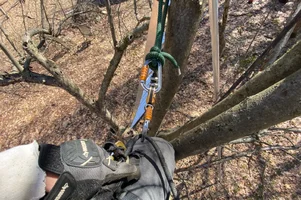
14ft orchard ladder got me only partially up there, then I climbed higher.
Last edited:
climbingmonkey24
Carpal tunnel level member
- Location
- United States
@southsoundtree What is that red trailer you’re towing (if that’s your truck)…regular one or a dump?
southsoundtree
Been here much more than a while
- Location
- Olympia, WA
Yes. I didn't climb that high. Very much a rushed, spur of the moment favor (dry, sunny, and short on time in the moment and dormant season).Both trees in the pic directly under After seem to have retained their "twig" density relatively top center, but I know a camera looking upwards can make a canopy edge appear to be vertical. I understand leaving it for a later pruning session.
Fruit tree prunes can have inordinate brush piles
Leaving more leaves for this round of pruning while getting rid of a bunch of weight.
Hopefully there will be more sprouts starting low to thin and train above deer height.
southsoundtree
Been here much more than a while
- Location
- Olympia, WA
"Both"...@southsoundtree What is that red trailer you’re towing (if that’s your truck)…regular one or a dump?
It's a 6-lug axle, flatbed trailer
It's a 5x8 trailer with a short tongue triangle. Fits tight driveways, movable by hand. Barely fits my mini or stumper. Hold 5 yards of chips or full of wood.
Sometimes I push my chipper into a tight space next to the tree, then push in the trailer. I can move the trailer onsite where I can tip it 45⁰ with the mini, requiring a little hand unloading sometimes. I've figured a way to go higher but it needs a little fabricating.
When your neighbor has a log loader, a lot of trailers are 'dump' trailers!
.
A phrase I got from a friend of mine, "grandpa ladder", lets you ascend into the branch structure of a smaller tree and then climb after that. My go to for canopy top verticals if they aren't out of control (too big) is to double lanyard (triangulate) in and then go to town with the Fiskars pruning stik with the cutting head angled over. The cut pieces come down like little javelins.

ATH
Been here much more than a while
- Location
- Findlay, Ohio
Visited this tree today...prop still holding well.For a light weight prop, I've drilled about 8-10" in and put a 3' piece of rebar into the end of the prop board, then the rest driven in the ground. Not saying that's always a good answer, but worked well when I used it. (As far as I know.... I'll revisit a tree we did last spring. Just had 50MPH winds and 70 MPH gusts last week. Haven't heard otherwise so I assume it's still up.
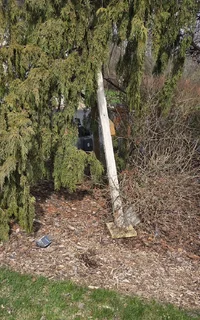
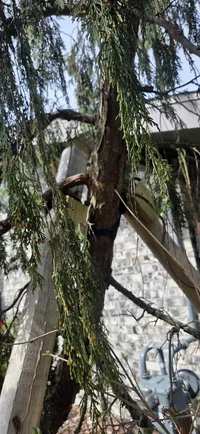
To hold the tree, I put a 2x4 solid brace between the 4x4 s and used dynamic cable at the top of the triangle to make a "sling" for the tree to sit in. I think it's preventing damage that would have happened if lumber were right against the tree. Not a great pic, but it's what in have (I think I posted pics when I installed this too...)
southsoundtree
Been here much more than a while
- Location
- Olympia, WA
You might give that termination a tightening, or it could be the pic.Just worked in some similar to those today. Maybe not as big of wood, but fairly tall for a typical orchard tree. Neglected, lots of deadwood, etc.
14ft orchard ladder got me only partially up there, then I climbed higher.
View attachment 101448
climbingmonkey24
Carpal tunnel level member
- Location
- United States
You might give that termination a tightening, or it could be the pic.
I see what you mean.
I didn’t think it was as loose as it might look in that pic. That’s something I try to be careful of.
southsoundtree
Been here much more than a while
- Location
- Olympia, WA
I'm a scaffold knot kinda guy. DrenaLine doesn't knot well. Too stiff, yet bouncy.
This is 2 years in a row of pruning, with a bit of training uprights into basically horizontal orientation.
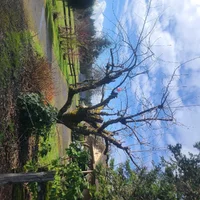
This is 2 years in a row of pruning, with a bit of training uprights into basically horizontal orientation.
southsoundtree
Been here much more than a while
- Location
- Olympia, WA
Just popping in on this thread with more after pictures about the resilience of fruit trees. And hollow trees in general.
This will sprout new branches closer to the ground, then I'll whittle the top down in a few years.
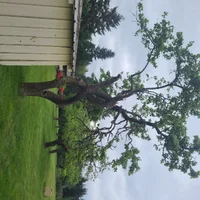
Ganoderma
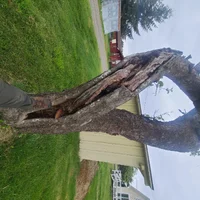
1--2" rind with cavities
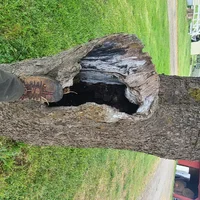
I could climb in from the far side of I chose to squeeze.
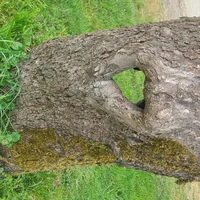
Cherry with P. Schweinitzii

This will sprout new branches closer to the ground, then I'll whittle the top down in a few years.
Ganoderma
1--2" rind with cavities
I could climb in from the far side of I chose to squeeze.
Cherry with P. Schweinitzii
southsoundtree
Been here much more than a while
- Location
- Olympia, WA
Fruit thinning time here.
southsoundtree
Been here much more than a while
- Location
- Olympia, WA
Just 1 random pre-training, 2 post-tiedown pics...1 of the 2 pears inside deer fencing.
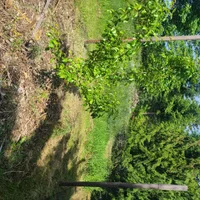
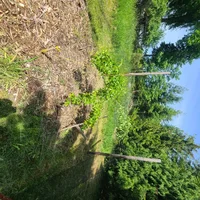
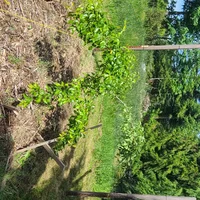
climbingmonkey24
Carpal tunnel level member
- Location
- United States
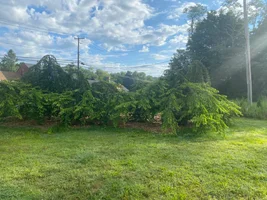
So here’s a situation I looked at today.
- Client wanted the trees to grow more upright, they had a slight crookedness to them, so they staked it about 2-3 years ago. Now the upper part is near horizontal. Gorilla tape was used around the bark, but I guess the non-adhesive part, and it sounds like it might’ve started melting or something and now it’s hard to get off. You can see one of the trees still has a stake somewhat connected to it with the tape.
- Around June of this year they aggressively pruned, and then it it exploded with new growth.
More or less the goal is to try and get it to grow more upright. My question is, does anyone have any experience rectifying a situation like this? Does the upper part need to be removed back to a healthy branch, or is it a lost cause at this point, etc.
Any advice or tips as to what we might be able to do to salvage these trees would be appreciated.
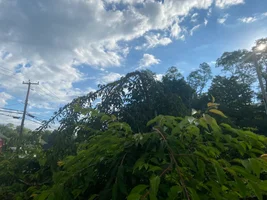
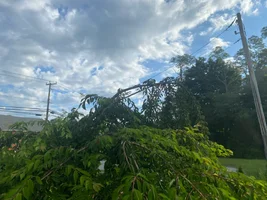
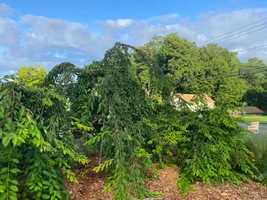
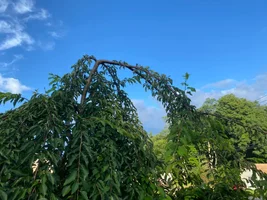
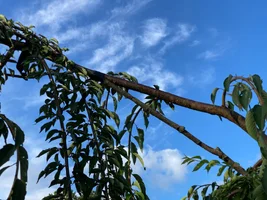
- Client wanted the trees to grow more upright, they had a slight crookedness to them, so they staked it about 2-3 years ago. Now the upper part is near horizontal. Gorilla tape was used around the bark, but I guess the non-adhesive part, and it sounds like it might’ve started melting or something and now it’s hard to get off. You can see one of the trees still has a stake somewhat connected to it with the tape.
- Around June of this year they aggressively pruned, and then it it exploded with new growth.
More or less the goal is to try and get it to grow more upright. My question is, does anyone have any experience rectifying a situation like this? Does the upper part need to be removed back to a healthy branch, or is it a lost cause at this point, etc.
Any advice or tips as to what we might be able to do to salvage these trees would be appreciated.
climbingmonkey24
Carpal tunnel level member
- Location
- United States
southsoundtree
Been here much more than a while
- Location
- Olympia, WA
I wonder if 'maintain' is more appropriate than 'salvage'? Fruit trees are resilient AF.
I am having a hard time seeing on my phone.
Can you describe your goal and what you see and think is the goal and the plan of action?
Fenced or not?
I am having a hard time seeing on my phone.
Can you describe your goal and what you see and think is the goal and the plan of action?
Fenced or not?

Analog
Participating member
- Location
- City of Trees
It looks like some sort of weeping cherry. If that's the case, upright probably aint happening

Reach
Been here much more than a while
- Location
- Atglen, PA
I was about to say that myself, those "manufactured" weeping cherry trees pretty much grow every direction except up.It looks like some sort of weeping cherry. If that's the case, upright probably aint happening
New threads New posts
-
test
-
 Alternatives to standard asphalt around roots
- Started by southsoundtree
- Replies: 1
-
-

-

-
 For Sale: 2018 Vermeer BC1000XL Chipper | 918 Run Hours | Deutz Diesel
- Started by Blue Ribbon Tree
- Replies: 2
-


