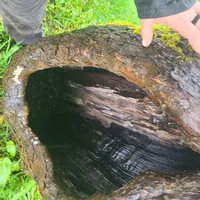
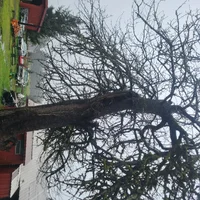
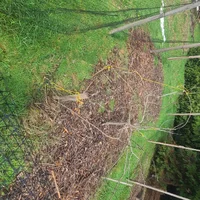
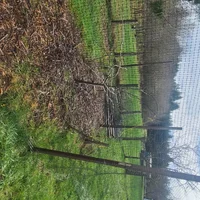
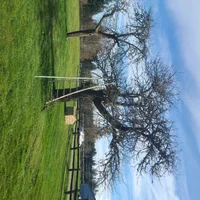
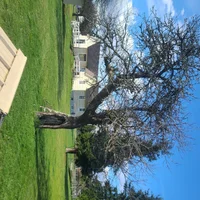
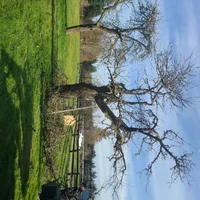
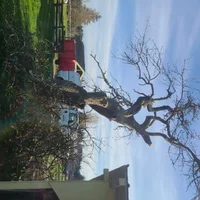
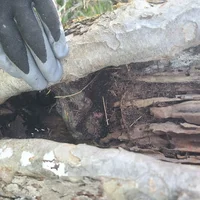
Fruit tree holding on by a thread, client wants to get another year out of it. Thoughts?

What is there to gain from thinning?
Keep all the fruit buds and prune to produce more.

...
When I said “thin” I meant pruning to support fruit production, not just haphazardly cutting random branches. Wrong word maybe

...Matias, are you referring to thinning to favor the "king" or terminal fruiting bud? ... ...
I am not talking about cutting stems at all, but rather waiting for the fruit to start swelling a bit after fruit set, and then removing the smaller fruit as well as any bug damaged fruit; literally thinning the fruit. ....
And this is why the term "thinning" was removed from the A300 pruning standard...
 
Fruit thinning is the actual and appropriate term for that particular process, and it has a fairly standardized and methodical approach, vs what used to be called thinning in general tree work.
Yeah...i was just laughing to myself a little at the different ways the term was being used - and even misunderstood in a few posts among professional arborists. Which is, I think, a good argument for not saying we are going to "thin" a tree via pruning ... because that term already has a meaning that doesn't involve pruning. But old habits die hard - I still use it in conversation, and try to correct myself if I catch it.
 
Last edited:
I am not talking about cutting stems at all, but rather waiting for the fruit to start swelling a bit after fruit set, and then removing the smaller fruit as well as any bug damaged fruit; literally thinning the fruit. If you have never seen it done, you will almost certainly be inclined to leave more on the tree than you should if you are chasing fruit quality. As far as the king bud goes, I don't remember that term, but I was simply taught to look first for the largest, and then for the best positioned of the fruits, imagining them swelling up to full size, and ensuring that they won't physically press on each other.

I seem to recall both stonefruit -peaches, plums, etc.- and pommes -apples and pears- making clusters of fruit that seem to emerge from virtually the exact same point, quite different from how drupes, and aggregate drupelets - grapes and berries- which clearly have a larger terminal fruit, and a linear-ish arrangement.

Ah okay, I see what you’re saying. Thanks for the clarification.
 
For a light weight prop, I've drilled about 8-10" in and put a 3' piece of rebar into the end of the prop board, then the rest driven in the ground. Not saying that's always a good answer, but worked well when I used it. (As far as I know.... I'll revisit a tree we did last spring. Just had 50MPH winds and 70 MPH gusts last week. Haven't heard otherwise so I assume it's still up.

I wonder if digging post style holes and burying the board or post (depending what is actually used) at least 12 inches may suffice? Could put some rock or small pieces of concrete paver slabs at the bottom of the hole and maybe even around the sides as an alternative to pouring concrete?

Or I could theoretically just pour if I really wanted to, but it would depend on if the client would want to do that.
 
  • Like
Reactions: ATH
Yeah...i was just laughing to myself a little at the different ways the term was being used - and even misunderstood in a few posts among professional arborists. Which is, I think, a good argument for not saying we are going to "thin" a tree via pruning ... because that term already has a meaning that doesn't involve pruning. But old habits die hard - I still use it in conversation, and try to correct myself if I catch it.
I donno, I do still think thinning has a place in our nameology ;)
How else would you describe ‘thinning’ secondary laterals in the outer 1/3 of large scaffolds to aid in air and light circulation?

I have seen some good descriptions of proper thinning work.

The most vague I’ve seen is ‘prune fruit tree’. That gets about 10,000 different pigheaded variations in practice.
I tend to think of it as they are literally domesticated species, as in the how a wolf is not a domestic dog. Yet cropping ears and tails are still a thing it seems to becoming less of a norm, like the dead spider prune
 
Last edited:
Couple thoughts. There is a chance that the tree was in a final year distress heavy overproduction of fruit cycle last year. I'm not a disease expert to offer any particular help in assessing whether that's your case. Trees with "cancer" often do this. Temper the cost of propping with this possible outcome.

I'd say that in a case of trunk cracking with lost trunk material the trunk is not just vulnerable to gravity/vertical load causing failure but is also vulnerable to torsional loading such as might occur on a windy day. Wind going in the direction branch to stem or stem to branch tend to lift or push down the branch vertically on the support while also trying to pull or push at the branch attachment point. There is a lower chance of this type of failure. However, wind hitting the branch from the side tries to torsion the failed stem crack wider open, with a good amount of leverage. To protect against this I suggest that the ground support end have a sideways-rigid attachment to the vertical post and a bit of a wide footprint. Think of it as tipping an A frame where if pushed hard enough one leg of the A frame will start to lift off the ground. Good news is that branch weight amplifies the effectiveness of the "A frame" at resisting side wind. Possible side effect - quantity of new reaction wood reduced if you reduce stress on it, but I wouldn't count on reaction wood as a big factor in this situation.

Written on one cup of coffee ;)
 
....
How else would you describe ‘thinning’ secondary laterals in the outer 1/3 of large scaffolds to aid in air and light circulation?

I have seen some good descriptions of proper thinning work.
....
"Prune at secondary laterals in the outer 1/3 of large scaffold branches with the goal of aiding air circulation and light penetration".

I think the point is anything that is an appropriate practice can be described without using the word "thinning" and "thinning" by itself can mean a LOT of different things, and not all are appropriate practices (lion tailing, for example is a "thinning"). Get rid of the word and make us be more descriptive/less vague.

Like you said "prune fruit trees" can mean a lot. When someone calls to ask if we prune fruit trees, my first question is "do you want productive fruit trees or a pretty yard tree... because those generally aren't the same pruning.
 
Couple thoughts. There is a chance that the tree was in a final year distress heavy overproduction of fruit cycle last year. I'm not a disease expert to offer any particular help in assessing whether that's your case. Trees with "cancer" often do this. Temper the cost of propping with this possible outcome.

I'd say that in a case of trunk cracking with lost trunk material the trunk is not just vulnerable to gravity/vertical load causing failure but is also vulnerable to torsional loading such as might occur on a windy day. Wind going in the direction branch to stem or stem to branch tend to lift or push down the branch vertically on the support while also trying to pull or push at the branch attachment point. There is a lower chance of this type of failure. However, wind hitting the branch from the side tries to torsion the failed stem crack wider open, with a good amount of leverage. To protect against this I suggest that the ground support end have a sideways-rigid attachment to the vertical post and a bit of a wide footprint. Think of it as tipping an A frame where if pushed hard enough one leg of the A frame will start to lift off the ground. Good news is that branch weight amplifies the effectiveness of the "A frame" at resisting side wind. Possible side effect - quantity of new reaction wood reduced if you reduce stress on it, but I wouldn't count on reaction wood as a big factor in this situation.

Written on one cup of coffee ;)
I did a fun experiment on an apple tree in the house we bought in 2019/2020. It was maintained very small and had a lot of large cankers.
I changed the management of it to summer pruning only, and a more generic ‘yard’ tree approach. This allowed for a much growth that I managed like restoration pruning coupled with true heading cuts less than 1/2” in diameter.

After a few years the tree managed to fully compartmentalize the target canker, appearing to start winning. The canker ceased advancement and the tree was able to start callusing the near 2/3 girdle from the canker.
Production was increased dramatically with the allowed growth too. So much so it uprooted (it was planted right between two of my drainfeild runs with circling roots. It was slated for removal anyways and we managed to air layer it!
 
I did a fun experiment on an apple tree in the house we bought in 2019/2020. It was maintained very small and had a lot of large cankers.
I changed the management of it to summer pruning only, and a more generic ‘yard’ tree approach. This allowed for a much growth that I managed like restoration pruning coupled with true heading cuts less than 1/2” in diameter.

After a few years the tree managed to fully compartmentalize the target canker, appearing to start winning. The canker ceased advancement and the tree was able to start callusing the near 2/3 girdle from the canker.
Production was increased dramatically with the allowed growth too. So much so it uprooted (it was planted right between two of my drainfeild runs with circling roots. It was slated for removal anyways and we managed to air layer it!
Fruit trees can be so tough! I would love to see any pics to enhance the story
 
I did a fun experiment on an apple tree in the house we bought in 2019/2020. It was maintained very small and had a lot of large cankers.
I changed the management of it to summer pruning only, and a more generic ‘yard’ tree approach. This allowed for a much growth that I managed like restoration pruning coupled with true heading cuts less than 1/2” in diameter.

After a few years the tree managed to fully compartmentalize the target canker, appearing to start winning. The canker ceased advancement and the tree was able to start callusing the near 2/3 girdle from the canker.
Production was increased dramatically with the allowed growth too. So much so it uprooted (it was planted right between two of my drainfeild runs with circling roots. It was slated for removal anyways and we managed to air layer it!
I think that summer pruning of fruit trees is highly overlooked.
 
Doesn’t pertain to this particular discussion but kind of related in regards to how resilient some trees can be.

Years back in my town there was a small-medium sized tree that uprooted. Well someone lifted it back into place and secured it so it would stay upright, and fast forward to now it appears the anchoring cable has since been removed and the tree appears to be doing well.

Pretty cool stuff.
 
Also slightly more off topic, I was wondering if anyone includes some sort of clause in their contract or estimate regarding not being able to guarantee long-term tree health after pruning or not being liable for tree issues, etc.?

To be more specific, I was thinking about situations where you prune a tree, and you know the way you pruned it is beneficial for the tree, but you also can’t guarantee nothing will happen to that tree down the road just from nature (insect, disease, etc). So it’s sort of like you’re protecting yourself from someone coming back and saying you damaged their tree or something.
 
Also slightly more off topic, I was wondering if anyone includes some sort of clause in their contract or estimate regarding not being able to guarantee long-term tree health after pruning or not being liable for tree issues, etc.?

To be more specific, I was thinking about situations where you prune a tree, and you know the way you pruned it is beneficial for the tree, but you also can’t guarantee nothing will happen to that tree down the road just from nature (insect, disease, etc). So it’s sort of like you’re protecting yourself from someone coming back and saying you damaged their tree or something.
I have some language in there that I wrote up from subbing to be the arborist on staff for a bigger infrastructure project in town.
Basically their language had it where I was liable for everything when onsite. Some pretty gross shit occurred so I spent 90% of my billable hours on an attorney to make sure I could get out clean.

Theoretically it involved a lot of root pruning and practices of trying to do the best for the trees while 30-40% of root systems were destroyed.

Long winded way of saying yes certainly write something up as these situations come up! First tree I cabled and did a crazy amount of preservation work uprooted about a year afterwards. Nothing I did other than cable a cracked stem, maybe that was enough to mess with its mass dampening but I doubt it.
 
  • Like
Reactions: ATH

New threads New posts

Back
Top Bottom