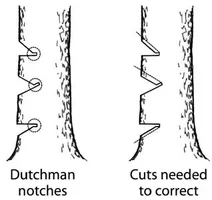
DON'T EVEN TRY IT!

"prior to the final back cutting step" This means the dutchmen is made in the notch cut not the back cut. If cutting material off the hinge during the backcut was part of the the dutchmen then what does PRIOR mean. Pat removed hinge material during his backcut.
Wrong just get your book out and read it buddy

Dent very clearly shows a number of different options for the swing Dutchman and refers to any cut that takes one side of the hinge off completely as a swing Dutchman leaving a lot of variations possible.

You can go by the definition of the osha website as per your diagram then we're just not talking about the same thing.

it's a matter of semantics .

I'm going with Dents definition.
 
Just look at his wording when he says the final back cut step which indicates there is an earlier back cut step that includes cutting off the side of the hinge per pats video
The operative word here is prior. Meaning before the backcut. Can you please address what he means by prior then.
 
Do you have a copy of Dents book? If you did you could just look at it and we wouldn't have to be jumping through these hoops over and over again.

It doesn't matter either way whether you take the end of the hinge off while cutting the face or during the back cut.

There are several different ways to tie a bowline it doesn't change the knot, and so it is with this cut.
 
I started another thread on the subject
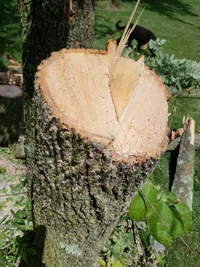
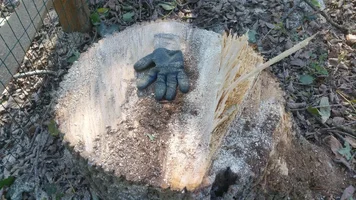
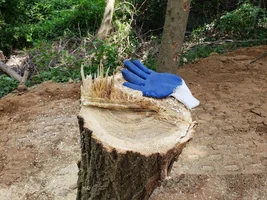
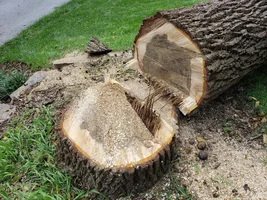
In your original posting of this photo you claim it is a swinging dutchman Daniel. Could you please explain what is going on with this stump, because I haven't got a clue what I am looking at. School us Master Splinter.....

swing dutch locust.webp
 
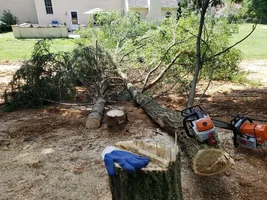
Figure what out? I've figured out that's a trashy face cut. Also, that salami cut isn't special. Don't tell me that cut is even remotely proper or that there's some bullshit book that shows that cut and its uses. Looks like my 7 year old got ahold of my 460 and went to town. Was that one of your practice cuts? Were you demonstrating how to fuck up? I haven't been on the buzz forever but I can say that every time I see you post something, it's some controversial bullshit where you are trying to argue that unsafe practices are somehow some kind of elite talent...Get off the gas pedal with the bullshit bro. Anybody with a bit of legit experience on this forum will call your bullshit man. Just because you've been doing this for X amount of years doesn't necessarily mean you've been doing it the right way. This trade is already dangerous enough to have dickheads like you spouting out nonsense to the less experienced and getting them seriously inured or killed. Now, don't come back on here trying to say I'm not skilled enough and blah blah blah... Sell your trash somewhere else sir. Nobody here seems to be interested in buying it.
Preach it bro!
 
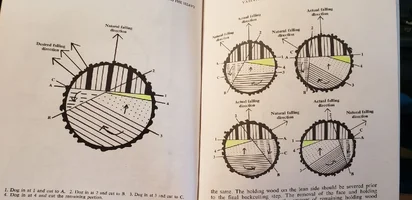
pg 110 "Swing Dutchman alters holding wood in a drastic manner. This technique can BEST be explained by the following example." Illustration 58

NOTE: in that example, he does take out the far side of the hinge after making the face and before starting the back cut, but that does not mean that is the only way to make the cut.

Dent continues on pg 111. "many variations occur in the amount of holding wood severed and the positioning of the bar. SOME of these variations are shown in Illustration 59. " Note the word "some" here indicates there are other methods for making the cut

pg 111. "Regardless of the amount of holding wood severed, the intention is the same. The holding wood on the lean side should be severed prior to the final backcutting step." Note he doesn't say prior to starting the backcut.

pg 111 "As the final backcut proceeds, the tree will naturally move in the direction of the side lean force" Note: the mention of a final backcut indicates that an initial backcut may have been used

pg 113 "The secret of the swing dutchman is not in the technique involved, but in determining when and how much of the remaining holding wood should be cut" Note: IMO when he says "the technique involved" he means how the cut is made, or the order of the cuts.

He is clearly saying here that what matters is how much of the side of the hinge is taken out and not how it is taken out. I've used the cut a lot (as Rico will show you) both on the ground and at height and would agree with Dent. It's not how the cut was made that counts, but how the final hinge is configured.
 
Do you have a copy of Dents book? If you did you could just look at it and we wouldn't have to be jumping through these hoops over and over again.

It doesn't matter either way whether you take the end of the hinge off while cutting the face or during the back cut.

There are several different ways to tie a bowline it doesn't change the knot, and so it is with this cut.
A whole lot of of destroyed hinge on your part Daniel, yet nary a word about a swinging dutchman... What changed in the last 2 yrs Daniel? Now a taper hinge is suddenly a swinging dutchman?
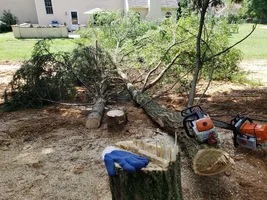
tapered hinge ash.webptapered hinge fat ash.webptapered hinge small locst.webptapered hinge walnut.webp


Intentionally leaving bypass on the downhill side of your undercut mechanically functions in a completely different manner than simply clearing your downhill side hinge while making your backcut. 2 very different matters buddy...
 
He doesn't have a clue what he's looking at... If anyone else does, let's hear it...
Already covered that one buddy.. Your lovely plate cut, all because you lack the basic skills needed to make a clean undercut with an undersized saw... Why not go learn how to do it right like the rest of us.......
 
Last edited:
Rico the holding wood in those photos looks exactly like the holding wood from Dent's diagrams on pg 110 and 111. I highlighted the final hinge wood in yellow to make Dent's image clear.

according to Dent (your hero): "The secret of the swing dutchman is not in the technique involved, but in determining when and how much of the remaining holding wood should be cut".

I posted those pics because they were all perfect falls, and especially the last one, which as you can see landed perfectly in the open yard after having a huge side lean into a neighboring silver maple. That I expected to lose that one and have it hang up, as we were only pulling with a throwline (no ropes on the stump grinding truck that day)

do you see all the shadow in the foreground... there was a line of trees along the berm.20200217_115941.jpg
 
Last edited:
Rico the holding wood in those photos looks exactly like the holding wood from Dent's diagrams on pg 110 and 111

according to Dent (your hero): "The secret of the swing dutchman is not in the technique involved, but in determining when and how much of the remaining holding wood should be cut".

I posted those pics because they were all perfect falls, and especially the last one, which as you can see landed perfectly in the open yard after having a huge side lean into a neighboring silver maple. That I expected to lose that one and have it hang up, as we were only pulling with a throwline (no ropes on the stump grinding truck that day)

do you see all the shadow in the foreground... there was a line of trees along the berm.
Yet you described every one of them as a tapered hinge and not a swinging dutchman. What has changed because according to your latest story they would all be considered swinging dutchmans.....

And what is that little part in Dougs diagrams colored in yellow?

Again I need to understand this mess and the logic behind the cut....Please explain...
 
Last edited:
Doug Dent's book on Timber falling defines a swing dutchman as a number of variations that remove one side of the hinge.

pg 110 " many variations occur in the amount of holding wood severed and the position of the bar. Some variations are shown in Illustration 59.... The holding wood on the lean side should be severed prior to the final back cutting step."

According to Dent any cut where the far side of the hinge is removed is a swing dutchman. How much of the hinge and on what angle the back cut is made may vary significantly.
Looks like he uses the word prior here
 
The hinges obviously taper. However, as a matter of semantics, each of the above is better-called swing Dutchman, per Dent's diagrams and description. The last time we went through this, I was showing examples of cuts I used to control for heavy side lean. It wasn't until you started calling them blasphemous names that I picked up Dent's book and saw that Dent had called them swing Dutchman and described their forms and usage, just as I had found when experimenting in non-critical situations. The shape of those hinges come right out of Dent's book.

I'll take Dent's advice as confirmation of the cuts' value, and ignore your criticisms.
 
So were 3 pages in and Daniel finally uses the phrase "slice cut".. Amazing.....


Can anyone please explain to me why we are taking falling/cutting lessons from a man who makes cuts like these, then has the nerve to question the skills and abilities of others? Fucking please....

View attachment 65438View attachment 65439View attachment 65440View attachment 65441View attachment 65442
Nice play on using the play structure for a little cushion Daniel.
That is some really horrible cutting with very dull saws.
 
The hinges obviously taper. However, as a matter of semantics, each of the above is better-called swing Dutchman, per Dent's diagrams and description. The last time we went through this, I was showing examples of cuts I used to control for heavy side lean. It wasn't until you started calling them blasphemous names that I picked up Dent's book and saw that Dent had called them swing Dutchman and described their forms and usage, just as I had found when experimenting in non-critical situations. The shape of those hinges come right out of Dent's book.

I'll take Dent's advice as confirmation of the cuts' value, and ignore your criticisms.
So what you telling us is your making a swinging dutchman without the dutchman part(bypass)? OK Daniel....


Unknown.png
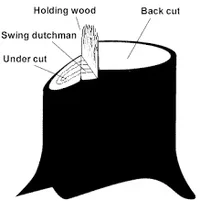
Swing Dutchman

The Swing Dutchman is a felling method used to pull a tree against its lean so it will fall in a more desirable direction. As shown in the above figure, it is similar to the Dutchman in that the two front cuts do not meet exactly. It is made by leaving a section of the undercut on one corner of the face. The portion left consists of a singlesaw kerf in one side of the face, with the face completely removed on the opposite side of the face cut. A single saw kerf must never extend completely across the stump (which would result in a full Dutchman).

Although it is common practice in certain areas of the country, the Swing Dutchman may cause the same hazardous results as the Dutchman cut; i.e., excessive stress on the hinge causing excessive fiber pull, splitting of the butt, or barber chairing and uncontrolled fall. It is therefore not a recommended practice.

Swing Dutchman


image022.jpg
 

New threads New posts

Kask Stihl NORTHEASTERN Arborists Wesspur TreeStuff.com Teufelberger Westminster X-Rigging Teufelberger
Back
Top Bottom