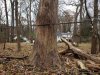
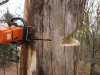
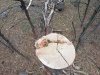
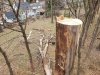
Can we talk about this face cut?

Are you saying that the notch itself is going to function improperly, or merely criticizing the size of the sawdust and the smoothness of the surfaces.

And do you really think that face is going to cause the tree to go to the right?
Because if you do, then that's the point of this thread.
I see what you are saying. Actually the hinge on the right having not defined apex acted like a dutchmen making the tree swing to the left. The tree being dead didnt really swing far enough and broke too soon. Looking at the direction of the gun and where the tree was on the ground indeed it did go left. Why not just gun more to the left and not rely on unpredictable dead hinge wood?
 
Was the tree dragged either direction by the branches contacting the other trees on the way by? Looks like a big branch hanging left.

Was it cut with a shorter bar, finishing the back cut, hence the lump of hinge to the left? Probably not a finesse back cut circumstance with the crappy tree. Does that make sense? When you get near tripping you probably want to lessen the up close and personal.

I can't reach a conclusive rationale, but I'm also not familiar with tulip trees. Healthy fiber vs dead either.
 
Last edited:
i agree with Rico the wood chip on the stump is the result of a dull/incorectly sharpened chain. Looking at the pic of the saw in the tree it looks like it started with a boring/plunge cut in behind the hinge and the drawing the saw around the back of the tree. The pic of the stump looks to show the guide bar was approx two thirds of the tree width. As the saw came round the bacl the nose wheel has niked the back of the hinge on the right. As the saw aproached the far side the tree fell prematurly leaving large chunk of hinge wood. Its dificult when you cant see the balance in the tree abouve the cut. Overall I think it demonstrates a lack of awerness re location of bar and chain within the cut.
 
i agree with Rico the wood chip on the stump is the result of a dull/incorectly sharpened chain. Looking at the pic of the saw in the tree it looks like it started with a boring/plunge cut in behind the hinge and the drawing the saw around the back of the tree. The pic of the stump looks to show the guide bar was approx two thirds of the tree width. As the saw came round the bacl the nose wheel has niked the back of the hinge on the right. As the saw aproached the far side the tree fell prematurly leaving large chunk of hinge wood. Its dificult when you cant see the balance in the tree abouve the cut. Overall I think it demonstrates a lack of awerness re location of bar and chain within the cut.

Bad planning. If short bar you first cut back cut on the danger/lean side, then do another back cut from the safe side - preferably just below the first back cut so don’t get saw caught in felled top going over.

Only time I need to use a saw with a bigger bar is when steering a top left right as it is going over or being pulled over which doesn’t happen often.

I do 24” diameter trees with a 12” 201 somewhat regularly... no hassle except for needing positioning again to cut the opposite side.
 
Bad planning. If short bar you first cut back cut on the danger/lean side, then do another back cut from the safe side - preferably just below the first back cut so don’t get saw caught in felled top going over.

Only time I need to use a saw with a bigger bar is when steering a top left right as it is going over or being pulled over which doesn’t happen often.

I do 24” diameter trees with a 12” 201 somewhat regularly... no hassle except for needing positioning again to cut the opposite side.
A 12" 201? I bet it has no problem being buried. That's what I run on the 2511.
 
It’s actually a gutless pig but all I have until I rebuild my 200’s. Not too bad if chain really sharp but try keeping it sharp on thick barked trees with dust in the bark :(
Our newest one is pretty gutless, but the 201 prior to the stupid computerized crap was wonderful. A minor muffler mod and re-tune and it would run with any 200.
I should shorten the bar on the echo. I hear they're sweet with about an 8 on them.
 
Our newest one is pretty gutless, but the 201 prior to the stupid computerized crap was wonderful. A minor muffler mod and re-tune and it would run with any 200.
I should shorten the bar on the echo. I hear they're sweet with about an 8 on them.

The only drama seen with pre computer 201 is the rear top handle attachment - breaks if the saw is dropped and lands on its head (which it never should be dropped)... but the 201 I am using is the 201TC (torqueless cr@p)...
 
Yes, that is exactly what is going on. there is a gap on one side and no gap on the other.
I find it strange that after a year or 2 of discussing this gawd awful cut and the ensuing gawd awful result (smashed swing-set) you now decide to proclaim that there was some master plan to your hackery. The problem is that your undercut undercut in the photo would have one intention, while your back-cut in the photo would have a directly opposing intent... In other words you are once again full of Caca Daniel...

The pictorial below tells the story.. A large bomb zone.. Your were extremely lazy and refused to do this job in a proper fashion. You made a gawd awful cut with a dull saw. You smashed a structure.. There is simply no amount of backpedaling that will change this reality Daniel...I myself am shocked that you would repost these picture and make a feeble, senseless attempt at trying to explain this hackery as some sort of master class in cutting....

tulip snag nasty close.jpgtulip snag back cut start.jpg20181124_143518.jpg20181124_143313.jpg
 
We have "talked about this face cut" Daniel. You just dont like the answers and opinions you are getting...If you have a counter narrative which makes a shred of sense please share it with us buddy........
 
Come on Daniel... Tell us what your thought process/game plan behind that undercut and backcut was?
 
Bad planning. If short bar you first cut back cut on the danger/lean side, then do another back cut from the safe side - preferably just below the first back cut so don’t get saw caught in felled top going over.

Only time I need to use a saw with a bigger bar is when steering a top left right as it is going over or being pulled over which doesn’t happen often.

I do 24” diameter trees with a 12” 201 somewhat regularly... no hassle except for needing positioning again to cut the opposite side.
I agree re cut the danger side first. Personaly I would leave the bar in the tree and bring it round without removing it for a second back cut.
 
@Daniel Was this your cut, or someone else's ?

Yours truly Greg.

Here's the set up: the tree had front lean. There was a zero liability agreement, due to how dead the tree was, and that the electric company's contractor Asplundh refuse to cut the tree, and that I was saving them a couple of thousand dollars over the next lowest bid.

The new homeowners were an older couple with no kids and were going to have the swingset removed. The only stipulation on the contract was that if I took the maple out, I would remove it, which I did not want to do as it was a long way to the driveway.

As you can see, the lowest limb on the maple got damaged, so the top was just barely able to clear the maple. I thought the top would have the distance to clear the swingset before the limb on the right hit, so I was slightly disappointed that the swingset got hit, but was much happier that the maple did not.

After that.. it's all right there in front of you.
 
Last edited:
Back
Top Bottom