Ash riddle

No, these probably came from the one or two varieties planted all across the Midwest after the elm collapse. My guess is they may be genetic identicals. Just like the honey locust. I'm not sure the story. The companies I worked for operated under the pretext. 100% mortality either treat it or cut it down. Municipalities cut them down as procedure. Some of the richer communities treated. Detroit didn't do anything.

I remember cutting live ash trees down thinking they were not quite dead. I am sure that customer could well have appreciated it for another ten twelve years at least.

Still a horrible tragedy. I keep looking for a monster ash survivor and I have not.

Interesting post. Do you think leaving a possibly infected tree might help the disease spread further? What happens to the wood from the diseased ash takedowns? I would think the powers that be would like to see all of that wood incinerated as quickly as possible.

I know some places have laws against transporting wood more than 50 miles unless it has been kiln dried, if I'm not mistaken.

Thanks for your posts on this subject, Kevin; it is all very interesting and scary stuff.

Tim
 

Took this on a bike ride this morning with my daughter. One of the few places for hundreds of miles where you can still find ash lined streets lol. You may say they don't look too good but they are competing quite well with lindens, silver maples and other beat up neglected street trees. Definitly not 100% mortality. Alive is Alive.
Sweet bike!
 
It's not a disease, it's a predator. Moving wood does and has spread the bug around the world and across the country. There are thousands of living ash trees across the city. On any given ash lined street of 30 to 50 year old ash trees. Prob ably planted in the 60s 70s and 80s. I would say the complete mortality is 25% another 25% are zombies with just a few green suckers, another 25% are more alive than dead, and 25% are fine.

Forest ashes seem to be in my ramblings seem to be tall and skinny and striving for light and in competition with other trees, they die quickly. The old growth ashes on belle isle seem to have all died. The big monster ashes semester to have all died completely.
 
No way these were treated.

I don't know how you could know that. There is a program around here where Ash have been and are still being treated by the Company that produces Safari called the Valent Program. In a small town next to ours there are streets that have perfect (green) Ash as a result of this. They pay nothing. It only lasts so long.

I will have to back track and check but I was in constant email contact with the head of the EAB research program, Dan Herms, who I remember saying it was 100% kill up there of non treated ash. In my town being on the local Urban Forestry Board for the 5 years beginning infestation and I actually found the first infested tree...I know no ash are thriving like that one on your bike ride and none will continue to survive with out treatment.

To compare EAB (infestation) with DED (infection) is a silly comparison. No Ash in the USA has the defense (an odor in the phloem) to repel the borer having evolved with them like where the ash borer came from.
 
No, these probably came from the one or two varieties planted all across the Midwest after the elm collapse. My guess is they may be genetic identicals. Just like the honey locust.
Genetic identicals of what.?....


I remember cutting live ash trees down thinking they were not quite dead. I am sure that customer could well have appreciated it for another ten twelve years at least..

I am sure that is total bs.
 
It's not a disease, it's a predator. Moving wood does and has spread the bug around the world and across the country. There are thousands of living ash trees across the city. On any given ash lined street of 30 to 50 year old ash trees. Prob ably planted in the 60s 70s and 80s. I would say the complete mortality is 25% another 25% are zombies with just a few green suckers, another 25% are more alive than dead, and 25% are fine.

Forest ashes seem to be in my ramblings seem to be tall and skinny and striving for light and in competition with other trees, they die quickly. The old growth ashes on belle isle seem to have all died. The big monster ashes semester to have all died completely.


Let me get this straight...You are saying that 25% of all ash in Detroit that had absolutely no treatment are doing just fine? I gotta send this quote to Dan Herms. He will get a good laugh out of this.
 
Come see for yourself. Maybe fine is not the best word. They were impacted clearly. But 12-13 years after the arrival, they are still here doing their job.

Who is dan herms?
 
Last edited:
So these trees were not treated, I know that because many of them are on vacant lots or abandoned houses. The block on my bike ride has just two occupied houses on it with residents that would not be spending money on imidacloprid when they have leaky roofs and broken windows.

The city has one forester for a city that covers more area than new york, boston, and Philly combined. The average income of residents is barely poverty level. Ash Trees that died in 2003 are still standing. When they fall it takes days sometimes weeks to pick them up.

If some one was spending money treating these trees out of the goodness of their hearts they are both weird and crazy. This is not an isolated block. It is every block in the city th at is planted with ash trees.

I do not know what the genetics of these trees is. I just presume they were purchased at similar times from probably th e same place, like most mass plantings.
 
I was surprised by how many viable ash trees I saw out there last month. Don't get me wrong, I saw an awful lot of scary looking ones too. But there were decent ash trees. And looking at the timeline, it would be hard to believe there were any treated trees in the bunch. Unless there is some vigilante Johnny imidacloprid driving around treating trees and squishing little green bugs
 
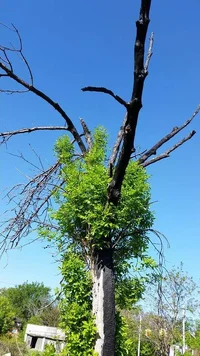
I think it's detroit. This street ash has been burned and beaten, the bugs have attacked it and it's still not dead.
 

Attachments

  • FB_IMG_1437924012783.webp
    FB_IMG_1437924012783.webp
    133.5 KB · Views: 29
It's not a disease, it's a predator. Moving wood does and has spread the bug around the world and across the country. There are thousands of living ash trees across the city. On any given ash lined street of 30 to 50 year old ash trees. Prob ably planted in the 60s 70s and 80s. I would say the complete mortality is 25% another 25% are zombies with just a few green suckers, another 25% are more alive than dead, and 25% are fine.

Forest ashes seem to be in my ramblings seem to be tall and skinny and striving for light and in competition with other trees, they die quickly. The old growth ashes on belle isle seem to have all died. The big monster ashes semester to have all died completely.

Thanks for the clarification about the fact that EAB is a predator and not a disease. I have not read up on it enough to know how EAB kills trees, or I have and just forgot.

Tim
 
Yeah the lead researcher across the country is bs and MR. TREEBING is the go to guy now for research data on his bicycle lol.

Okay suit yourself. I am not sugar coating the ash borer heartbreak. I just have been here since the first ash borer came and am waiting for the 100% mortality that researchers have been talking about since the begining. It has not happened here yet. I cut down hundreds of ash trees through it all. I remember working in clouds of ash borers. I see the signs. I have been looking at these trees for 12 plus years waiting for them to die. And to be truthfully they are looking better and better every year since the main event. Maybe as they get healthier the bugs will be back in greater numbers and wipe them out the second go round. Who knows. All I know is I can ID an ash tree and if you drive through detroit you will see a lot of them. The burnt out tree I posted.., the fire occurred in 2012. The bugs came in 2003 or 4. It's 2015 now. It takes a lot to kill that little bad ash mofo.
 

New threads New posts

Kask Stihl NORTHEASTERN Arborists Wesspur TreeStuff.com Teufelberger Westminster X-Rigging Teufelberger
Back
Top Bottom