
Working on SRT system

Tom Dunlap

Here from the beginning
Administrator
For the past three weeks I've spent most of my time in the tree working off my SRT access line. I'm beginning to think that my trad system might soon become eight-track. There are a couple of small limitations that are awkward to work around but I'm comfortable with the work around.

Sometimes I use my usual ascent system which is a 1:1 system. Rocker at the waist, Microcender with short lanyard for the upper, footlock, Pantin or Liu Easy Bar for lower. Then, when I get to the top of my climb, I lanyard in and change over to using the Gri Gri. I'm going to buy an I'd which is a much better tool for this application.

The other ascent system is a variation on a "Geriatirc Assist" as Robert Phillips calls em :) The RADS system is what I use Rope Ascending and Descending System. I can't put my finger on the link to an illustration right now. Either Google or check back later, I'll get the link.

With the RADS I put the GG on my floating d. Then I put a Shunt on the rope with a screw link and a small pulley. The rope that exits the GG loops up through the pulley. You can either pull yourself with the rope, footlock or use ascenders. As you move up you push the Shunt as you go. I can get two footlocks before I push up the Shunt. Then, when I get to the top of the climb I'll take off the Shunt. Most of the time anyway.

Here is the limitation. If I need to go back up, I can't footlock the tail because the GG locks off. I have to use the Shunt setup to get back up. I've been working out the work around. If I know that I'm going to yo yo climb, I make sure that I have plenty of rope below me. Then I leave the GG on the rope, work down the tree, then yard myself back up, using the Shunt as the redirect, up top.

Since the rope doesn't up and down, I find that I'm doing a lot less rope management. If I'm going to drop down one side of a limb but know that I'm coming back up to work down the other side, I just pull enough of a candy cane to get me out and back. This is a place that I'm paying attention. I might be missing something.

Redirects are the same as with doubled rope/trad climbing. I can use natural or retrievable too. I'm going to make up a couple of short redi/false crotches to carry along.

Does anyone else work off of SRT?

At lunch I was speculating that it would be an interesing experiment to teach a brand new climber with this system and then, later, show them a trad system. I wonder which would be easier. I'm thinking that SRT would be easier.

Another real plus of this system is that the climber is always working in a system that can be converted into a rescue lower. For an explanation of my SRT acess system, go to the TCIA page, http://www.natlarb.com/
go into Publications and then look in the 9/02 issue.

Give me some feedback on this system. I know that I have my blinders on since I'm such a fan of SRT. I really want to know if I'm missing anything.

I do realize that I double the load on the TIP. That is always considered when I set the line.
 
</font><blockquote><font class="small">In reply to:</font><hr />
I do realize that I double the load on the TIP. That is always considered when I set the line.
[/ QUOTE ]

But do you really?
Doesn't it depend on the angle of the rope and how many other branches the rope goes over?
I use SRT when the limbs are tight, it all depends on the circumstance.
 
I'm not yet ready to start experimenting with expensive rope tools in order to make SRT feasable for working an entire tree.

I do access many trees with SRT and am quite comfortable doing some work on my way up to tie in. I use a Petzl handled ascender on a webbing sling (much easier to pull yourself up with the handle) and my VT friction hitch tied in as my backup. The benefits are that I do not have to spend as much time swapping over to DdRT once at the top since my friction hitch is already tied, and if I use something else than it's something else to carry up with me. I do not footlock so my Pantin is always on my ankle to enable me to step up the rope.

If I could find one tool to use as my ascender/ descender that is as reliable as my friction hitch, then I could see going SRT. Until that tool is made then I will probably stick with current technology. It would have to be one slick tool, since I'm fairly quick using my current methods (for an old fart).
 
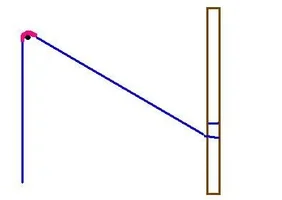
One place that SRT is handy for me is for increasing the bending ratio on the rope when placing a climbing rope over the strand as illustrated in the attachment.
 

Attachments

  • 6519-srt.webp
    6519-srt.webp
    3.5 KB · Views: 290
Mechanically, you are right, there would only be 2x possible with return line (control leg on load) to ground is parallel with the load line, and no overhead friction.

Whereby, a running bowline that choked around the overhead support (and was pulled down to your arrival point in tree by rigging line clipped into eye of bowline) would only have 1x, for no return leg to ground with tension of that leg pulling on support along with load leg.

Any friction on support (drawing down at a slant across top of support, wrapping under, around 2" branch on top a few degrees etc.) reduces the pull on the control or to ground leg of system, thereby less pull on support.

For the maximum 2/1 effect on the support, besides no friction, both lines need to pull pairallel to each other, for a more open angle of pull on support, is less focused, relieving some of the pull on the support from the control or to ground leg's pull on support.

If you are pretightening/ pulling over with a 3/1, 4/1, 5/1 etc. you want these properties of low/no friction at all bends in line(pulleys), and all lines pairallel; or not all of potential power is realized.

Orrrrr something like that!
 
Re: SRT system married to a DbRT

I use an easy system that blends both SRT and DbRT. With a rope sleeve protecting the bark at the TIP I use acsenders to advance.

The blend is that I have the SRT anchor point back at the top of the top ascender so it self-advances. I am sure to rig it with webbing so the force on the top ascender is not doubled and I use an USHBA Basic that has the design of being able to descend by rotating the whole thing just like a LockJack.

By having both feet in stirups on the lower ascender and both hands on the lower ascender (CMI) handle I can ascend using the strenght of both hands and both feet. With this 2:1 MA you can most of the time just use both hands as the top ascender self-advances.

With a split-tail tied to a Blakes on the other end of the rope I get basicly a 200 foot long lanyard.

See you at the top of the giant tulipifera's in North Georgia on Sept. 26th,
Dan House
 
Kevin,

But do you really?

2:1 is the theoretical worst case multiplier unless I bounce. When I choose a TIP I always make it large. When possible, I have the line go through several limbs.
 
That wasn't meant to read "do you really realize".
It was meant to read, "do you really double the load at the tip", meaning there are variables which I know most climbers are aware of.
 
Tom, whenever you feel ready to completely abandon the
traditional system, feel free to send me all your
1st, 2nd and 3rd generation Lock Jacks and Rope Guides :)
 
I have been climbing SRT for 8 years now with zero problems .Very rare for me to even tie in the conventional way.You have lots of catching up to do . Tom and I discussed it a few years ago at the Wi. Arborist comp. in Madison .
 
I use srt for entry in certain situations. As for working on it exclusively you must be doing some pretty specific work unlike the most of us. I'd like to see a working climb competition between fellows experienced in SRT, working SRT, and trad fellows working trad style. I have a feeling I know who would win ;)
 
In cases where another strong support (or path to) is unavailable/ruled out/needs assistance; the other ways to reduce 2xLoading would be a single line hanging totally on support like running bowline etc. with a line to pull ring open for removal of system (only induce 1x climber load/impact on support) or with friction and/or wide angle of lines.

Any friction will reduce the secondary load on the support (in addition to climber load/impact)that makes the system a 2:1 rather than a 1:1; this could be choosing a limb that is broader across the contact area of the line, tracing the line down the limbs length (also acting as secondary support at fair angle/ less leveraged somewhat?), wrapping the line around the other side of the limb and back etc. Anything that increases the friction, decreases the pull on the support limb from the line that goes (redirects climber pull)from support to the ground; that makes up the rest of the sum of the pulls onb the support in excess of the climber's load/impact.

Spreading the angle between the support leg to the climber and the control leg to the ground, reduces the 2/1 pull effect too.

For if you wanted to pull the limb down, you'd install a line to pull more than once, with as little friction as possible and the angle between the lines tight for maximum 2/1 pull with body weight/impact as power input. So, going contrary to all those sciences to maximize those effects turns those lessons backwards on themselves, to give safer loading on a LifeLine in SRT IMLHO.
 
Tom ,

I've tried using srt system for working. It's kind of neat , but one thing I have noticed , is your ability to let the line run when possibly swinging , jumping from limb to limb,and fairleading back in quickly. those were the only pitfalls that I had a problem with .

Now I didnt really experiment a lot with this , so maybe you have this problem solved . I only use srt for entry when needed and exiting. Is there something I'm missing ? I wouldnt mind trying srt more for work climbs to increase my knowlege on it .

Thanks
Greg
 
Have you ever been to a jamboree? They're not what I would call tensely competitive. They're excellent ways to learn new things.

I didn't say "I would smoke your sorry srt-climbing ass with my mad trad skillz."

I brought up the point of a competition because it's easy to see the advantages/disadvantages of different techniques when they're used by similarily experienced people in the same tree doing the same things.

I think that srt falls short in too many ways for me to consider using it more than I do.

The most salient disadvantage of working with srt is the unavailablity of a system that efficiently allows you to move up and down the rope w/o futzing with a bunch of pulleys and secondary devices. Likely someone will come up with a better system/device at some point but you'll still be left with the fact that if you tie your rope off to the base of the tree you must have a stronger TIP than a trad system, meaning the trad climber can tie in higher, a great advantage IMO. Of course you can tie your rope off at your TIP but then retrieval at very least requires another rope. Both techniques also make it difficult for the climber to easily move his TIP while in the tree, something that I often find necessary.

A trad system is superbly versatile, SRT is not.

I'm not trying to put down anyone's style here, nor do I think that there is no place for ever working with SRT. Certain situations even necessitate it, but for most of my climbing I'll stick with the traditional style.
 
I asked to show my technique at the Wi jamboree and was told NO because no1 else climbs a working climb SRT and that it was NOT a recognized method of working climb .Pretty much the samething anyone is told when they have a new way of doing things ..... so..I gave up even trying to get anyone to look . Tom did show intrest that day but it was shortlived to my disappointment
PS sorry if I mistook your comments
 
Sorry to hear that, I don't see any reason why you shouldn't have been allowed...fellows pull out all sorts of unseen techniques for aerial rescues and the master's challenge. Too bad they wouldn't at least let you demo it.
 
Yes I know ......... I would still be happy to demo it anytime but it seems that as always their is a fear of the unknown .If anyone would like to see it they would have to come to a job site LOL. Pretty sad that so many of the powers that be have their haed in the sand.
 

New threads New posts

Back
Top Bottom