Unicender

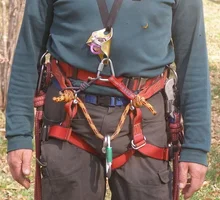
The Screamer is in the system for my peace of mind. Since I'm climbing on static line, KMIII, if I ever fell there is a good chance that I could generate a high load on the anchor point and my body.

Take a look at the Screamer spec sheet:

http://www.yatesgear.com/climbing/screamer/index.htm#5

Screamers are designed to be a controlled shock absorber. Besides climbing applications Yates is working on a system for race car driver's helmet support. In case of a crash the driver's head doesn't throw forward with so much force. They also have made them for NASA to use in motor mounts for testing rocket engines. Pretty amazing engineering.

The bridge is adjustable for ease of use. When I ascend I push it out. This allows me to get a long step every time. When I'm working I like it close so that I don't have to reach for the Uni.

As I'm climbing I try to keep as much hardware above or below my face as possible. If I ever slipped or fell I really don't want to get slapped in the face by a gob of aluminum and stainless steel.
 
Thanks for clarification on your setup, Tom.

I have never climbed SRT so I don't have any knots in mind that would apply. In my DbRT I don't use any mechanical devices, so I'm just not well versed in their applications. I'm not shunning these tools, since I know (from testimony of others) that they function smoother than most friction hitches, I was just looking for a better understanding of your technique.
 
[ QUOTE ]
Are they reusable, or is it a one time deal?

[/ QUOTE ]

One time use, it's basically a folded sling stitched together that rips apart under the specified load rating, absorbs shock and keeps you tied in to the rope.
-moss
 
OTG,

Today I tried using the chest ascender in the offset version. It was a bit too tight with the red runner on the left side. I might make up a longer runner using Tech Cord so that the delta link goes to the red loop on the harness.

Here's the 'centered' version of the chest ascender attachment.
 

Attachments

  • 78308-Chestascendercenteredcs.webp
    78308-Chestascendercenteredcs.webp
    61 KB · Views: 386
Very interesting looking device!

Am I right in thinking that the only way that you can ascend easily using the unicender is by incorporating the pantin and microcender or similar?

Say you branch walk out then down through a fork(natural redirect) to prune a branch below, how do you get back up easily through the fork when your legs are tied up with the unicender?
 
Grover,

The Uni takes the place of a friction hitch on,in my setup, a single rope. If you go to the Uni homepage you can see how it is setup for a DdRT.

If I have short ascents to make, like in your example, I footlock the tail and slide the Uni up in the same way that someone who is climbing on a traditional DdRT system. Actually, the Pantin stays on my foot all day, sometimes at lunch too. That way I can just slip in and slither up the rope.

When I'm working I keep the Uni close, when I ascend I slack out the bridge to get a full length move with my legs.

If I'm going to pass a limb or move back through a natural redi where the rope is touching the tree make very sure that the ascender isn't rubbing on the wood. Before I get to the rope rubbing place I put the chest ascender back on. Then I move the Uni in to the compress the bridge/lanyard. Just as I move up I make sure that the Uni is below the wood then sit back onto the chest ascender. Next, I'll slide the bridge out to it's longest extension. Then I pull the climbing line back a little and slip the Uni above the branch into clear air. All the while I'm still being supported by the chest ascender in case something happens to the Uni during the limb pass.

Having a backup attachment right at hand gives me a lot of peace of mind.
 
[ QUOTE ]
I've spent many hours trying to find a friction hitch that works for ascending and descending on SRT. So far...nothing.

[/ QUOTE ]
Tom,

I think I've mentioned this before, but have you ever tried a dog-n-tails (basically an elongated VT) for both ascent and descent? The length might be problematic in some applications. See attachment.
 

Attachments

  • 78747-dogntails.gif
    78747-dogntails.gif
    4.2 KB · Views: 284
Robert,

I've never used a DnT configuration.

You're right, the length is problematic. It can only be as long as a little less than my arm reach. then, when it is compressed to slide the whole works needs to let loose completely.
 
And thanks for the email heads up about this thread. I'd seen the Unicender website more than a year ago, but the price tag turned me off.

It seems far more useful for DbRT than for SRT, but it seems you've made it work for you. I wonder about accidental closure of the friction arms if the Unicender hits a branch (or other obstruction) on the ascent.

As far as your use of the Screamer as "insurance", it seems it would come into play only in the event of an accidental uncontrolled descent which was arrested before hitting the ground. No one in the caving community, which uses only static line, has ever felt the need for a shock absorber other than using dymanic lanyards for attaching hardware to the harness. One thing you don't want is to have a fall arrested and end up with the ascender/descender out of reach (I'd also make sure that your adjustable lanyard can't extend beyond easy reach).

Do you tie off or back up the Unicender when working (I couldn't tell from your picture), or trust it to hold in any circumstance?

- Robert
 
I haven't much time to post, but I'd just like to state a couple of things:

- Arbs usually have an access line for SRT anchored at the base in such a way (several) to allow a climber in difficulty to be rescued from the ground immediately (lone workers excepted). This is THE major advantage of rope access that arbs have over other industry/cavers where the rope is normally anchored from above. This is one reason why roped access industry has such strict rescue rules and requirements (in EU, not sure about USA).
- This extra rope gives additional stretch, so lower forces in a fall. This means many choose a static line for bounce free ascents. This makes an energy absorber wise. Worrying about getting down quickly isn't valid due to the ground rescue ease.

- This access rope anchored below can lead to genuine safety concerns when working with cutting tools - too easy to cut yourself out of the tree in the heat of a thinning/ivy battle.

- The BIG disadvantage for Arbs is the constant use of cutting tools without back up!!!
I only work from SRT with my line anchored at the TIP (through an alpine butterfly so it can be retrieved from the ground). This makes ground rescue impossible, and self rescue a challenge in the event of a cut arm. so I ascend with the RAD technique - descent can be exercised immediately by releasing the upper ascender cam with a thumb flick (weight is on the waist attached gri-gri) and descending on the gri-gri/ID.

- The use of the unicender for emergency descent as an upper ascender, doesn't seem so effective, because you still have to get off the chest ascender first - better if the unicender could be used as the chest ascender. If the energy absorber has kicked in, its going to be impossible to descend if the rope has been anchored at the TIP for cut through safety.

Just some important points to chew over when considering your working day risk assessment and effective controls.

All good stuff leading to the holy grail of Arborist safe working systems; safety, ergonomic efficiency, practicability & immediate descent.

I believe this can be achieved with an ascend/descend chest ascender.

So much for a short reply - that just cost me $70...
crazy.gif
 
Good points Laz2, I only use SRT for ascending and would not even consider using SRT for work positioning in the tree.

I think it is a bad idea to work in a tree using SRT with the rope tied off at the base of the tree using a running Bow etc exactly for the reasons you stated - accidental cutting.

Which is why I try not to get involved with even using my Silky to clear small branches on the way up hanging from my ascenders. Suppose I could use a back up when cutting? Still dont like the idea though.

I just feel that SRT will never work as efficiently as DBrT for work positioning.

Tying off your SRT at the top of the tree has problems as well such as retrieval when finished. You could attach a throwline to the non-working end of a running bow and pull the knot out from the ground, but with a long descent the throwline might not be strong enough plus the throwline would probably get in the way when working.

I can understand why people would want to figure out a way of using SRT for work positioning but DBrT just feels better to climb on, suppose I've just been conditioned to work that way. I like it.
 
There are considerations and limitations with any rope access method. If the climber is aware of these then...fore-warned is fore-armed.

For several years I've worked off of an SRT system that's anchored to the base of the tree with a rack or something similar. During all that time I have always been keenly aware of protecting my anchor and line. When I cut while ascending I always use a lanyard and I'm super-aware.

Grover...you're using DBrT...is that for 'doubled rope technique' ? That acronym is generally accepted to be DdRT to differentiate from DRT which is the use of two completely seperate ropes like in rock climbing.
 
[ QUOTE ]
There are considerations and limitations with any rope access method. If the climber is aware of these then...fore-warned is fore-armed.

[/ QUOTE ]

There are distinct advantages to working off SRT, not least of which is overcoming any energy absorption issues that working off of a DdRT raises, and the use of safer adjusting devices than those currently available for DdRT.

It does require discipline to ensure that a back up is ALWAYS used when cutting. This shouldn't be an issue, because the climber is only likely to cut the line close to the trunk, therefore a simple matter of lanyarding on.

There are issues of the ground worker cutting the line also - again, tight discipline required. Using a section of ladder to secure the wraps at 6ft should take care of that issue - just keep the ladder handy.

Grover, to dead end the line in the TIP, yet retrieve from the ground, just run an alpine butterfly, the same as footlockers do to stop the legs of rope being pulled apart around a large limb. No need to leave a throwline. Working SRT from the RAD technique is probably the safest all round, though not the most efficient. However, if you are working a tree up (which is probably why you want to work off of SRT anyway), then the RAD technique is great, because you will be moving short sections at a time. Certainly more eficient than body thrusting between sections.
cool.gif
 

New threads New posts

Back
Top Bottom