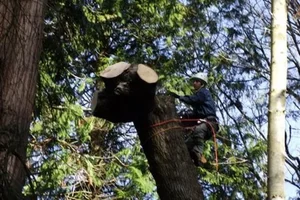
tree splits below climber while climber tops tree

I hear a lot of tricks how to clip in when cutting a leaner. Can't we make sure that the splitting doesn't occur?
Handling smaller sections or making a notch and side cuts (Don't know how the two side cuts are called in English but I mean the ones that point in the felling direction and are connected to the notch.) and then start your cut from the back of the notch toward the outside (back) of the tree. When cutting like that you can avoid getting a split tree.
 
I found this (attached) picture to illustrate my previous posts.

The piece I have cut is what I call the 'knuckle' and I find it to have some weird pressures. The tree in this photo is a Big Leaf Maple, but very similar to the Cottonwood that blew up on me... the lean, etc.

I notice the placement of my (steel core) lanyard and my climbing line below (cinched tight around spar). These days, I have gone to a Buckingham friction saver below my lanyard, with climbing line thru the steel rings. Makes me feel sepersated from the 'circle of death'.
 

Attachments

  • 300261-Camanomaple2(Small).webp
    300261-Camanomaple2(Small).webp
    70 KB · Views: 348
Re: tree splits below climber while climber tops t

I agree side cuts are the best way to avoid splitting..I was taught to do the side cuts below the notch..some times I will do two sets of side cuts...one set directly underneath as if u were doing a break cut then another set about two inches below that..if its a really large piece I will add a cut in between the two side cuts as if starting another notch not really deep but makes me feel better...it seems to me that the split would hit the side cuts then this other cut and break free if not second set of sidecuts as backup..is this over kill is your method better..just wondering if my sytem has merit?
 
Re: tree splits below climber while climber tops t

Did it ever split towards the second side cut?
I always place the side cuts just a fraction over the bottom cut of the notch.
With most leaners I wouldn't even think of starting with my felling cut at the back of the tree. I'm more in my comfort zone when I know how big my hinge is going to be before it starts to tip over.
You don't really have to start cutting directly behind the hinge. Start the bore cut more towards the middle of the tree and work your way towards the hinge. When the hinge is OK you 'work' your way out of the tree by cutting towards the back. After that you have a nice "pop" and a clean tip over without cracking or splitting.
 
Fireman,
True when you are topping and cannot put your TIP in another tree then both must be on the spar, I have an Idea on how to do this and get the stability we need. I will work on it and get you a picture so we can examine both good and bad points.
Scrat
 
[ QUOTE ]
Most splits are casued by improper cutting technique.. specifically the lack of a notch or the bypass of the two face cuts, which is a far too common site in examining the logs left by other arbs in my area..

[/ QUOTE ]


???? I'm with Norm - what are you trying to say????
 
I'm a little confused, it seems like people are discussing two different situations here. In the reported accident, the trunk split below where the arborist was connected to the tree and cutting, creating the "circle of death" force. A plunge or bore back cut would be used while making cuts on a stem with a heavy lean to prevent splitting or a barber-chair above the cut.

Right?
 
[ QUOTE ]
I'm a little confused, it seems like people are discussing two different situations here. In the reported accident, the trunk split below where the arborist was connected to the tree and cutting, creating the "circle of death" force. A plunge or bore back cut would be used while making cuts on a stem with a heavy lean to prevent splitting or a barber-chair above the cut.

Right?

[/ QUOTE ]

In some situations, yes.
It's not clear what the climber was doing in this incident, to 'bring on' the split.
 
[ QUOTE ]
I, being a volunteer firefighter tried to get some local tree companies to provide an emergency list of professional tree climbers to some of the local fire departments because like you said 25' is like being on the ground to us and how are they going to help a climber that's 70 or 80' up in a canopy where they cant get there ladder truck.Unfortunately I was NOT met with welcome arms. Most of them said they train for that situation but I have yet to see anything .I think its a firefighters union thing but I could be wrong

[/ QUOTE ]

I am on the opposite end of it then you are. I am a volunteer firefighter, and own a tree bizz. I was welcomed with my input to my fire dept and neighbouring ones on aerial tree rescues where we cannot get our 100' platforms into. The high angle rescue teams do not have the right equipment for tree rescues. ie. nothing to put ropes into trees or ascending them with spikes or anything. They are used to using an anchor point to rappel down to their patients, total opposite to what they are used to. I had a few guys from my hall come out when we practiced last week, and opened up some eyes on how things are supposed to be done.
 
How about wrapping the spar with a couple load straps or something similar (and easier to manage) and "leap-frogging" them down following each cut. Just something I saw in a Sherbrooke Tree video...Graeme McMahon dismantling a 60 meter spar with a vertical split.

http://www.youtube.com/watch?v=Y6hEfav9ZwI

Totally different situation, as the bole was already known to be split, but if it wasn't too cumbersome it could be a decent safety measure.

Just some thoughts...
 
[ QUOTE ]
I'm a little confused, it seems like people are discussing two different situations here. In the reported accident, the trunk split below where the arborist was connected to the tree and cutting, creating the "circle of death" force. A plunge or bore back cut would be used while making cuts on a stem with a heavy lean to prevent splitting or a barber-chair above the cut.

Right?

[/ QUOTE ]


A heavy lean can cause the tree to split above (barberchair) or below the cut.. Whichever fibers have less resistance to splitting is going to let go, when enough force is applied..

A slight bypass in the face cuts will cause the hinge to seize, which often results in the barberchair or trunk split.. also cutting a backcut too high above the notch can cause twisted grain to hold on and rip down past the cut and into the circle of death.

I have never heard of a tree splitting like that cottonwood, where there wasn't a lot of force pulling on the tree. Just another reminder of how dangerous this work is... thanks for sharing that photo..
 
I've taken my share of big tops with crazy head leans. The most effective way to mitigate the danger is to strap the tree together, both above and below the cut. I tend to use chains and binders when in big wood, but beefy straps with ratchet tighteners also works very well, as you want to get as much tension on the strapping as possible.

Many barber-chairs also involve a lot of operator error.
 
I think this happened to me too

I was 30 ft up a red oak and cutting a large forward leaning limb when it banana peeled down the middle and took me with it.

It felt like somebody hit me in the chest with a sledge hammer.

Later I realized that the only reason I wasn’t hurt far worse was because I screwed up the first face notch and decided to move a foot or two up the limb and start over. The limb broke off at that point and jumped over my lanyard.

I don’t see how moving your lanyard to the center connection would help in this situation but I know now to always plunge cut a forward leaner.
 
...how moving your lanyard to the center connection would help...

The idea is for the lanyard to form a ring around the trunk... with you outside of that circle. If the trunk splits, the lanyard will either stop it from splitting out more, or break. If it breaks the lanyard, your climb line will catch you, and you won't be crushed to death by the farside of the circle (outer part of lanyard) pulling the nearside of the circle (you) into the tree. When you're on your side Ds a circle is formed by the harness backpad and the lanyard, with you inside there with the tree. The tree is lots tougher than we are.

Of course, being tied in twice while cutting is still required. Having your climb line choked to the stem just below the lanyard limits how far you will fall... because it's choked, the loop around the tree will expand with the splitting trunk.

I hope I described this adequately... if not, I apologize. Sometimes this stuff is hard to visualize.
 

New threads New posts

Back
Top Bottom