tree splits below climber while climber tops tree

The idea is for the lanyard to form a ring around the trunk... with you outside of that circle. If the trunk splits, the lanyard will either stop it from splitting out more, or break. If it breaks the lanyard, your climb line will catch you, and you won't be crushed to death by the farside of the circle (outer part of lanyard) pulling the nearside of the circle (you) into the tree. When you're on your side Ds a circle is formed by the harness backpad and the lanyard, with you inside there with the tree. The tree is lots tougher than we are.

Of course, being tied in twice while cutting is still required. Having your climb line choked to the stem just below the lanyard limits how far you will fall... because it's choked, the loop around the tree will expand with the splitting trunk.

I hope I described this adequately... if not, I apologize. Sometimes this stuff is hard to visualize.

Ok I get it now, but switching to the center still seems very dangerous. All of our gear is rated at 25kN at least so even if I had switched, no part of my climbing system was going to break away and I still would have ended up in a very bad situation.
Seems to me that preventing the accident is far more important than thinking about the safest way to have an accident.
 
...preventing the accident is far more important...

Well, that's for certain... a backup plan is always a good idea, too. I have a short lanyard that is set up for doing this on my lower Ds that doesn't take up much harness or ditty bag space. I take it up with me on sketchy trees like ash and locust, along with a ratchet strap. That whole squishing your innards out thing... that creeps me out. I'd rather be overly cautious than dead, any day.
 
Well, that's for certain... a backup plan is always a good idea, too. I have a short lanyard that is set up for doing this on my lower Ds that doesn't take up much harness or ditty bag space. I take it up with me on sketchy trees like ash and locust, along with a ratchet strap. That whole squishing your innards out thing... that creeps me out. I'd rather be overly cautious than dead, any day.

There was a group of hunters spotlighting on night and had some success with gutted and cleaned carcasses on the truck. One of the hunters had an immediate urge to poop so made his apologies and crouched behind a tree.

One of the hunters thought it a great time to play a joke on his beleaguered friend so grabbed some of the innards left on the truck and sneaked behind his crouching friend and dropped the innards on the steaming pile and sneaked back to the truck, chuckling and joking with the rest of the crew.

The crouching man in due time let out a wail, and then went silent for some time. One of his hunting pals called out “You alright out there?”

The crouching man made his way back to the truck and said “You would never believe it! I pooped my guts out! But don’t worry I pushed em back up with a stick...”
 
#1 reason for barber chairs/trunk splitting is operator error when cutting. Know when are where it is likely to happen, and learn how to properly cut when there is a high likelihood of a barber chair event....
All of JD's suggestion are spot on, but "the circle of death" is only one of the things that can kill you when you experience a barber chair while aloft. The single best thing you can do is through proper cutting avoid the event all together
 
Splitting down trunks doesn't have to do with cutting always. Internal forces are strong.
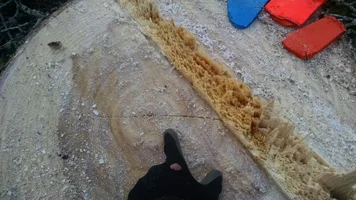
Here is a crack I saw opening right after felling this forest cottonwood.


Gord, a proficient climber and Sawyer posted a bigleaf maple video Spar Split Surprise. Split wide, but not crushing.


I try to cut just above large knot, or between them when chunking split- prone trees.


I figure, and someone correct me if I'm wrong, no science behind this...

If you unload 3000# of head lean from tree, it's like have the leverage of 3000# pushing in reverse, trying to split the trunk, without the wood above the cut to help hold it together.


IIRC, Gord's split totally after the piece left, as he was chunking short logs.

I hear and feel popping and cracking during chunking cuts on maple, alder, cottonwood, etc.
 

Attachments

  • IMG_20191215_145719447.webp
    IMG_20191215_145719447.webp
    513.4 KB · Views: 104
Last edited:
Nicest stumpie I have seen around here in a long time! Beautiful cut...

Obviously improper cutting is not responsible for all barber chairs, but proper cutting can mitigate/overcome a lot of potential barber chair events.
 
It’s the norm to hear a pile of fresh cut alder popping like pop corn.

Species profiles, and adjusting the way you cut goes along ways to prevent this from happening.

A few days ago I watched a crane pick on a alder barber chair on the climber. It split upwards as the climber chose a straight through cut. A bypass or snap cut could have been a better choice, but they were trying to control the amount of swing
 
Many trees have a high internal stress (intrinsic to species) and when cut pop like popcorn. Have even seen one draw water that way, although I have been lazy and haven’t got an ID on it.

Little different than the stress that results in barberchair. Have also seen large wind stress cracks split open the trunk once the top cut off - but even that is more the removal of holding wood on storm damaged tree, than a barberchair which technically is from a leaning top, although there might be some cross over in the type of split and resulting barberchair in a few cases because of the way a storm damaged trunk splits once the top starts to go that results in a barberchair.
 
I hear and feel popping and cracking during chunking cuts on maple, alder, cottonwood, etc.

Besides the precise hinge-forming, I'm super impressed with the growth rate on that tree, first 9-10 years the ring spacing is huge! Overall diameter is pretty big considering how young that tree is/was. Just not going to see growth rates like that in the northeast U.S. I've removed several smallish forest grown black oaks half that diameter th.at are 125+ plus years-old, you need a hand lens to count most of the rings.
-AJ
 
a picture is worth 1000 words! You and I are in that statistical category (age wise) where surviving something like that is rare.
Absolute tragedy what happened. Thanks for the visual. Lightning struck Pines and Poplars sketch me out around here.
 
I deal with a lot of Boxelders that have grown almost horizontal for a stretch to find more sunlight. As a relative beginner, I assume these have a large potential to barberchair. I try to not climb them for removals, cutting with my feet on the ground. Am I right to avoid climbing and cutting them from the top down by spending a crazy amount of time rigging them?
 
I deal with a lot of Boxelders that have grown almost horizontal for a stretch to find more sunlight. As a relative beginner, I assume these have a large potential to barberchair. I try to not climb them for removals, cutting with my feet on the ground. Am I right to avoid climbing and cutting them from the top down by spending a crazy amount of time rigging them?
I have been amazed at how poorly they behave, and I work Bradford pears regularly.
There is nothing wrong with going out of your way to not climb some of the least trustworthy trees around.
If they are a lot of your workload, you should be paying attention and figuring out what you CAN trust them to do so that at some point you can tackle them in any way with confidence.
 

Hi all, newcomer to the forum. Saw this thread and it reminded me of this article I saw in an old petzl catalogue. You have to scroll down to see the relevant picture in the article btw. I couldn't work out how to just take the I wanted and post it. It is just away of making the lanyard a closed system between the climber and tree, rather than an open system with the harness as part of the circle, if that makes sense. I saw it, thought about it then it became one those things I should try but keep forgetting to do,
It says in the article it's been a compulsory safety measure in France since 2007, specifically to protect climbers if the stem splits. I did wonder if it's a rule that's never followed or ignored as it looks like it could be a bit of a faff if you're not used to having it. Anyone do this?
 
Hi lain, welcome to TreeBuzz.

I have never used a secondary tool/part to close off my lanyard. Though I do several things to have my lanyard work better for me under specific situations. For instance I give it one full wrap when I am going up a tall section of slippery spar (20 feet or more). Also I will go from one side of my harness around the spar and back to same side of harnesses D-ring (or to itself) if I am doing anything I believe could result in a splitting top should all my best plans fail.

What would you anticipate using that set up for?
 
Thanks Merle.
Reading that petzl article it seems to say that the extra prussik cord to close the lanyard off, is a mandatory practice for using on lanyards or flip lines in France when working the main stem down. So I was a bit curious about it when I read that as I hadn't seen it before and I'm a Brit so not all that far away. It looks like a way to mitigate against the c.o.d, whilst still having the stability that having the flipline on the side D's gives, when you are blocking down a stem. So I guess that it would be used every time you're in your spikes blocking down. I have to say I've never used it, like I said I saw it in that article then thought abit about it then kind of carried on as normal, which for me is a flipline round the stem and climb line below as I work it down. So bog standard stuff.
I will try to remember it this week though and give it a go, got the first job I can realistically do since we were put on 'lockdown', on Tuesday and Wednesday. I don't intend to cause any splits but am Curious to see if it is a pain to use.
 
I will be interested to hear how it works for you. Forgive my ignorance but what does c.o.d. mean? I skimmed back through the article and didn't pick it up.

I will say that the times that I start to focus on the possibility that a top will split or rip heavy shards of bark down the sides of a stem and choose to wrap one of my lanyards around the top and back to same side of the saddle I am focused on worst case - an extreme event.

Well.....if that extreme event were to happen because all my other mitigation failed I cannot see that the little "lanyard snugger" between me and the tree would help. It looks like the lanyard would just have more friction to overcome before it jerked the two sides of a body tight against opposite sides of the tree.

It seems that system could be useful to deal with small to medium events but not heavy force events. Which, if I'm right, leaves one needing to decide (guess) when it is impotent in a situation and not to be employed.

Maybe I'm missing more. I'll be interested to see what you discover.
 
Last edited:
And I was thinking the same thing Merle, about the lanyard snugger. Seems like it would just slow down things but not stop it.
 
Ah, Circle Of Death. Yes I agree about it maybe not effective on a big split. I also think both sides need to go to a fixed point on the lanyard rather than just the carabiner on the one side being free to slide. I wouldn't mind hearing from any French climbers, as it says in the article it has been mandatory since 2007! So I guess it is taught on their training courses.
I do wonder if it's a bit of a; ' Oh there could be a problem if the stem splits.', 'Guys won't want to chog down just off the centre ring cos it's more awkward.' 'Lets do this compromise and it looks like we've addressed the issue.' Type situation.
Or perhaps I'm being cynical and it's been tested and it can be a life saver?
 

New threads New posts

Back
Top Bottom