Tree appraisal help

Who hired the landscaper and was he given instructions to cut the trees or did he just make the decision himself? Your client might not have the bulk of responsibility. Based on the photos, the condition and location values could be quite low.
The client told the landscaper to cut the trees down, and he did not specify where the property boundaries were. It’s a weird triangle shaped property line and the client is taking all the responsibility.
 
Does Wade & Gatton still do wholesale trees? I bought some from them years ago. I've seen a few websites listed for them that are dead addresses (wadeandgatton.com linked on their FB site and www.wadeandgattonnurseries.com). FB doesn't seem to indicate they do.

Anyhow back on topic...you could go that route and use Cost Compounding Technique. But, if they get "biggest possible" that MAY be different than the "largest commonly available nursery plant" (pg. 60 of The Guide, 10th Edition). Are 8" caliper trees "commonly available"??? The previously mentioned Ohio publication says 3.5". You can demonstrate otherwise, but have the data to back that up.

Having said that, if they go that route as you described, and the neighbor is happy, then you don't need to appraise anything...the case is settled with 2 parties coming to terms based on new trees being planted.

Last I knew the son from Wade & Gatton is still planting. He planted some massive Norway spruce at a condo complex that is a client a couple years ago. Things may have changed since then?
 
  • Like
Reactions: ATH
The client told the landscaper to cut the trees down, and he did not specify where the property boundaries were. It’s a weird triangle shaped property line and the client is taking all the responsibility.
Man. That's just an unfortunate lack of forethought. Certainly not the first time that's ever happened though.
 
Just gonna stand on the soap box for a second and suggest planting something regionally native if it ever comes to that.
I'm generally all on board with that and strongly encouraged it ... But we don't have many evergreen choices around here!

Norway maple (Edit....Norway SPRUCE, Norway maple is trash) does great and doesn't spread, so that's is also my go to evergreen. Not wanting to speak for @macrocarpa but we are close enough geographically that we face the same challenges.
 
Last edited:
....
Don’t forget that on top of the value of the plants themselves include x number of years of establishment, mulch, structural pruning, follow up visits and watering.
...
Not if you are using Trunk Formula Technique as prescribed by the 10th Edition.
 
  • Like
Reactions: evo
I thought I remembered there being a triple damages multiplier in these kinds of cases. That number gets crazy fast.

My big take away after learning about some cases a few years ago was to absolutely never cut trees out side the property line.
3x damages are state law, so can be variable. The Guide specifically instructs an appraiser to not include that in a report. That is an attorney's job to bring it to the case.
 
Last I knew the son from Wade & Gatton is still planting. He planted some massive Norway spruce at a condo complex that is a client a couple years ago. Things may have changed since then?
On their FB page it looked like they were still spading big trees. I just didn't know if they still sold wholesale trees (can I buy some 6' evergreens from them, for example?). Guess i oughta call.
 
The last or second most recent TCIA mag had an article on this. In that example it went to court and $$$$$$$. Think it was “the guide is just a guide” or something like that, referencing a tree value appraisal guide that held little sway. Sounds not fun, just remember to bill extra for the headache.
So the "good" news there is that they both agreed that The Guide is the correct book to use. It is certainly not as prescriptive as the author of that article makes it out to be. There is quite a bit of professional judgement. I don't know anything about the case, but I get his frustration with wildly different numbers.

I wouldn't be surprised if, a he suggested, the other arborist was stuck in the 9th edition and working the numbers to match what he thought they should be based on that. It's not OK...but I'm also guessing the defense attorney wasn't adequately related to take apart the arguments.

One quick example where I had a wildly different #...and I think the other arborist was using the 9th edition as well despite his report saying he was using the 10th. His report was in response to mine and there was a statement of mine he quoted and said it wasn't and "arboriculturally accepted practice"...the funny thing is what he quoted was taken from The Guide AND I had a page reference number for it LOL. He was a more experienced arborist than I...but obviously missed that one.

The other thing I think he really missed...he referenced instructions from the Guide about depreciating a tree in close proximity to a sidewalk because of damage they cause to sidewalks.
He applied the exact same formula to depreciate it because of an underground pipe...where they had co-existed for 80 years with no damage. I told the attorney that ones easy: "Let's take a mile walk along city streets. Do you expect to see sidewalk damage? That is a normal thing, right? Now lets walk a mile of buried pipe. Do you expect to see damage? You wouldn't see the damage, but you'd certainly see excavation from where it is being repaired. Jury, have you ever heard of a tree doing the same kind of damage to a pipe that we see daily with sidewalks? Nobody is arguing that a tree cannot cause damage, but we are talking about probability here. Is a tree as likely to damage a pipe buried 4' deep as it is a sidewalk?". Never made it to court. Thankfully they settled (I have no idea what for)...so I didn't get to see that played out.
 
The last or second most recent TCIA mag had an article on this. In that example it went to court and $$$$$$$. Think it was “the guide is just a guide” or something like that, referencing a tree value appraisal guide that held little sway. Sounds not fun, just remember to bill extra for the headache.
One more rabbit hole on that article. He said neighbor's tree was damaging his client's retaining wall. Could his client have sued tree owners to have it removed so it wasn't damaging his wall???

Another client of mine: hired me to consult on a situation. Their tree was right next to neighbor's detached garage. The wall was being pushed in and concrete slab was an absolute mess. Neighbor wanted to cut all roots on that side of the tree and shave the trunk. I said 'that will destabilize the tree and almost certainly result in tree failure '. Neighbor shot back pretty angry "well what are we supposed to do about this tree damaging our garage". I just said "I was asked what the consequences to the tree would be if it was cut as described. That is my area of expertise... I think you need to talk to legal counsel about the rest of the situation...I honestly don't know the answer and am not qualified to offer advice even I thought I did"
 
3x damages are state law, so can be variable. The Guide specifically instructs an appraiser to not include that in a report. That is an attorney's job to bring it to the case.
Very true, but a good thing to keep in the back of your mind
 
  • Like
Reactions: ATH
Northern white cedar’s nice if the deer don’t strip it. Map says it’s cuspy in Ohio?
They are native to Ohio as well as eastern hemlock. But neither are found naturally in my area. pH is too high for hemlocks here, although they tolerate it and usually look scraggly. And you’re right, the deer would munch the northern white cedar into lollipops. I plant them quite a bit in fenced in yards.
 
They are native to Ohio as well as eastern hemlock. But neither are found naturally in my area. pH is too high for hemlocks here, although they tolerate it and usually look scraggly. And you’re right, the deer would munch the northern white cedar into lollipops. I plant them quite a bit in fenced in yards.
Yeah... geographically, you are pretty close to native Hemlock...but if you look at the Ohio map they are pretty small pockets...then you see those areas in person and it doesnt take much to realize we don't have much topography that looks ... and maybe that's why Hemlock isn't anywhere else in the state. So while it's regionally native, it's also hardly appropriate in most settings we deal with.
 
I planted some western arborvitae to the deer wouldn't eat them... The bucks just girdled them by rubbing instead.
Thuja plicata? I see the nurseries are starting to carry the straight species alongside the green giants.

They are my favorite evergreen screening tree to plant now that the spruce have become questionable. But yes the deer love to destroy them with their antlers! That and they really enjoy destroying bald cypress.

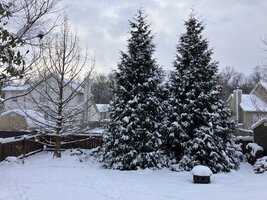
This is my backyard this morning. 2 Thuja plicata (green giant) and the bald cypress on the left. I should’ve put 3 cedar because that bald cypress will outgrow the space and I don’t like seeing the neighbors house half the year. I’m trying to keep it tucked in for now.
 

Attachments

  • IMG_5780.jpeg
    IMG_5780.jpeg
    873.1 KB · Views: 16

New threads New posts

Back
Top Bottom