Tips and Tricks

ANOTHER OPTION:
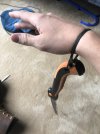
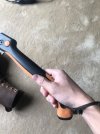
Ever drop your saw? Me, too -- sometimes on purpose. But, I always get it back … The KEY-BAK has a 48" kevlar tether. I can reach full extension with either hand. It has saved me several times over the years without injury or DQ.

 
Yes you are, but don't feel bad, I've known of some very knowledgeable people that still don't get it.

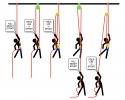
The simplest way to verify this is to set up the 3 systems, a single line, a doubled line and the pictured haul-back system and haul yourself up each one.
This is one really hard concept to understand. It is almost magical. I never got a hand on it until I did liked @DSMc recommends. Once I did I could slap my forehead and move on. No amount of 'splaining was enough.
To follow the lead of @DSMc and @Tom Dunlap — For years, I've struggled with how to explain why the same system can be called a 3:1, while some call it a 2:1. So, I made a little diagram that might help. It all depends, like most things, on your frame of reference. The exact same system feels like a 2:1 to a rigger on the ground and it feels like a 3:1 to a climber.
 

Attachments

  • 1-2-3.jpg
    1-2-3.jpg
    167.7 KB · Views: 68
I don’t think I would want that tight of a connection, I would rather it swings away than rotate somehow back to my arm, body, or face.
 
Yes you are, but don't feel bad, I've known of some very knowledgeable people that still don't get it.

The simplest way to verify this is to set up the 3 systems, a single line, a doubled line and the pictured haul-back system and haul yourself up each one.
I still need some convincing. In test number one, the climber is pulling his entire total weight with gear (let's say 200 pounds) up the single SRT rope with each pull. Now in test number two, which is supposedly 2:1 now, he runs the rope thru a pulley and back to himself, exactly halving his weight across the pulley on each leg when at rest with no pulling to climb. 100 pounds on each leg, precisely, if we assume a frictionless pulley for now. Now he wants to ascend a bit and adds a little pull to the leg opposite the saddle leg to gain some height. Here is the thing troubling me: whether a single line for SRT or doubled back to himself for MRS, the TIP or TIP pulley still sees exactly the same total weight of climber and gear, or our 200 pounds, all the time. This is a constant and no pulling of any kind anywhere in the system can change that. Whatever he does, the rope will immediately move back and forth over the pulley to equalize. So, if he has real 2:1, and can pull, say, 30 pounds over and above the 100 pounds of half-weight that is always on that leg, so that he has gained twice that or 60 pounds of upward pull subtracted at the saddle from its 100 pounds, then we have an impossibility. He cannot under any circumstances add only 30 pounds down against 60 removed up. There is no '100 pounds lifting 200'. The two legs would not total 200 pounds at the TIP at that instance. What I think he is doing, that feels like great MA, is merely moving the same 30 pounds from the saddle over to the down leg by shifting his body weight over by hanging on the pull down. Thus, instead of feeling his entire 200 pounds as he rises, like on the single line in test one, he only feels the 30 pounds he has to add to one of the equal legs and subtract from the other at the saddle, to raise his 200 pounds. Ironically, this feels actually much greater than 2:1 with 30 applied to raise 200, but is really not MA at all. He has not actually divided the total force needed at all. You have 130 pounds suddenly on the down pull against 70 remaining at the saddle at that instant, he rises and removes some rope from the loop he is hanging on to capture the progress, and the total weight at the TIP has remained his same 200 pounds the whole time, 130 and 70 for an instant instead of the 100 and 100. He has pulled 30 to gain 30 at the saddle. The 60 total difference is just that, a difference, not a total gain. It is the same 30 pounds simply moved to the other leg. And the same amount of rope is actually used, not twice the rope. He moves twice the rope at his hands only because he is also the load and is rising past his own rope moving in the opposite direction. One foot of rope moving up matches one foot of rope headed over the pulley and back down to the ground. As I see it, we may have a neat trick by splitting the climber's weight equally between two legs over a pulley for basic MRS, but I don't see we have any actual MA for the whole work accomplished. He may indeed pull twice the rope with half the force as a groundie each time, to climb, but he is also only moving half the distance each pull that a groundie could give him. His two pulls equal the single one from a groundie, both in distance moved up and also in total rope usage. How is this actual 2:1, except merely seeming to be that at the climber's hands each pull, when in fact each of his pulls is only doing half the job. Further, this means the drawing, with its one single added layer of MA with the pulley moved from TIP to saddle, is just moving from 1:1 to 2:1, not 2:1 to 3:1. We ignore the added pulley up at the ascender since it is not adding more MA and only a 1:1 redirect back down from the TIP to the climber. It may feel 3:1 to the climber himself in the third test but have we really done 3:1 overall? Only twice the rope has moved to the ground, not three times, and he has risen half the distance of rope length used, not one third. The difference involves what the climber experiences against what he is actually accomplishing in the same motion. Consider a driver going 30 mph seeing a car pass him doing 30 the other way. They do indeed pass at 60 but how far has the driver himself actually moved along the road? Or a boat moving up a river to cover 10 miles, against fast river current flowing the other way at 10 mph. The boat has to do 20 mph thru 20 miles of the water moving past him to cover the same 10 of actual distance up the river. Their experiences are valid but are not a true reflection of what they are ultimately accomplishing if they have intended to move a certain distance. As far as I can recall, this is the substance of a discussion between a bunch of experts I was privy to hear at the Sedro Woolley twin-rope thing a few years ago. Mumford was one of the group and I think he could clarify this issue much better in a video (if he hasn't already!!!). The three tests above work as they are said to and felt very convincing to me when I have tried them at times, but don't really tell me the exact amount of mechanical advantage I actually gain.

 
I still need some convincing... He moves twice the rope at his hands only because he is also the load and is rising past his own rope moving in the opposite direction. ... It may feel 3:1 to the climber himself in the third test but have we really done 3:1 overall? Only twice the rope has moved to the ground, not three times, and he has risen half the distance of rope length used, not one third...

So, you chose the blue pill? You are fixated on the non-moving pulley while ignoring the fact that the distance from that pulley is moving closer to the one pulling, which makes it, in essence, a moving pulley.

In a doubled rope system the climber pulls 2' of rope for every 1' foot of altitude gain. In the 3:1 referenced, the climber will pull 3' of rope for every 1' of altitude gained. The rope passing the pullers/climbers position defines the system.
 
In a doubled rope system the climber pulls 2' of rope for every 1' foot of altitude gain. In the 3:1 referenced, the climber will pull 3' of rope for every 1' of altitude gained. The rope passing the pullers/climbers position defines the system.
I don't dispute any of that. Everything you said is true. However, you are defining the system solely from the climber's point of view, which is necessary in the trade since you are the climber having to do the climbing. But as SingleJack pointed out above, there are other points of view, and basically the system in the drawing is 2:1 to everybody and everything else but the climber. The groundie, the customer watching who hired you, the tree waiting for you to get up there, the rope used, everything else. The upper pulley is not a fixation to me at all; it can be completely ignored. You can just remove it and lead the rope tail right straight up through the second tip to pull up on. With the rope going up and continuing on without turning around at the fixed pulley, you clearly have a 2:1 system with the climber's weight shared equally between two supporting legs. I still maintain it is only seeming to be a sort of 3:1 to the climber when you put that tail leg through a new fixed TIP pulley and hand it back to him and then only because he rises as he pulls, using more rope than would otherwise be needed. I don't agree it is true 3:1. Both pulleys do not move, only the lower saddle one. They may seem to both move together if you totally ignore the fact that the upper one is a fixed TIP. I don't think there is any problem with this view. To the climber himself, yes, this all works as actual 3:1 and it seems fine to me if he wants to think of it like that since it gets him up the tree. I am just saying that when I look up at a climber doing this, with the rope piling up on the ground from him at a 2:1 ratio, him rising at a 2:1 rate, then I see 2:1 happening to the tree and job in hand, not 3:1, regardless if he experiences 3:1 himself from the extra rope he passes. If I am the climber, it will work for me too as 3:1, no argument there. It actually is pretty neat that it does work so well. I do it all the time, just like the drawing, in coming back in from an SRT limb walk on a ZZ/RW, with a DIY ascender/pulley thing I made after seeing the QuickRoll (and its price) at WesSpur. Works great.
 
I don't dispute any of that. Everything you said is true. However, you are defining the system solely from the climber's point of view, which is necessary in the trade since you are the climber having to do the climbing...

How the system works for the climber is the only accurate assessment of a climbing system. Calling it something else because it works differently in other applications is a 'yeah, but' and pointless argument.
 
How the system works for the climber is the only accurate assessment of a climbing system. Calling it something else because it works differently in other applications is a 'yeah, but' and pointless argument.
Certainly it is largely pointless what we call some of this if it works, as long as it does not encourage any confusion somehow. I have still been using 'SRT' and 'DdRT' and I am told by some that these are obsolete and inaccurate terms now. And of course, we have whole threads here about what else they should be called. I believe most arguments of any kind are of the 'yeah, but' nature and often the only positive outcome is it encourages constructive thought on a subject by both parties. Now, one thing does occur to me about the 2:1/3:1 thing that may sometimes directly affect the climber himself if he is calling it one or the other, and that is a situation where to estimate the length f rope he is going to need in a given spot is critical. On a longer drop-down or longer limb walk where you have slapped on this pulley to add MA, if you don't have quite as much tail left as you would like, and are assuming this is going to be 2:1 when in fact you are using three times the rope, there could be a big difference in the amount of rope length you think you had available after you have dropped down any real distance. So, to recognize this as 3:1 rope use from the climber's position is certainly the only approach for the climber himself. At least twice I have done something like this thinking I had enough rope tail and ended up dangling short of where I was headed by quite a few feet and the stopper knot on the end in my hand!
 
So, to recognize this as 3:1 rope use from the climber's position is certainly the only approach for the climber himself. At least twice I have done something like this thinking I had enough rope tail and ended up dangling short of where I was headed by quite a few feet and the stopper knot on the end in my hand!
Great comment B: so for the shorty rope set esp. (say when travelling) - you go from lotsa (SRT) to not as much (DdRT), to maybe enough, maybe (using pulley or MA system say on a stem choke)! Have seen folks not ever bother tying in a stopper knot of some kind three or four feet from the end of their rope (F8 or whatever you feel is better) - maybe this is just a really cool habit to get into no matter your climbing system - just one less thing to fuss with or forget and it only takes <30 sec? A requirement for climbing comps?
And when buying your next rope(s) - if you only EVER use SRT - cool but what if . . . . . future possible systems in use influences rope length choice . . .
 
Last edited:
Great comment B: so for the shorty rope set esp. (say when travelling) - you go from lotsa (SRT) to not as much (DdRT), to maybe enough, maybe (using pulley or MA system say on a stem choke)! Have seen folks not ever bother tying in a stopper knot of some kind three or four feet from the end of their rope (F8 or whatever you fell is better) - maybe this is just a really cool habit to get into no matter your climbing system - just one less thing to fuss with or forget and it only takes <30 sec? A requirement for climbing comps?
And when buying your next rope(s) - if you only EVER use SRT - cool but what if . . . . . future possible systems in use influences rope length choice . . .
This may be the only area where what we call it does affect the climber himself! It was embarrassing both times when it happened to me, because I was in a group. And would have been a total PITA if I had let the tail end get away from me.
 
...
I have still been using 'SRT' and 'DdRT' and I am told by some that these are obsolete and inaccurate terms now...

I do hope you actually realize that what we are discussing is nothing like a changing acronym.

I am having trouble with your understanding of how much rope is used in each system, but still not accepting the face value of the numerical mechanical advantages. The amount of rope used per the moved object is a defining measure.
 
I do hope you actually realize that what we are discussing is nothing like a changing acronym.

I am having trouble with your understanding of how much rope is used in each system, but still not accepting the face value of the numerical mechanical advantages. The amount of rope used per the moved object is a defining measure.
Well, I can try to further explain what I was getting at, if we are not drifting too far off topic to continue to discuss the tip shown in the drawing. Look at your own statement: 'the amount of rope used per moved object is a defining measure'. Fine, but this is true for either point of view and basically no help in deciding 2:1 or 3:1 if you leave it at that. If you want to ascend a given amount, you will use exactly the same total length of rope as the groundie would. How has your statement clarified anything? Us climbers will experience what seems like 3:1, the groundie sees it as only 2:1 but the same rope length passes the climber. Also, if you try to learn anything about pulley systems as a new climber, google around or open a textbook to see it is called 2:1 and they never make any distinction as to who is pulling on the rope. Talk to your own craneman or rigger, a seaman, a physics teacher, you will hear 2:1 for that drawing. The ONLY thing the climber does different with the rope length at all is he pulls several times the amount as a groundie would for the same rise in height. He just gets to spread it over several pulls of the same length as the groundie but each with correspondingly less force, raises only that smaller proportional amount each time, but he still moves the same exact total amount of rope past himself finally as the groundie would have, to move himself a given distance, if you want to define the mechanical advantage by only that. This is my only point, the possible vagueness that exists with our own form of the definition as climbers. Day to day, who cares? It all works fine, like magic, so no big deal, just intriguing stuff to consider and to keep in mind if, as a beginner, we try to learn about pulleys and MA from any expert source other than another climber. In this way, what we call it verbally IS similar to the same sort of confusion as if we use unfamiliar or changed acronyms.
 
I still need some convincing. In test number one, the climber is pulling his entire total weight with gear (let's say 200 pounds) up the single SRT rope with each pull. Now in test number two, which is supposedly 2:1 now, he runs the rope thru a pulley and back to himself, exactly halving his weight across the pulley on each leg when at rest with no pulling to climb. 100 pounds on each leg, precisely, if we assume a frictionless pulley for now. Now he wants to ascend a bit and adds a little pull to the leg opposite the saddle leg to gain some height. Here is the thing troubling me: whether a single line for SRT or doubled back to himself for MRS, the TIP or TIP pulley still sees exactly the same total weight of climber and gear, or our 200 pounds, all the time. This is a constant and no pulling of any kind anywhere in the system can change that. Whatever he does, the rope will immediately move back and forth over the pulley to equalize. So, if he has real 2:1, and can pull, say, 30 pounds over and above the 100 pounds of half-weight that is always on that leg, so that he has gained twice that or 60 pounds of upward pull subtracted at the saddle from its 100 pounds, then we have an impossibility. He cannot under any circumstances add only 30 pounds down against 60 removed up. There is no '100 pounds lifting 200'. The two legs would not total 200 pounds at the TIP at that instance. What I think he is doing, that feels like great MA, is merely moving the same 30 pounds from the saddle over to the down leg by shifting his body weight over by hanging on the pull down. Thus, instead of feeling his entire 200 pounds as he rises, like on the single line in test one, he only feels the 30 pounds he has to add to one of the equal legs and subtract from the other at the saddle, to raise his 200 pounds. Ironically, this feels actually much greater than 2:1 with 30 applied to raise 200, but is really not MA at all. He has not actually divided the total force needed at all. You have 130 pounds suddenly on the down pull against 70 remaining at the saddle at that instant, he rises and removes some rope from the loop he is hanging on to capture the progress, and the total weight at the TIP has remained his same 200 pounds the whole time, 130 and 70 for an instant instead of the 100 and 100. He has pulled 30 to gain 30 at the saddle. The 60 total difference is just that, a difference, not a total gain. It is the same 30 pounds simply moved to the other leg. And the same amount of rope is actually used, not twice the rope. He moves twice the rope at his hands only because he is also the load and is rising past his own rope moving in the opposite direction. One foot of rope moving up matches one foot of rope headed over the pulley and back down to the ground. As I see it, we may have a neat trick by splitting the climber's weight equally between two legs over a pulley for basic MRS, but I don't see we have any actual MA for the whole work accomplished. He may indeed pull twice the rope with half the force as a groundie each time, to climb, but he is also only moving half the distance each pull that a groundie could give him. His two pulls equal the single one from a groundie, both in distance moved up and also in total rope usage. How is this actual 2:1, except merely seeming to be that at the climber's hands each pull, when in fact each of his pulls is only doing half the job. Further, this means the drawing, with its one single added layer of MA with the pulley moved from TIP to saddle, is just moving from 1:1 to 2:1, not 2:1 to 3:1. We ignore the added pulley up at the ascender since it is not adding more MA and only a 1:1 redirect back down from the TIP to the climber. It may feel 3:1 to the climber himself in the third test but have we really done 3:1 overall? Only twice the rope has moved to the ground, not three times, and he has risen half the distance of rope length used, not one third. The difference involves what the climber experiences against what he is actually accomplishing in the same motion. Consider a driver going 30 mph seeing a car pass him doing 30 the other way. They do indeed pass at 60 but how far has the driver himself actually moved along the road? Or a boat moving up a river to cover 10 miles, against fast river current flowing the other way at 10 mph. The boat has to do 20 mph thru 20 miles of the water moving past him to cover the same 10 of actual distance up the river. Their experiences are valid but are not a true reflection of what they are ultimately accomplishing if they have intended to move a certain distance. As far as I can recall, this is the substance of a discussion between a bunch of experts I was privy to hear at the Sedro Woolley twin-rope thing a few years ago. Mumford was one of the group and I think he could clarify this issue much better in a video (if he hasn't already!!!). The three tests above work as they are said to and felt very convincing to me when I have tried them at times, but don't really tell me the exact amount of mechanical advantage I actually gain.
The system is a gun tackle, except the climber is applying the force to the moving load (himself) changing it from a 2:1 to a 3:1.

I think you are mixing force and energy analysis. Mechanical advantage is a method of multiplying force. Lifting a climber to height changes his energy state (increases potential energy). It's done by applying force to the climber through the rope (and pulley). Applying that force to move the climber higher produces work which changes his energy state. A pulley is a simple machine that multiplies your force input - but slows your rate of doing work. With a 2:1 or 3:1 it takes less force but more time to produce the work of lifting the climber.

As to your analysis of the climber shifting his weight to lift himself on a 2:1 system: he is using the pulley as a fulcrum and the rope as a lever, like in a see-saw. By shifting his weight, he is putting a heavier kid on the other end of the see-saw.
 
By shifting his weight, he is putting a heavier kid on the other end of the see-saw.
Right, Tuebor, but that heavier kid is a chunk of himself moved over, that is the thing. The weight of the new kid is subtracted from the first kid because it is the same kid just leaning over and hanging on the down pull. The weight of the total mess hanging at the TIP never changes. The fuzzy part to me. that you guys still fail to make clear to me, is how this stays 3:1. Look at the situation above in one of the posts, of a 150 pound climber hanging in that drawing, with 50 pounds on each three legs of rope. Two to the saddle pulley and one in his hand holding on. Okay 3:1 ratio right now, fine with that. BUT it is weight only; there is no MA happening. He is exercising no mechanical advantage at all right then, just hanging there at one point, same as if he tied the down pull to his saddle bridge. The three equal weights are hanging on the ropes to a single TIP but there is no upward force picking him up until he pulls harder on the down leg and begins to employ MA with that pull leg and it begins to move down. The three legs have stopped being a single tie point sharing three equal legs as long as it is moving. He clearly has to lean over and add to the 50 pounds on the down pull leg to go anywhere up. The entire affair still weighs 150 at the TIP above, so where does that added weight come from? There is no way he can add 10 or 20 pounds and lift 150. It is not 150 now at the saddle. He adds, say, 10 pounds of extra pull to try and ascend. 60 pounds now on the down leg, leaving 90 at the saddle. 60 plus 90 for 150 total TIP weight which can never change. You see where this going! He pulls 60 down and raises the 90 lbs remaining saddle weight? Maybe so. Maybe this is the magic I am missing, but it looks fishy and I don't see 3 to 1 now anywhere there is weight and force. Where is it? What does the rope used have to do with it? It's total stays the same anyway.
 

New threads New posts

Kask Stihl NORTHEASTERN Arborists Wesspur TreeStuff.com Teufelberger Westminster X-Rigging Teufelberger
Back
Top Bottom