To the splicing of stuffing the sausage, rubber bungee wraps as gripper can help greatly at some points; and always use NEW rope rather than all tightened and ruff i think.
Sure, force, but also distance or speed.
I add this because sometimes seeing force is like seeing the wind and "seeing is believing".
Wow, so much said here!
In my imagery, distance is a reciprocal of force;
so i try to always have view that naming one, names the other.
These antagonistic /displacing each other/ at the cost of each other reciprocals to same sum are shown in a moment measure of how much distance and power as total expression in that moment of the total sum whole.
More distance crammed denser into that moment gives speed, denser force is more power as choices of the sum total volume in moment. Can work funneling of total sum either way to concentrating or spreading depending on which end of funnel is input etc.
.
As like 10speed bike choose granny uphill or 10th gear once at racing speed type transmission of choice of power or speed from the same, finite power source volume input, just reapportioned (always at a co$t of conversion).
.
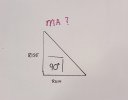
i also always look at the hypotenuse /slanted leg across from the 90degree in a right angle triangle as the actual,
then the legs of the 90 degree itself as the amounts expressed individually at each end of the 90degree geometric paradigm. i say paradigm so look at either end as a possible solution to capitalize on.
.
Trucker's Hitch therefore has 3 positions of 1,2,3 legs that can each be :input, machine pivot or output for 2 different ways each for 6 various effects from the simple tool; of the volume of forceXdistance input redistributions to not be greater than the original sum as output.
.
Dual treadwheel (for balanced force thru output shaft)/hamster cage winch/crane takes lots of outer distance funneled into smaller distance of output to center shaft wraps:
As more European minds tackled problem they only saw make larger crank to spool ratio to get more power.
But Oriental mind, turned the model recursively inward on it's own self to go smaller for same target/more power in the Chinese windlass/differential (seems typical of their other philosophical etc. lendings /mind).Which seems confusing as starting to see the light enough to grasp that far; if lose sight of just watch the input /output ratio model, can end up back in the darkness of Plato's cave; banging head on wall again(as i remember it so).
.
As we dilute a force over a larger distance we have more distance/less power in trade (just as diluting lemonade concentrate to same total pucker power, just less per mouthful).
.
Another twist tho:
Press/not impact common hammer on scale, is a 3rd class lever(like arm), losing power w/distance multiplier
>>Choke up to hammer head and just press on scale gives more power on scale than common extended grip press, as losing leverage in 3rd class mode w/more distance.
.
But in another paradigm on the other end of the rainbow extending from static to dynamic status :
By capitalizing on distance per moment(speed) when swing hammer/dynamic
>>we get the velocity squared of E=MC^2 and the lower leverage position now outruns the static leverage loss to deliver more power, not less via speed.
Now, extra distance from 3rd class lever is friend, not foe when seeking power return as gives more speed per moment to impact harder from the weaker (statically)power leveraged position. The static part M of formulae is of how much resistance to overcome static to dynamic is a simple multiplier; but the dynamic C^2 measure is an exponential multiplier.
.
Pattern repeats in even electronics forces:
Watts as total = Resistance of change from static to dynamic X Amps^2(speed, dynamic component squared).


 www.treestuff.com