Mr. JB, i was just thinking about you earlier today and wondering how you are. Hope you are well. oomTransport Hitch (aka "Voodoo Hitch)
Also, as a safety, it should be 'locked-off' with the tail run back around the anchor and secured to the carabiner nearest the anchor … IMO
Navigation
Install the app
How to install the app on iOS
Follow along with the video below to see how to install our site as a web app on your home screen.
Note: This feature may not be available in some browsers.
More options
You are using an out of date browser. It may not display this or other websites correctly.
You should upgrade or use an alternative browser.
You should upgrade or use an alternative browser.
Tips and Tricks
- Thread starter Richard Mumford-yoyoman
- Start date

SingleJack
Participating member
- Location
- W MD
Still kicking …
Good to hear.Still kicking …

Serf Life
Been here much more than a while
- Location
- Maine Island
Adjustable platform for working on trucks. 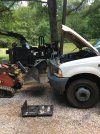

Reach
Been here much more than a while
- Location
- Atglen, PA
And when you’ve got a 6.0, you know all about working on trucks!Adjustable platform for working on trucks. View attachment 76536

Bendroctanus
Carpal tunnel level member
- Location
- Springfield
So much yes!Adjustable platform for working on trucks. View attachment 76536

Serf Life
Been here much more than a while
- Location
- Maine Island
Thankfully haven’t had many headaches. I had a shop do a full update with all the bells, whistles, and deletes before I brought it home. Today was trouble shooting lack of turbo and it was just a loose boot, love the easy fixes that a noob like me can figure out.And when you’ve got a 6.0, you know all about working on trucks!
Standing in the bucket is better than on a 5gal one, plus there is space for tools etc next to you. No fall arrest harness Brocky, but the lift has workers comp...

TheTreeSpyder
Branched out member
- Location
- Florida>>> USA
Using harness is better than using workmen's comp mite sell.
Reach
Been here much more than a while
- Location
- Atglen, PA
That’s good. We have one we bought for almost nothing, put $10k under the hood, and that cured all the problems too. Loose/blown turbo boots can be exciting and dramatic, but are very easy to fix.Thankfully haven’t had many headaches. I had a shop do a full update with all the bells, whistles, and deletes before I brought it home. Today was trouble shooting lack of turbo and it was just a loose boot, love the easy fixes that a noob like me can figure out.
Standing in the bucket is better than on a 5gal one, plus there is space for tools etc next to you. No fall arrest harness Brocky, but the lift has workers comp...

You're reminding me of when I used to deal with industrial fall prevention and protection. Those situations where you just hit the requirement for fall protection (4 ft for general industry, 6 ft for construction) are really challenging. A self-retracting lifeline is about the only way to keep a worker's head from hitting the ground with such a short fall. A little slack and a shock absorbing lanyard that extends several feet doesn't help much when falling a few feet. Kinda like opening your parachute at 50 ft.I’m sure a full body harness with shock absorbing lanyard are being used with that mechanical lift.
- Location
- Poconos
When climbing SRT on the Akimbo bring the CT quickroll hand ascender. Attach to your climbing line above the Akimbo and put the running end through the pulley for 3-1 anytime. This is also very convenient for lifting and lowering other lines, pulleys, saws etc...
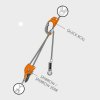
If you're pulling on the eye end of the rope, I believe this is only a 2:1. It looks like a z-rig, but the load and anchor ends are reversed, so you have a 2:1 on the harness at the lower left with a direction change (no mechanical advantage) on the pull line using the pulley on the handled ascender. Please let me know if I'm not looking at it correctly.When climbing SRT on the Akimbo bring the CT quickroll hand ascender. Attach to your climbing line above the Akimbo and put the running end through the pulley for 3-1 anytime. This is also very convenient for lifting and lowering other lines, pulleys, saws etc...
View attachment 77102

If you're pulling on the eye end of the rope, I believe this is only a 2:1. It looks like a z-rig, but the load and anchor ends are reversed, so you have a 2:1 on the harness at the lower left with a direction change (no mechanical advantage) on the pull line using the pulley on the handled ascender. Please let me know if I'm not looking at it correctly.
No. It is indeed a 3:1 because the puller is the load and is also moving. Many, many, people get that wrong.
Gotcha, thanks. Makes the most sense to me (now) thinking of it in terms of the climber unweighting him/herself by the amount of force he/she is pulling, plus getting double that on the harness pulley for a total 3X advantage.No. It is indeed a 3:1 because the puller is the load and is also moving. Many, many, people get that wrong.
But it's only a 2:1 if a groundie, squirrel or raccoon pulls it for you!

Burrapeg
Been here a while
- Location
- Puget Sound
I don't get how the drawing is 3:1 instead of 2:1. A climber pulling his own rope over a limb or thru a fixed pulley is still having to lift himself the full amount of his weight. This is 1:1. The fact that he is moving twice the rope to do this seems quite deceptive to me. It feels like MA but actually isn't. Twice the rope is moving past the climber even if the groundie is pulling it. There may be just half his weight on each leg of the rope at rest but this changes instantly as soon as he tries to rise. He must shift his own half over and add it to the half already required on the other end of the rope, basically pulling his whole weight same as the groundie would. It is not like he magically weighs half as much suddenly. So I don't see how a climber pulling the rope himself makes this drawing's setup 3:1. We have only added a single lower pulley for MA, remembering that the upper pulley on the ascender is just a fixed redirect tied straight up to the TIP. It adds no further MA at all. Am I missing something else?
In a way, it is sort of like that.It is not like he magically weighs half as much suddenly.
I was first looking at the diagram in the "traditional" way where you have a separate load, anchor and haul force. However, in this situation, the load (climber) and haul force (climber) are unified.
Picture a 200 lb climber holding a vertical fixed rope and standing on scales. If he pulls 100 lb of force on the rope, the scale will read 100 lb. He's magically halved his weight.
Consider the diagram with a 150 lb climber. If the climber pulls on the eye end with 50 lb of force, his effective weigh becomes 100 lb. His 50 lb of downward pull on the rope creates 50 lb of upward force on his body. Combined with the 50 lb on each leg of the pulley attached to his harness gives a total of 150 lb of upward force for 3:1 MA.
For a 200 lb climber attached to a line run through an overhead pulley, if he pulls 100 lb on the free end, he reduces his effective weight to 100 lb. The end attached to his harness also has 100 lb on it, so he can hold himself in position. With additional force, he will lift himself. So whether you look at it as (a) 100 lb of force lifts 200 lb or (b) pulling 2 ft of rope to moves the load 1 ft, it's a 2:1 MA.
It adds no further MA at all. Am I missing something else?
Yes you are, but don't feel bad, I've known of some very knowledgeable people that still don't get it.
The simplest way to verify this is to set up the 3 systems, a single line, a doubled line and the pictured haul-back system and haul yourself up each one.

- Location
- Retired in Minneapolis
haul yourself up each one.
This is one really hard concept to understand. It is almost magical. I never got a hand on it until I did liked @DSMc recommends. Once I did I could slap my forehead and move on. No amount of 'splaining was enough.

Eric H-L
New member
- Location
- Indianapolis
Not my original idea because I heard this suggested elsewhere ...
After I dropped my Silky Zubat while aloft and working alone, I really disliked climbing down to retrieve it. Afterwards, I attached a cheapie carabiner to the hole in the Zubat's handle, then tied (using fisherman's knots) a discarded telephone coiled cord from that biner to the Zubat's scabboard. I found the standard headset length of coiled cord does not impede my reach. And because I can pull it back up, I no longer keep a death grip on the Zubat and will drop it anytime necessary or convenient. The cheapie biner also allows me to disconnect the Zubat so I can use it while walking about on the ground.
Great idea! Other less free options: Scuba shops sell a nice coiled camera lanyard that would be good for a handsaw. Also the construction industry is requiring tool lanyards more and more so they are more readily available.

Sent from my iPhone using Tapatalk
Last edited:









New threads New posts
-
test
-
 Free CEUs: February 05 & March 05 - 'Urban Forestry Today' Webcasts @ Noon (Eastern)
- Started by UFT
- Replies: 0
-

-

-
-
-