SRT from an od head ...

Sometimes I think I put too much effort into making everything "retrievable", like I'm never going to get in the tree or can't get back to that point.

I don't think it's wasted effort. It is good work practice, in my opinion, which gives you an option that can avoid leaving gear in a tree that probably should not be. I understand what you mean, though.

Tim
 
Leaving a little pony tail drooped over the other side will allow you to pull line back through redi without going back up to it. Just don't lose your tail.

I also would like to see a diagram, photo or video of this technique, going from easiest to provide, to most difficult. It sounds like a really simple but powerful technique. Thanks in advance for any answer you choose to provide.

Tim
 
Tim. I often use a ring and revolver combo to avoid the crotch. Basically I lanyard in. Hang off the lanyard and slack my line to remove the combo. There are some really innovative retrieve able redirects that let you just pull them out. I just haven't practiced them low and slow to perfect my technique. Unfortunately where I word production trumps the opportunity to practice new stuff. The other bummer is I have no mature trees to practice in in my yard. The horse knot is pretty fail safe if tied correctly but I have watched smart horses untie themselves from hitching posts so I need to make sure trees don't do the same. Lol.

Mac. Are you busting on me bro? My overly sensitive and tender personality got a little choked up over that comment.

There is so much stuff on the net about redirects. It's hard to believe over 40% of Internet traffic is porn. Lol
 
Thanks for the response, Steve. The way that you describe your redirect is just the way I imagined doing it myself. Thanks for the confirmation.

I know what you mean about the horse knot. I watched Kevin Bingham's video on that item, and it looks really slick, but like you say, it would make me nervous to try using it unless I'd practiced it a lot under safe conditions.

I guess I'll need to think about a good place to practice with the horse knot.

This has me thinking about JohnnyPro, and his twin rope floating crotch technique. If you could find three smallish trees that are fairly closely spaced, you could do the JohnnyPro double rope floating crotch in between two of them, and use the horse knot in the third tree, for redirect practice. When you pull and release the horse knot, all that should happen is that you go for a little JohnnyPro-like swing, safely in between two trees, instead of slamming back into a stem. It could also allow a climber to test his ability to safely go inverted, by setting it up so that there's only two or three feet between climber and ground.

Steve, you've got my wheels turning now, buddy! Thanks for this! This could end up being a really fun experiment. I never did get an answer from JohnnyPro about how he configures his saddle to ensure that he is safely able to go inverted.

Kevin Bingham climbed at least once with JohnnyPro, and kevin was able to safely do flips in his saddle while with JohnnyPro. So maybe Kevin can enlighten us. I'll understand if he chooses not to comment, just because of the potential hazards involved.

I guess what has me a little excited is the idea of having a way to safely practice, low and slow, three different and important techniques. Namely, twin rope technique with floating crotch, horse knot redirect technique, and inverting-in-saddle technique.

If you have any little kids around, I'd think making a small swing like this, once you get the kinks worked out, would be just a hoot!

Thanks again, Steve! I'm going to be keeping my eyes open now for a triangle of trees that could be used for practice.

Maybe you have neighbors of your own with mature trees that would not mind giving you a free pass onto their property to practice whenever you felt the urge.
 
Last edited:
Thanks Tim. I think all you need is 2 swivels or swiveling systems to flip. Just make sure lines are outside to your d rings and let-er-rip. As far as the swings go. Have fun. I am not that interested in it. It's fun to watch and secretly prt of me wants to show off with an epic tree dismount but all it takes is one small miscalculation and there goes the climbing career. I move at a consistent purposeful speed all the time. Rarely do I jump or swing around in a tree. Jut never seemed to contribute to production. You know saws smashing around and all. When I start thinking about doing that kind of showmanship and speed my inner voice asks me why. I don't have a good answer so my voice tells me "ok then". Maybe if I was 20 years younger and still invincable. Lol
 
Thanks for the response, Steve. I think I'm really pretty much like you are as far as climbing styles are concerned. Except that I'm probably slower and more cautious than you are. I guess what I was talking about above is just having a way to practice the remotely retrievable horse knot redirect, low and slow near the ground, in a way that assures safety when the knot is released. A small swing, clear of obstacles, might be a byproduct of such practice.

My motive for wanting to practice going inverted is just to know that I'm able to configure my saddle in a way that ensures that I cannot accidentally be dumped out of it. I don't own one of those SRT harnesses that incorporate a set of heavy duty shoulder straps that are rated to hold the weight of the climber. It looks to me like some climbers have their harnesses configured in a way that allows them to be upside down, looking at the ground, with no sign of slippage from the harness. It appears that the harness may cinch at the abdomen, above the hip bones, and that it is the hip bones that are preventing the harness from slipping off.

It would give me a good feeling to know that I could hang straight upside down with no sign of slippage, but also not be unbearably uncomfortable either. Circus acrobats do this routinely, with much smaller harnesses, so I'm thinking that it is just a matter of getting the harness properly fitted and configured.

Right now, I primarily depend on the fact that my climbing system is attached above me, and therefore tends to keep me in my saddle. It would just be nice to know that there is a backup beyond that.

Climbing safely and remaining injury-free are the most important considerations. Safety first, always. That way improves the odds of always being available to do useful work on another day.

Thanks again for the valuable feedback.

Tim
 
I move at a consistent purposeful speed all the time.

You'll still be around in ten years, too. You will already have the skills it takes to do the work at an age when the circus performers are selling beer and cigarettes at the local Stop 'N' Rob store, wearing orthopedic shoes, a back brace and a morphine pump.
 
Ha. Maybe so Jeff. I just find days like yesterday (heat index 105. 900% humidity) much harder to recover from. I used to bounce back quick but this morning I'm dragging. Maybe it's the fact I dont get any sleep? Anyway. Thanks.
 
Butch, from the TreeHouse forum, gave me a solution to the severe muscle cramping I was experiencing after climbing in high heat last summer. He recommended drinking at least two bottles a day of Pedialyte, if I'm spelling it correctly. He also said you should front-load it, as in, drink a bottle of it before you even leave the house in the morning. Pedialyte is the liquid that they give to babies that are suffering from dehydration due to illness, I think.

I was reliably getting cramping in my legs at night, and especially when I made the mistake of stretching out too quickly upon awaking. Instantaneous, massive leg cramps. One particularly hot and hard climbing day, I did not even make it home before both sets of quads started massively seizing up on me, just sitting in the car at the fast-food joint I'd stopped at for dinner.

It was after this event that I sought the solution, and Butch provided it.

I also eat two or three bananas at the end of a day like that, to replace potassium.

The combination of drinking two or three bottles of that electrolyte fluid, along with the bananas, either completely eliminates the cramping I've experienced, or so close that it's not significant.

I'm thinking that the symptoms you are experiencing might be relieved to a great extent by the use of the combination I mentioned above.

The name brand stuff is expensive. I was buying the store brand stuff that sat on the shelf right next to the name brand stuff, with no difference in result. The store brand stuff is a bit more than half the price of the name brand, in my experience.

Also, I recently tried to find an even cheaper solution to the problem, and found it in powdered mixes available from Amazon. I'll try to include links to the products in question in my next post.

I re-use the plasic bottles that I got from the supermarket brand, to mix the powdered stuff into. They're the perfect size, with a twist-on cap that does not leak. I fill the empty drink bottles about halfway up with water, then use a cut-off soda bottle as a funnel to direct the electrolyte powder into the drink bottle. Then I shake it up a bit to mix it, then add the rest of the water needed to fill the bottle up, and shake again before sticking it into the refrigerator.

Doing this extra bit of work mixing the powder drops the price per bottle to about one third the price of the premixed bottles. I'm not yet sure whether it works as well as the premixed stuff, though. I may end up using more powder per bottle than they recommend, just to see what I think.

I'm working on this post with a handheld computer, and there's a glitch in the software that makes it nearly impossible to edit my last line. So ignore what follows this, and I'll come back and edit it later on my laptop.

I use 1/4" haul line and attach them with clove hitches
 
Ha. Maybe so Jeff. I just find days like yesterday (heat index 105. 900% humidity) much harder to recover from. I used to bounce back quick but this morning I'm dragging. Maybe it's the fact I dont get any sleep? Anyway. Thanks.

Also, I did not mean to discount the lack of sleep as a major problem. Some people can function pretty well on little or no sleep. I am not one of those people. I do not climb professionally, and therefore do not have the external pressure on me to climb on a schedule no matter what. I generally want to feel as though I've gotten good sleep, and in a quantity that feels right for my body at the time, in order to consider climbing. I'm an older guy, and want to feel energetic and strong and alert on the days I consider climbing. It all just takes so much effort that if I'm struggling with fatigue due to bad sleep or short sleep, I generally kiss it off. I want the climbing to be a generally positive experience, and feeling really "off" due to bad sleep is something I find tough to overcome. I'd be concerned I might injure myself or worse, due to lack of focus. I guess you veteran climbers learn to deal with it, but the prospect of being forced to climb while severely fatigued or on a really short ration of sleep kind of frightens me. I like to feel I'm at 100% of normal working capacity when I'm engaged in such an inherently dangerous activity.

Sorry for being so long-winded.

Tim
 
Here's a link on Amazon to an 8 pack of the name brand stuff, which might be the cheapest way to obtain the full-on real deal.

http://www.amazon.com/gp/aw/d/B00DV...=pedialyte&dpPl=1&dpID=41pHkLk4UYL&ref=plSrch

If you have or acquire an Amazon Prime membership, you get free two day shipping on most things that Amazon directly ships themselves. It also includes free streaming video (though the selection of "Prime" movies and TV shows is somewhat limited), and the just recently added free streaming music service. Plus free books if you're a Kindle owner.

Too much, again, I know.

Maybe you and I are brothers, separated at birth.

Tim
 
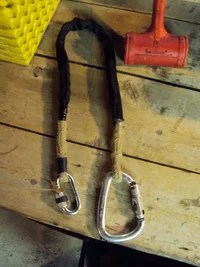
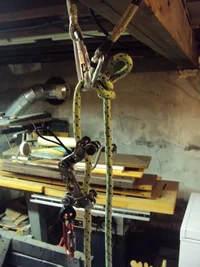
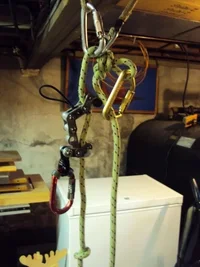
Here is my simple SRT "friction saver" using an oval steel link and large carabiner. I like this set up because the transition from a base tie to a canopy anchor is quite simple and you don't need to play around with so much rope. I only use this for pruning and never on removals.

You ascend on your basetie, lanyard in, and then ascend to your higher or more appropriate tie in point with either a Ddrt system on your tail, or with your 2:1 lanyard. You can keep letting slack out of your srt system and drag it up with you. Clip in to your srt friction saver, and tie an alpine butterfly that butts up against the oval link. You can back it up with spiking the alpine butterfly like shown in the picture. Retrieval is very easy, even with redirects using a simple overhand knot. Obviously placement of the friction saver is important for removal.

DSC00377 (480x640).webp DSC00378 (480x640).webp DSC00379 (480x640).webp
 
Following this conversation, I see so often climbers saying, I do it this way or that way or I only climb SRT, I only do DdRT, base anchors for me, canopy anchors for me, I always use two climbing lines, I use one climbing line, both ends, I only use one end, I always do things the same way so I don't get confused, I like to try different things, on and on....in the end it's not one way or the best way, it's all of these things when needed.
Thanks to all of you for adding to my toolbox so hopefully I make the right choice, from so many, when needed.
 
Last edited:
Following this conversation, I see so often climbers saying, I do it this way or that way or I only climb SRT, I only do DdRT, base anchors for me, canopy anchors for me, I always use two climbing lines, I use one climbing line, both ends, I only use one end, I always do things the same way so I don't get confused, I like to try different things, on and on....in the end it's not one way or the best way, it's all of these thin when needed. Thanks to all of you for adding to my toolbox so hopefully I make the right choice, from so many, when needed.

Wise words Dr. Mumford :birra:
 
I also would like to see a diagram, photo or video of this technique, going from easiest to provide, to most difficult. It sounds like a really simple but powerful technique. Thanks in advance for any answer you choose to provide.

Tim
Vid in the works . I'm sure there's some out there ,but you know I gotta flip my hair show off my saka jb mod and do a couple redirects all in one flick.maybe even a canopy jig in there
 
Thanks Tim. I rarely suffer from dehydration. Usually no cramping. Just get tired at the end of the day especially if I was up running calls on the fire truck all night before I do tree work. Recovery from hot days is a little more challenging for me as I get older but I've got it pretty much dialed in. I have eaten the same thing for lunch every tree day for the past 10 years. It's the perfect mix of solid, semi solid, protein carbs and a banana. It works. The guys I work with will sometimes order pizza and I just won't eat it. Throws off my machine. Anyway I appreciate your response. I will keep the pedilite in mind. We have had several of the worst heat and humidity days I can remember for a long time. They even closed a major road yesterday because it was buckling from the high temps.
 
Wow, Steve, you are a strong guy. No way could I be up all night and then even consider climbing the next morning.

You're welcome for the tip about the Pedialyte, and the electrolyte powder substitutes. For me, using that stuff is a night and day difference in how my body reacts to a day working in the heat.

If it is not too personal a question, I would love to have you lay out the ingredients for this lunch you've been eating for ten years. My system works like yours does, I think. When I find foods that agree with me, and cause me to maintain a good energy level and alertness, I just stick with it for a very long time.

Thanks in advance for any response you choose to give, if any.

Tim
 

New threads New posts

Back
Top Bottom