
Muggs
Been here much more than a while
- Location
- Canuckistan
Yes, pull lineSorry for the dumb question, but I assume by "tag lines" you mean a pull line?

Follow along with the video below to see how to install our site as a web app on your home screen.
Note: This feature may not be available in some browsers.
Yes, pull lineSorry for the dumb question, but I assume by "tag lines" you mean a pull line?

Poor cutting, and possibly in the Circle of Death with the lanyard.This is a video that can show you problems with a thin notch. It is not a top removal, but it could occur while topping a tree. The notch closes and the weight of the limb (in this case) causes it to split. If you were felling a tree, we call it a barber chair. A thin notch on a heavy top could do the same thing and smack you in the kisser. I will make a thin notch when dropping portions of the stem down because short logs are not likely to split, and once the log is going where I want it to, I would just as soon have the hinge let go. I'm pretty sure if he had made a good notch on the bottom this would not have happened. Anyway, here it is for what it is worth:
Poor cutting, and possibly in the Circle of Death with the lanyard.
A Coos Bay was one easy option.
Box-cut, another.
Heavy leaners are no joke. Don't drop-cut a heavy leaner.
Small saws exacerbate the issue.
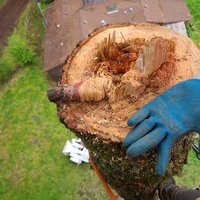
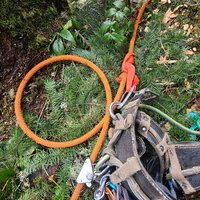
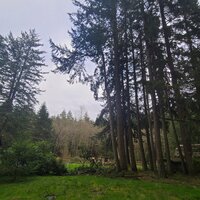
Take your time and be safe. Think things out. What might happen if I do this. Or, where is this going to go once I cut it loose. What is it going to hit, and if it does, what might happen as a result.I just want to say, this thread has been great and has already made me safer. Thank you all. Excellent replies AND videos
I disagree with the machine part you're taking a top you shouldn't have to pull that hard and it is much easier to pull to hard without realizing it. A simple 2:1 which we should all have the equipment to set up or a rope puller is all you should ever need for topping imo.In a word, yes, a narrow notch is more likely to cause a barber chair- because the felled stem would havecommitted to a direction but not gained enough momentum to break a hinge. This would be especially true on a large top, one with an overly thick hinge, in a tree type that is known for strong hinge wood.
Using a humboldt or conventional notch is less important. a face cut that is at least 45 degrees, the thinner the hinge left, and the smaller, less head lean on the tree all equal less chance of an extreme bending moment and barber chair. Bending moment- the force a top exerts on the stem as it pushes off- this can easily throw you off your spurs.
I use tag lines to pull over tops all the time, it’s a margin of safety for directing the top. If it makes you uncomfortable you should fell more trees from the ground with a tagline to become more familiar.
I prefer a tag to be pretentioned to a desired tautness before making any cuts. I like it to be on a machine if available because it is just strong and easy. If that isn’t an option and it’s an important pull I like the tag to be anchored and tensioned. The grounds person can then simply lean onto the taut line if additional force is needed and they won’t be tired from having been pulling while I make cuts and position myself.

Agree 100%Agreed, I'm not really comfortable with being in a tree that has a machine pulling on it.
I tend to operate a bit different than most. I always have at least a 20' lanyard with me on a Petzl Zillion. Besides using it for advancing over limbs when climbing, I move the Zillion to a carabiner on my bridge and use it for choking the stem when blocking it down instead of using my climb line. If I go out on a limb, I will choke the stem with it and use it as a second tie in, albeit horizonal. If I am out on a limb working, I am not going to lanyard onto a limb and put myself is a position that is uncomfortable, and mostly that is what it is going to do. Not to mention it really isn't all that safe, as you said.I’ve given too much thought to the automatic redundancy hazard of lanyard use.
Frequently in the PNW, we will put our selves in work positions and locations where lanyard use is NOT redundant and little more than a positioning aid. Out on the tips or a Douglas fir for an example, where you must keep all your weight on your climbing line to avoid the limb failing under your feet. If you lanyard in to the limb you’re standing on, or a neighboring limb it’s often 2” diameter stuff 10-20’ out from the trunk.
If you cut your climb line you will shock load the limb, likely breaking it, or just sliding off the end.
Thus not redundant at all.
Yes a dual system can be a cumbersome but obvious solution, OR a hack is to carry a spare hitch cord, and just before you get to your target, slap it onto your climb line. Move your lanyard to your bridge and take a few more steps out. This gives you two points of attachment out of reach from your saw.
Obviously this is more of a single line trick.
But most of the time I will choose to use my lanyard for work positioning, as the rope angle puts my climb line way out of saw range anyway. But I will never call it redundant

Very true, when it does happen the cry goes out from me to the bloke in the loader.Agreed, I'm not really comfortable with being in a tree that has a machine pulling on it.
Great info, thanks. Around here it is a lot of mature Leyland Cypress, white oak and red maples.What species do you work, @WannaClimb?
Be aware of how parts of the tree behind you will rotate over you as the top falls.
I like a top to be cut up the way I want it, then call for the pull.
Before I face-cut, I have a test-pull done by the ground worker.
People want to help. It doesn't mean they know how to help or hinder. Too much pull can split a top. More pull is more recoil of the climber on the spar.
My goal is not to see if they can bend the whole tree, and how much they can bend it. Barring the need for momentum to fight side-lean, the groundworker needs to just rotate the top over the hinge until gravity takes over. Finesse over power.
The more horizontal the line-angle of the pull rope, the less pull it will take from the ground worker.
Installing a high pull-line can be done with a short throw-line and weight, or just a weighted rigging line (Biner and/ or throw weight) thrown through a fork and choked or re-directed down to the bottom of the piece being removed, near the climber (above the cut... in the same vein as a climbing system SRT Basal Anchor).
Wedges don't pull on bad roots like a pre-tensioned pull-line does.
A wedge to back-up a pull rope is an easy safety measure (probably frequently not done).
A Maasdam continuous rope-puller is a great inexpensive tool...Mechanical Advantage with progress capture.
A 2:1 pulley set-up to double your ground worker's pulling power is simple and cheap. (2) 2:1 MA systems, piggybacked is also very cheap, compact, and inexpensive. Bulk hitch cord tied into a friction hitch can be used for a progress capture.
Throwing a small top, instead of rigging by an inexperienced ground worker can be a win.
Beware that all ropes are clear of falling tree parts (a dangling, secured bight on a harness getting caught by falling tree parts, or a thimble/ stopper knot on the end of a lanyard getting caught in a fork, etc).
Always think of the worst case scenario of a rope getting tangled in a moving/ spinning piece of machinery or falling/ rolling wood. Redirecting the excess rope tails (standing ends) laterally away from the active work zone over limbs and fences can be nice.
I like to hang my rigging line with a carabiner on a weak, breakaway cord, not directly on strong parts of my saddle. In time, some company will start to make a breakaway system for hanging gear like they make saw lanyards. A rigging (any) rope, attached strongly to a saddle, going into the chipper is bad news.
That’s fair and to each their own.I disagree with the machine part you're taking a top you shouldn't have to pull that hard and it is much easier to pull to hard without realizing it. A simple 2:1 which we should all have the equipment to set up or a rope puller is all you should ever need for topping imo.


