Re: Sherrill\'s PI splice
Guys & Banjo,
Am back in town now and have thoroughly investigated this splicing issue. Let me start by explaining one important detail. We take our splicing product VERY seriously. It is the only thing we manufacture in house and, as Nic mentioned, is managed by a full time and dedicated splicing staff (of 6). All of us know that one bad splice can kill someone, no redos, period. We are not a splicing shop for recreational boaters. The splicing manager (Gary Brantley) has been with us for 12-years and is the epitome of pursuing perfection. Gary's inspection policy is rigid. On this and other "doublebraid splices" the rule is that only 5-year veterans can inspect splices. (We have two other splicers who meet that criteria.) Training for new employees usually consists of the more simple (3-strand and hollow braid) splices for about a year (depending on how good a splicer is and how enthusiastically they approach their work). Gary has regular splicing competitions where splicers try to out-break each other (using our test machine) on similar splices. We feel very dedicated to the profession of rope splicing.
Here are my findings on the matter;
The core hemorrhaging and core bury are two different issues (as mentioned in a pm to Banjo).
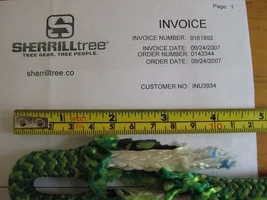
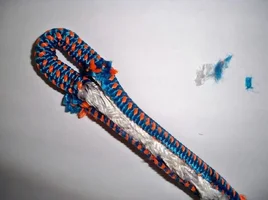
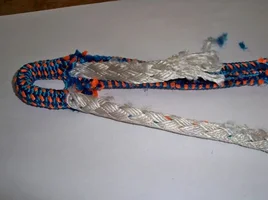
The photos displaying the short core bury posted at the top of this thread are not according to Yale's spec.
It appears that the splice was not zeroed out and that the core was tapered based on a weak milking procedure early in the process.
To Gary's recollection and records, we have had no other returns for this splicing error while showing12 core hemorrhage issues with PI (at the eye only).
As for the core peeking through the cover this is not an unheard of phenomenon among ropes of this construction (thin jacket). I would politely disagree with Nic's statement; "If it (core) does (emerge), like shown in the picture, the cover will open up more to the point where the core is holding most/all of the load... you lose compression in the splice."
The fact is that when this happens (and the cover strands are "below" the core strands) the COVER is taking the greater load and actually enhancing compression forces. Regardless, it’s not preferred. I didn't see it as so dangerous because a 400-pound load posses little threat to breaking through a 6,000-lb rope that's supporting half of the load. I personally think most people would stop using a life supporting rope long before the hemorrhage completely emerged from the cover and started fraying. Fortunately, most people are rather picky this way.
____________________________________________
Digging deeper -
Ted, we looked for your time of purchase in our data files and found your name but no order. Did you get this from a Vermeer dealer? And if so in what state. Among the two dealers within driving range of your home address, neither has purchased Poison Ivy with 2 tight eye splices. We were merely investigating who here might have performed such a poor splice and then who might have passed its inspection.
Gary does not recall talking to you about this incident but admits that without the thread photos and written detail supplied here it could just be a foggy memory.
Jamie Goddard at Yale doesn't remember talking to you about it either and says he's the only one at Yale that would respond to this call. I can only presume that the issue is older than you’re remembering or that perhaps the details on our end weren’t interpreted as well as your writing in this thread.
Banjo (Ted) - in your 5th post you state "This came from Sherrill, they spliced it. What do you think."
Then, a few posts later you state "I got this splice from someone else, I noticed it during the workday, and chopped it before he could say peep."
Please explain this contradiction. Also understand that nothing in this investigation is personal towards you. I'm genuinely trying to get to the bottom of this now public issue.
__________________________________________
Comments
In the future if someone elects to self-dissect a splice please include (in your photograph) the serial number tag or other important clues that help delineate proof of mfg. Not that a removed splicing tag is hard proof but it helps in the detective work.
As I said to Ted in a pm, we are all about transparency in such matters. Please trust us to properly evaluate a perceived problem for everyone’s sake. If you’d like photos of our examination, just ask. We are not cloaked in secrets. And finally, we are human. We definately make mistakes. Something unusual could disprove all that I’ve written here. If it does, I’ll be back to admit it.
Guys, this is about all I can offer. I think i've exhausted all avenues of evidence in the matter. I hope it's understood as written and somewhat helpful. Will keep watch for further evidence to chase down so please don't hesitate to contact SherrillTree directly.
Best to all.
T
PS Funny how things get misinterpreted.
Ted, you wrote above; "True, but the serial number is ONLY for date of sale. They can't tell when or who spliced it."
If you'll reread my pm it reads that we CANNOT tell date of sale (or who spliced it), rather it records date of manufacturer.