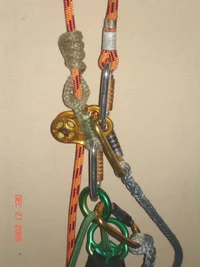
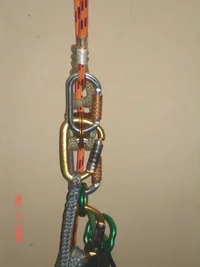
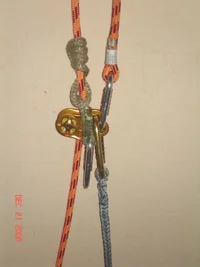
Share some of your tricks with everyone

Here's a trick. I put a short french prussic lope on my flip line. It only sticks out about 6 inches, and I leave it there. When I go to lanyard in, instead of going from d ring to d ring, I keep my flip line adjuster on my bridge, go around the branch, and put the caribeaner into the prussic lope. This way the prussic can be adjusted up tight to the branch and you don't have to hang of your hips, and you get full range of motion. Also you can safely lanyard around a branch where there is no branch or crotch to keep your rope from slipping down.
 
[ QUOTE ]
I like that srt set up, throw a figure 8 above the knot will add friction and control in the case of a need to lower, and def a stopper not would be a must in my opinion, just in case.

[/ QUOTE ]

Stopper knot I completely agree with, but the figure 8 is unnecessary as the VT (or whatever hitch you decide to use) provides plenty of friction combined with the friction of the rope going over branch(es) for a controlled descent, should it be needed.

jp
grin.gif
 
If you're just ascending SRT then switching to DdRT, why not just tie off at the base with a running bowline? Rescue shouldn't really come into play that often on ascents.
 
I think its because ascent is the only time you are not easily lowered by other means. Rescuing someone who has been footlocking is way harder than rescuing someone who has been climbing Ddrt. I think really, it is only important to have it on the acents and for working I think it can be somewhat of a liability.

However, with just a running bowline, the climber is still rescuable by simply prussicing the rope with another rope that is wraped aroudn a tree and then cutting the bowline.
 
[ QUOTE ]
I connected to the ring with my teather-since all three holes are used on the hitch climber and the ring is used, i connect to the swivel and srt my lanyard.

[/ QUOTE ]

I really liked this idea... so much that I ordered up a hitch climber just for this purpose.

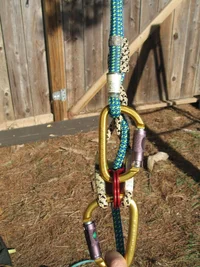
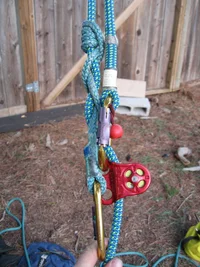
Not sure if this matters or not, but I tested it out today using different hole configurations on the hitch pulley. I came to the conclusion that the pulley is designed to be used (when used for a fair lead) utilizing the middle hole to dead end your climb line into, then using the bottom hole for your hitch. Now when used this way, you have no hole to set your tether into.... top one will not work now. I tried it using it the way you have pictured, hitch in the middle and climb line on top, but it splays out the bottom legs of the hitch, and they are not riding along the plate with the holes in it anymore.. rather they run along the cheek plates of the pulley. This photo shows it set up having the hitch in the middle... notice how much the legs splay out
 

Attachments

  • 152986-IMG_3201.webp
    152986-IMG_3201.webp
    284.3 KB · Views: 393
Now, in this picture I changed the set up... used the bottom hole for the hitch and middle one for my climb line. Now, the set up is much cleaner, with the hitch properly set/dressed.

My question: is the way the hitch is dressed in the first photo safe? I just do not like the way it looks. The trick I bought it for is now on the back burner... since when I have it set THIS way, there is nowhere to connect the tether. Suggestions anyone?/Users/PMMB/Desktop/IMG_3204.JPG
 

Attachments

  • 152987-IMG_3204.webp
    152987-IMG_3204.webp
    365.8 KB · Views: 356
Ive used it the way in my pic for a year and never had a problem.Every one ive seen who use the hitchclimber leaves the middle hole open..Maybe you should shorten the length of your climbing hitch.I actually quit using a VT because of the problems you addressed.I went to a shorter cord and now tie a knut,XT or a 5 to 1 VT.
 
I think that grizzly splice might be the cause of it spreading so much in the top hole.Try a traditional splice with a little shorter cord.
 
[ QUOTE ]
I came to the conclusion that the pulley is designed to be used (when used for a fair lead) utilizing the middle hole to dead end your climb line into, then using the bottom hole for your hitch.

[/ QUOTE ]


Thats what I do too. I like as little movement as possible before the HC engages the hitch. I want the HC to start advancing the hitch as soon as I pull on the climbing line. With the hitch on the bottom hole there is minimal distance between the HC and the bottom of the hitch. And I agree with Jimmy. Shorter, or no, splice and a shorter cord.

When using the system the Jimmy showed, both legs of the climbing line are taut as the HC moves the hitch up the line. If the eye end of the climbing line is in the top hole and there is a short cord/hitch then the eye can rest on the top of the hitch and prevent the hitch from grabbing when the climber sits back on it. Using the middle hole for the eye puts the eye a little lower so that it is less likely to engage the hitch. This also tips the HC backwards, away from the hitch, so again the eye is less likely to engage the hitch.


[ QUOTE ]
Now when used this way, you have no hole to set your tether into.... top one will not work now.

[/ QUOTE ]

You can use the top hole for the bridge extension. Use two 'D' 'biners for the climbing line and slip an HMS 'biner behind the biner in the middle hole. Its crowded, but it works well.

 
[ QUOTE ]
I think that grizzly splice might be the cause of it spreading so much in the top hole.Try a traditional splice with a little shorter cord.

[/ QUOTE ]

Yeah, I thought that was a suspect too. I tried my trad spliced cord, but same issue.

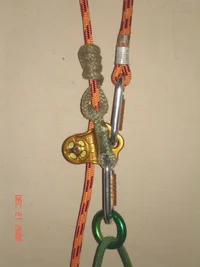
Here is another set up I tried out. The mechanics work out fine, but the positioning of my lines are now different.. my hitch is on the top, with the eye of my climb line behind it.. But, I was able to keep the bottom hole open for the tether. The only issue with this set up is now I have to get used to having the hitch on top.

See pic
 

Attachments

  • 153001-IMG_3211.webp
    153001-IMG_3211.webp
    210.7 KB · Views: 292
Have you guy's had any problems with the biner holding the rope catching your hitch, releasing it when you sit down? Especially for those that say they use a shorter cord i would think this would make the prolem more prone to happen. I've only had it happen once or twice but its always in the back of my head. With a shorter cord i'd be afraid of it happening more regularly.

By the way i have my hitch in the bottom hole, and have moved my climing line to the middle hole to prevent what i describe from happening as often.
 
When i put the eye of my climbing line on the center hole it actually cause the HC to lean back more and I lose some of its fair leading abilities.It also nullifies the use of the 3rd hole and probably escapes its original design and versitility. Probably Be better off with a Mickey Mouse and save some money.I guess im just use to it this way and have tweaked it to the point where it really works for me without problem.Id recommend trying it a few times and maybe changing Knots or cordage to see which works if any.Otherwise just use the tip slider that may work better,so your hc doesnt seem like a waste.You actually could set that up with a small prussik and put your spliced end in the middle hole.
 
[ QUOTE ]
Have you guy's had any problems with the biner holding the rope catching your hitch, releasing it when you sit down? Especially for those that say they use a shorter cord i would think this would make the prolem more prone to happen.

[/ QUOTE ]


[ QUOTE ]
When i put the eye of my climbing line on the center hole it actually cause the HC to lean back more and I lose some of its fair leading abilities.It also nullifies the use of the 3rd hole

[/ QUOTE ]

I think the three of us were writing at the same time. See my post above.

Jimmy, you're right, using the middle hole for the eye does tip the HC, but that actully helped my setup, as explained above, and I don't notice any loss of fair lead capabilities.

Top hole works fine for the bridge extension/tether.
 
[ QUOTE ]


You can use the top hole for the bridge extension. Use two 'D' 'biners for the climbing line and slip an HMS 'biner behind the biner in the middle hole. Its crowded, but it works well.

[/ QUOTE ]


Could you post a picture of this when you have some time? I am trying to picture what you are saying...

Thanks
 
[ QUOTE ]


[ QUOTE ]


You can use the top hole for the bridge extension. Use two 'D' 'biners for the climbing line and slip an HMS 'biner behind the biner in the middle hole. Its crowded, but it works well.

[/ QUOTE ]


Could you post a picture of this when you have some time? I am trying to picture what you are saying...

Thanks

[/ QUOTE ]


Regular setup with the HC, side view

Top hole--empty (and obscured by the legs of the hitch cord)

Middle hole--eye end of the climbiong line

Bottom hole--hitch cord
 

Attachments

  • 153083-DSC08830_rotated_bright_added_reduced_35%.webp
    153083-DSC08830_rotated_bright_added_reduced_35%.webp
    87.4 KB · Views: 322
With bridge extension/quickdraw, side view:

Top hole--HMS 'biner for top end of extension/quickdraw

Middle hole--eye end of climbing line

Bottom hole--friction hitch

Saddle--HC
--bottom end of quickdraw with 'D' carabiner.
 

Attachments

  • 153086-DSC08826_rotated_added_bright_reduced_35%.webp
    153086-DSC08826_rotated_added_bright_reduced_35%.webp
    114.3 KB · Views: 317
Same setup on HC, HC disconnected from saddle, bridge/quickdraw extended, still connected to saddle (out of view).
 

Attachments

  • 153089-DSC08828_rotated_bright_added_reduced_35%.webp
    153089-DSC08828_rotated_bright_added_reduced_35%.webp
    85.3 KB · Views: 290

New threads New posts

Kask Stihl NORTHEASTERN Arborists Wesspur TreeStuff.com Teufelberger Westminster X-Rigging Teufelberger
Back
Top Bottom