Share some of your tricks with everyone

Not sure if there is an issue with this application, but it works pretty smoothly.

jp
grin.gif
 

Attachments

  • 151491-IMG_3449.webp
    151491-IMG_3449.webp
    37.2 KB · Views: 471
It's not a must in terms of tree health. Using a false crotch provides consistent friction for the climber, smoother ascending and descending when moving about; with an AFC you have a world of options that aren't limited to just the crotches.

Certainly not a must for removals though.

jp
grin.gif
 
When taking a tree down, in most cases you have to constantly move your tie in point. If your using a false crotch it seems like it would slow you down. I understand that a false crotch makes the climb easier because there is no friction, but id rather have a little friction and get done faster. I know its an option, i just dont see it as a must. Maybe it certain situations, and your tied in at the same point for a while. This is just my opinion. Could you explain the reason you feel its a must?
 
Normally I keep the same tip during the entire removal-i would say 9 times out of 10.Using a friction saving device saves resistants less resistants means more energy-more energy equals a safer faster job.Most large removals(Decurrent)may require going down and back up several times if thats the case why fight friction.In large excurrent trees(like a pine) its good to work the tree on the way up-in this case i prefer to anchor a pulley from the ground,so I dont have to keep changing my tie end point.I really try not to change tip unless its gonna be safer and faster.Like you said Andrew it does take up alot of time.I actually had one of my climbers do a removal with my ropeguide.A big Red Oak lots of rigging had to go down and up alot or everything would be a big un productive mess.Anyway he was blown away at how easy it was not fighting friction all day.
 
That makes sense. I guess I look at it different because I dont climb many pine trees and most of the trees I remove have a bigger canopy so I have to work the tree in sections(left, right, front, back)
 
[ QUOTE ]
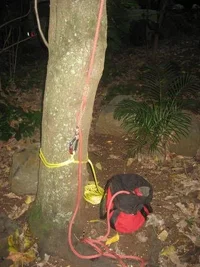
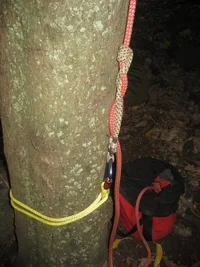
One more pic; works for SRT and to lower climbers easily and adjust slack quickly.

jp
grin.gif


[/ QUOTE ]

Looks pretty susceptible to dropping the climber if it's hit by a limb.
 
I would at least throw a slip knot behind the friction hitch to keep it from slipping in a shock load or when bumped by the limb (or someone walking by carrying a limb)
 
That's a good idea, especially for working off of SRT. I only use SRT for ascent and then switch to DdRT; I could see the merit of putting a stopper spiked with krab to prevent slipping especially for working off of.

jp
grin.gif
 
they are not exactly a must to me. When I was doing Fema work in texas and speed was a big big issue, I rapidly found myself losing a lot of gear. no pulleys, no rings, no tangling strings.

it all depends on the type of work environment your in. Pulleys and things are good for your body but they can slow you down a lot. Mentally as well.

Fro the most part it was a lot of up and down climbs for one or two broken or hangers.
I found the fastest way to aproach the tree was as follows.

throw line, do not isolate, pull line over, tie off to tree. Footlock single line, decend single line and boom.
 
I totally agree with you Kevin.When we did work in the ice storm it was usually the same,a couple limbs and back up the next.I was referring more to big trees you have to prune or remove.Alot of large Burs Oaks,Red oaks and Cottonwoods take up to several hours to prune so then they are great.Getiing hangers out of post oaks I would never bother installing anything frictionless.WE even used a long ladder and it was great.
 
absolutely if your are going to be Ddrt all day in a big tree, you need some kind of pulley. especially if you are hauling a saw around all day.
 
I have found it so much easier to climb with as little friction as possible. An afs works excellent when climbing on the spar for your tie in point. I find that I really don't change my tie in point all that often when doing removals I just slide the afs down the spar and it takes very little time. I have only been using the afs for about 6 months now and it seems to work better than the other method of trying to get the climbing rope tight around the wood. I will geerally use the leather cambium saver on the onset and switch over when I get to the wood.
 
I like that srt set up, throw a figure 8 above the knot will add friction and control in the case of a need to lower, and def a stopper not would be a must in my opinion, just in case.
 

New threads New posts

Kask Stihl NORTHEASTERN Arborists Wesspur TreeStuff.com Teufelberger Westminster X-Rigging Teufelberger
Back
Top Bottom