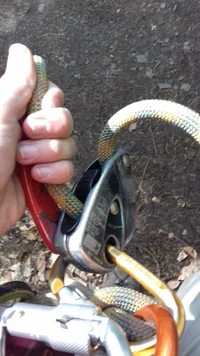
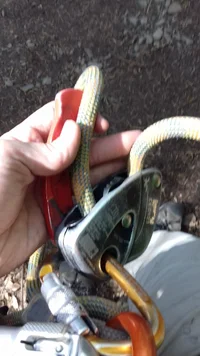
Rope bridge, finally. Now what knot?

[QUOTESo in your previous post below, how can each side of the bridge only experience 50% of the load? ][/QUOTE]
??
I think you are confused (sorry).
Here is a link to physics of picture frames - which is a 'close' analog of a harness rope bridge:
Link: https://www.physicsclassroom.com/class/vectors/Lesson-3/Equilibrium-and-Statics

I think what is happening is that you are fixated on "%" instead of 50/50 mirror loading.
Maybe you locked on to 50/50 as meaning something else?
What I meant by 50/50 is that both side terminations see identical loading (assuming focal/hang point is equidistant).

For a further conceptual exercise in physics, consider the following hypothetical problem...

Imagine that the harness side termination points are part of a rigid body support system (ie connected via a rigid beam). Imagine that attached to each side termination is a non stretching and mass-less wire rope. Load applied at the focal/hang point will transmit a resultant load to each wire rope support based on the included angle.
Lets assume a reference 100 kg load at the focal/hang point.
If the included angle is set at 90 degrees, the load transmitted to each wire support will be approximately 70 kg. This means 70 kg will be applied to each side of the rigid body support. That means 70 kg + 70 kg = 140 kg net force acting on the rigid support member.
So of that 140 kg net force, each side attachment point has 70 kg (in a 50/50 split).
Obviously, the human body isn't a rigid support member... but there is still force applied to each of your 'hips'.
 
  • Like
Reactions: evo
There won't be any issues with heat when using it for an adjustable bridge. Also, usually there is more heat with skinnier ropes, as there is not as much surface area to spread out the load and friction on. The issue you run into using larger diameter ropes is that you can't descend as easily and you can't take up slack well either. I wouldn't try ropes with smaller diameters than recommended without extensive testing though. I don't know why you think that it's only usable as a lanyard grab, it is perfectly useable as a primary descender as well, although it won't handle super long descents as well as an industrial descender or a grigri, just because it has a small cam. Devices with a negative spring (holding the cam open) are commonly used as primary multicenders, and are certified as such too, even when there is a springless alternative, similar to the safeguard. So even if the safeguard would allow slippage, which I don’t think it does, it is still perfectly useable.
I have descended on a Safeguard and I feel a whole lot more control with a bigger comparable lever controlled cam'd descender. The bigger the better, so when it comes to being suitable for descents, short or long, it feels like an overly downsized Grigri. As a multicender, it can work with or without a RAD's set up, but again, there's no comparison to more rugged and appropriate devices like the Rig or ID. Aside from a absolute emergency, I'd never use a Safeguard on any descent, with the exception of using it on a short lanyard as a rope grab. With the typically short lanyard lengths, like a bridge adjuster, I agree that there's not enough rope to cause that much friction, but getting back to the original topic, I'm still not understanding how the Safeguard can conveniently and efficiently connect onto a saddle bridge's solid D-ring or a fixed side plate, at least without a locking carabiner. On the Sequoia saddles the D's open up, but the Safeguard still doesn't sit as nicely as the RNL does behind a bridge's D's or side plate, at least from what I'm seeing so far. I'd prefer a non-adjustable rope bridge rather than all that unnecessary hardware. If I wanted to adjust the position of my multicender, I'd probably switch and use some sort of adjustable tether, or a double rope bridge, one with a shorter bridge and one with longer a bridge length, again saving the weight of all the added hardware.
 
Last edited:
Be advised, dangerous advice, abusive, condescending and/or patronizing remarks are subject to being reported to the site's administrator for further appropriate action.
Interesting comment - almost everything you have stated is incorrect.

Your latest line of argument is now with heat issues when using the Safeguard with ropes larger that 11.0mm diameter.
In the context of a rope bridge, this is non-sensical and irrelevant.

Also, you are also trying to play your legal hand of cards.
I would be pleased for you to cite court cases to back your legal point-of-view.
Not sure which legal jurisdiction you live and work in ?
If USA jurisdiction, please cite case numbers so I can check the facts.
 
Last edited:
I'm still not understanding how the Safeguard can conveniently and efficiently connect onto a saddle bridge's solid D-ring or a fixed side plate, at least without a locking carabiner. On the Sequoia saddles the D's open up, but the Safeguard still doesn't sit as nicely as the RNL does

John@TreeXP, nobody is forcing you to use a Safeguard.
It is my personal preference.

You don't have to like it.

In fact, you are welcome to hate it.

If you prefer to use a Roll N Lock device - you are perfectly entitled to do so.
Given your legal fears re violating some product warranty, did you check with the manufacturer of your harness to see if retro-fitting of a Roll N Lock would void your warranty?
Also, have you checked your local OHS laws if retro-fitting a non manufacturer supplied device into your PPE breaches any statutes or bylaws?
 
Interesting comment - I would say that you are falling on your own sword - and desperately seeking an escape route.
Almost everything you have stated is incorrect.
I would say that you don't like being challenged - and you feel cornered - and so you are retaliating in every way that you can.
Your latest line of argument is now with heat issues when using the Safeguard with ropes larger that 11.0mm diameter.
In the context of a rope bridge, this is non-sensical and irrelevant.

You are also trying to play your legal hand of cards.
I would be pleased for you to cite court cases to back your legal point-of-view.
Not sure which legal jurisdiction you live and work in ?
If USA jurisdiction, please cite case numbers so I can check the facts.
We're not on trial and what may work for you, may not work for everyone. I take exception to anyone who recommends anything contrary to any manufacturer's product guidelines, especially when lives may be at stake. We're not debating the wisdom or legalities in trying to push the envelope in this manner for one's own personal edification, regardless of the safety issues. If anything, I would encourage you to contact MadRock directly, advise them of your comments and see what their positions are in that regard. I'm sure we'd all love to see them chime in on this conversation and address your points, since their devices are geared for belaying climbers using dynamic ropes on a rock climbing wall much more so than being well suited for tree climbing, hence the reason why major tree gear distributors don't carry their product/s.

Again, I'm not objecting to you using any of your own gear in any way you may see fit, but promoting yourself as an authority on the matter, while ridiculing the opposition and attempting to justify your methods in defiance of any manufacturer's guidelines is a slippery slope.
 
Last edited:
take exception to anyone who recommends anything contrary to a manufacturer's product guidelines.
And I take exception to your exception!
I encounter this line of thinking almost every day - and it is a tired and dead-end argument.

but promoting yourself as an authority on the matter, while ridiculing the opposition and attempting to justify your methods in defiance of a manufacturer's guidelines is a slippery slope.
Its not so much of case of declaring oneself as an authority. Rather, it is challenging your mindset regarding product liability and the use of the Safeguard within a harness rope bridge (which is a closed circuit).
I would be willing to take you on in a head-to-head legal argument about manufactures and product liability in the context of height safety PPE.

Please tender your legal arguments so that I may consider them and reply.
 
Last edited:
  • Like
Reactions: evo
And I take exception to your exception!
I encounter this line of thinking almost every day - and it is a tired and dead-end argument.


And this is the real source of your irritation.
You see me as a threat to your own standing.
And you dont like it.

You are programmed to think this way - and this is something you need to learn to overcome.

I find it incredible that you can't admit that most of what you have stated is just plain wrong. I think you have a serious problem with being called out on all your errors and false statements.

I am calling you out - and I can see that you really don't have the depth and breadth of knowledge that you think you have.

As for the legal debate - I am an expert in this field. I am happy to declare myself a legal expert in law as it applies to height safety at a workplace. In fact, it is my full time occupation - giving legal and technical advice to many high profile companies.

I stand ready to take you on in a head-to-head legal argument about manufactures and product liability in the context of height safety PPE.

Please feel free to tender your legal arguments so that I may reply.
You just confirmed my point. Thank you. Lets move on, shall we?
 
... What I meant by 50/50 is that both side terminations see identical loading (assuming focal/hang point is equidistant)...

LOL! I am not confused, nor am I fixated on anything. I used your wording to phrase my questions. You used the words "50% of the load", in a manner that would calm fears. In truth though, a bridge termination could see substantial "net" load because the bridge will be flattened, adding force at the connection, and reducing focal point stability allowing non-equidistant loading.
 
In truth though, a bridge termination could see substantial "net" load because the bridge will be flattened,

Interesting comment...
My spider senses are tingling - and I feel another knowledge debate of 'who knows more than who' coming :)

Given the nominal weight of 1 human (ie the tree climber) - how must force do you believe could be transmitted to each side termination of a harness rope bridge?
And - related to this - is your remark "flattened".

Lets examine your use of the word "flattened" in detail.

Due to inherent stretch of both the rope bridge and the harness itself - it is never going to be 180 degrees (ie a perfect straight line).
Even if you did a thought experiment and employed a steel wire rope bridge - it still would never end up in a perfect 180 degree straight line.
What does this mean?
Real world loading profile on harness rope bridge will likely max out at approximately 150 degrees (included angle).
According to our friend Sir Isaac Newton, this would mean transmission of approximately 200 kg to each side termination (based on a reference load of 100 kg at the focal point).

With a little bouncing/jerking, we could see this spike to perhaps 250 kg - 300 kg.
Lets consider 300 kg as a possible worst case loading profile.
The question is; "Is 300 kg going to result in catastrophic failure of your PPE?

Depending on which standard you wish to cite, fall-arrest / work positioning harnesses are tested to 15kN (approx 1500kg) - at ventral/dorsal attachment points and 12kN at side mounted D rings. Given these harness design parameters, it is difficult to see a situation where 300 kg is going to cause lethal harm to a side termination or to an adjustment device (eg Safeguard).

Would you be able to show me some calculations where loading would approach the yield point of a side termination on a harness in the context of positioning in a tree?
I would also need to see the scenario context where a tree worker who is 'positioning' - could approach the yield point of the harness stitching/anchor points. Also, please show calculations for generating forces higher than 3kN to side terminations in work positioning context (and what rope bridge 'included angle' in necessary to yield such results).
 
Going by one climber's personal experience isn't my idea of a sound approach in a case like this.

Says' the internet climbing instructor.. Give us a freaking break guy.. maybe the homeowners & yuppies your "consulting" eat this up, but we ain't. Agent Smith's logic is beyond sound & if you haven't noticed, he may know a thing or two beyond the off the shelf attitude..

Just because TS ,Wesspur, etc don't carry something means absolutely squat.. but go ahead & worship them as your golden gear calf.. maybe they can stock some mics for you to drop..
 
@John@TreeXP I agree with you on the point of it not being a great option for a bridge because of mounting options.
On the point of mad rocks devices being for dynamic ropes and rock climbing, this is not true for the safeguard, it is made for static ropes from 8.1 to 11mm. But regarding other belay devices like the lifeguard and grigri, you just answered why the maximum diameters are what they are there, nkt because it's unsafe, but because it won't feed the rope well when belaying, especially when lead belaying.
 
I agree with you on the point of it not being a great option for a bridge because of mounting options.
Its simply an engineering issue... every tree climbing harness is different - just need to figure out best option for the type of harness system you own. Lots of different 'connectors' on the market.
Interestingly, Petzl sell an option to retro fit an adjustable rope bridge to their sequoia harness range.
Link: https://www.petzl.com/INT/en/Profes...nt-bridge-for-SEQUOIA-and-SEQUOIA-SRT-harness
What does this mean?
It means you can retro-fit an adjustable rope bridge system if you wish...
Petal will obviously want you to part with your money and exclusively use their product!
Again - nobody is suggesting that anyone has to use a 'Safeguard'... its a personal choice of what system best suits your needs.

you just answered why the maximum diameters are what they are there, nkt because it's unsafe, but because it won't feed the rope well when belaying, especially when lead belaying.
Fortunately, the application of belaying a lead climber has absolutely nothing to do with a harness rope bridge adjuster :)
Also, the Safeguard device is not intended to be used as a rock climbing belay device...!
 
Its simply an engineering issue... every tree climbing harness is different - just need to figure out best option for the type of harness system you own. Lots of different 'connectors' on the market.
Interestingly, Petzl sell an option to retro fit an adjustable rope bridge to their sequoia harness range.
Link: https://www.petzl.com/INT/en/Profes...nt-bridge-for-SEQUOIA-and-SEQUOIA-SRT-harness
What does this mean?
It means you can retro-fit an adjustable rope bridge system if you wish...
Petal will obviously want you to part with your money and exclusively use their product!
Again - nobody is suggesting that anyone has to use a 'Safeguard'... its a personal choice of what system best suits your needs.


Fortunately, the application of belaying a lead climber has absolutely nothing to do with a harness rope bridge adjuster :)
Also, the Safeguard device is not intended to be used as a rock climbing belay device...!
I know petzl has their own bridge, and I thought about getting it before I got my treemotion. I'm certainly not against using the safeguard as a bridge adjuster, I just personally would use it. I think it would be a much safer option than the rollnlock I just ordered...
Exactly my point that lead belaying has nothing to do with this, which is why rope diameter recommandations don't really matter much.
 
... I feel another knowledge debate of 'who knows more than who' coming :)...

I think not, LOL! I am just an old tree climber that thought a few points needed clarification. I read far too many scientific articles that make fact-based statements that can be misleading because not all the facts were presented. Your statement that each leg of the bridge will only see 50% of the load was an example of this as it left out many variables.

... it is never going to be 180 degrees (ie a perfect straight line)...

It does not need to be in order to reduce focal point stability. As you stated, any angle beyond 0% will introduce variable force vectors. That is a good thing to understand. Some are easily calculated, again as you have shown. However, in a fall, velocity and force vectors can change things and are not so easily calculated.

That, and to account for strength losses do to wear, is why our equipment is rated at a reduced percent of its tensile strength.
 
Its simply an engineering issue... every tree climbing harness is different - just need to figure out best option for the type of harness system you own. Lots of different 'connectors' on the market.
Interestingly, Petzl sell an option to retro fit an adjustable rope bridge to their sequoia harness range.
Link: https://www.petzl.com/INT/en/Profes...nt-bridge-for-SEQUOIA-and-SEQUOIA-SRT-harness
What does this mean?
It means you can retro-fit an adjustable rope bridge system if you wish...
Petal will obviously want you to part with your money and exclusively use their product!
Again - nobody is suggesting that anyone has to use a 'Safeguard'... its a personal choice of what system best suits your needs.


Fortunately, the application of belaying a lead climber has absolutely nothing to do with a harness rope bridge adjuster :)
Also, the Safeguard device is not intended to be used as a rock climbing belay device...!
Sadly that adjustable bridge addon attachment from Petzl isn't designed for their 2019 Sequoia saddles, just the earlier versions and many other brand's saddles. It is still usable on the 2019 Sequoia, but it adversely changes the way the bridge balances when loaded, because of the redesigned D's that now support a dual rope bridge.
 
What an i missing here.. i thought the Lifeguard was the sprung version.. Safeguard was no spring.. Hence, Safeguard being developed to be more in line with what work positioning requires..

What are you trying to say, that it would be better if there was a spring in there working to keep the cordage from passing through freely? As in, opposite design feature as the Lifeguard has? Like, spring causes cam to bite cord? As in how the spring works in the Art Positioner or typical rope grab fashion?

I have the Safeguard, I've since figured out how to work it smoothly, but it always requires two hands to do so when fully suspended. I think it's the short handle that makes it hard to feather smoothly..

No levered belay device is appropriate to run one-handed in full suspension, doesn’t matter how long or short the handle. We’re spoiled by hitches with the rope wrench or hitchhiker, you can do it one-handed in full suspension, but even then it’s wise to share the load with your belay hand, takes a little pressure off the hitch gives much smoother control if you’re on a longish more than 5 or 6 foot downward movement.
-AJ
 
per John@TreeXP:


I can confirm that the Safeguard will work with 11mm - 12.5mm diameter ropes!
I have abseiled many times with a Safeguard using Sterling half inch (12.5mm) HTP rope. No problem. I have also used 11mm ropes - no problem.
And, I have used 8.0mm Sterling high strength cord - no problem.

Part of my job is product testing and evaluation. I deliberately push the envelope with various gadgets to see how they perform. I have heard many times over the past year or so from people claiming that you cant use 12.5mm ropes with a Safeguard. As soon as I first heard this, I thought to myself... "Challenge accepted!"

I like being a mythbuster - and so I was pleased when the Safeguard worked just fine with 12.5mm diameter Sterling HTP rope :)

However, as per Richard Delaney's high impact force drop tests on 8.0mm diameter cord (using 100kg mass) - due to the instantaneous catch of the Safeguard, it severely damages the 8.0mm cord.
However, in the context of a rope bridge in a tree climbing harness, each side of the bridge only experiences 50% of the load. Also, most rope bridges would be using cord/rope greater than 8.0mm diameter.

I have a feeling that some don't realize that load on a rope bridge is spread 50/50 to each side termination on the harness. For example, if you were using a 'Safeguard' device as a rope bridge adjuster, it would only see 50/50 split of the shared load (based on included abgle created by rope bridge).

Also, in the context of work positioning (or just 'positioning'), you are not in free-fall - your PPE is supporting you under continuous tension. To generate the kind of impact force necessary to damage 8.0mm cord on a harness rope bridge, you would have to suffer a significant free-fall greater than FF 1.0. Again, only 50% of the impact force is transmitted through to the Safeguard.

I would further comment that I don't experience rope slippage/creep through a Safeguard device - this being due to the fact that it is springless (ie the spring has been removed). This distinguishes it from its sister product - the 'Lifeguard' (which has a spring and allows the rope to slip/creep).

Also, the Safeguard only weighs 154 grams. Yes, you could shout very loud and state that it weighs almost double that of a Roll N Lock (at 80 grams) - my comment would be that if 154 grams was a major concern - you have much bigger issues going on with your rig!

Great post Agent Smith, tree climbers are climbing work positioning, dynamic shock loads on the tree climber should never be happening. In the event of some massive climber screwup it could happen but that’s on the climber. I’ve had partial TIP blowouts on high base anchored systems, there was enough forgiveness in the tree parts flex and rope and that my “landings” were always soft. A tree climber would have to make multiple judgement/technical errors to cause significant dynamic loading on their climbing system.

I don’t think we can build protection from bad decisions into our climbing systems, I certainly don’t want to.
-AJ
 
No levered belay device is appropriate to run one-handed in full suspension, doesn’t matter how long or short the handle. We’re spoiled by hitches with the rope wrench or hitchhiker, you can do it one-handed in full suspension, but even then it’s wise to share the load with your belay hand, takes a little pressure off the hitch gives much smoother control if you’re on a longish more than 5 or 6 foot downward movement.
-AJ
While I agree, I must say that the Lory/Eddy family of devices are very controllable with one hand, and you can also descend by pressing the handle in from the open position. There's also the Lory Pro by Skylotec, which like the Safeguard is springless. One handed operation does go against the instructions of course, and I'm not saying you should do it. It's pretty easy to hold the tail in your hand with the lever though, like this:20190601_162537.webp
 

Attachments

  • 20190601_162541.webp
    20190601_162541.webp
    178 KB · Views: 2
While I agree, I must say that the Lory/Eddy family of devices are very controllable with one hand, and you can also descend by pressing the handle in from the open position. There's also the Lory Pro by Skylotec, which like the Safeguard is springless. One handed operation does go against the instructions of course, and I'm not saying you should do it. It's pretty easy to hold the tail in your hand with the lever though, like this:View attachment 62474
That's the device i actually had in mind when i posted that comment about the Safeguard's lever length & two hands.

You must really like that Eddy.. I can see you've put allot of use on it.. Definitely worth the purchase?
 
While I agree, I must say that the Lory/Eddy family of devices are very controllable with one hand, and you can also descend by pressing the handle in from the open position. There's also the Lory Pro by Skylotec, which like the Safeguard is springless. One handed operation does go against the instructions of course, and I'm not saying you should do it. It's pretty easy to hold the tail in your hand with the lever though, like this:View attachment 62474

Haha! Total trick! That works though you will burn your hand on a longer medium speed rappel, awesome for short moves.
-AJ
 

New threads New posts

Back
Top Bottom