
Navigation
Install the app
How to install the app on iOS
Follow along with the video below to see how to install our site as a web app on your home screen.
Note: This feature may not be available in some browsers.
More options
You are using an out of date browser. It may not display this or other websites correctly.
You should upgrade or use an alternative browser.
You should upgrade or use an alternative browser.
Rope bridge, finally. Now what knot?
- Thread starter samsquatch
- Start date


Interesting pick....I think I like some stretch in my bridge too. I never used dynamic rope tho. I've toyed with the idea of using a dynamic rope or at least a rope with more stretch like nylon does for topping trees to help absorb the shock when working with green groundies on the rope or whatever. Blocking down a stem etc....NER’s 10.5 mm Glider TPT, a dynamic, nylon rope, left over from another project.
Joeybagodonuts
Participating member
- Location
- Boondocks
Because the Safeguard isn't spring loaded, rope slides through when it's not weight loaded. If the Safeguard had a spring loaded cam that secured an unweighted rope, then it would be a great tree climbing tool. As a lanyard adjuster it's OK on DdRT, but when using a Safeguard on a lanyard in a SRT system for vertical descents, it's just way too jerky and fragile for my taste.
What an i missing here.. i thought the Lifeguard was the sprung version.. Safeguard was no spring.. Hence, Safeguard being developed to be more in line with what work positioning requires..
What are you trying to say, that it would be better if there was a spring in there working to keep the cordage from passing through freely? As in, opposite design feature as the Lifeguard has? Like, spring causes cam to bite cord? As in how the spring works in the Art Positioner or typical rope grab fashion?
I have the Safeguard, I've since figured out how to work it smoothly, but it always requires two hands to do so when fully suspended. I think it's the short handle that makes it hard to feather smoothly..

John@TreeXP
Branched out member
- Location
- Bainbridge Island
I have the two devices mixed up, so my earlier unedited post may be confusing the two. I'm referring to the (black, not red) Safeguard I suppose, but because the spring isn't bidirectional or provide proper tension to avoid rope slippage, like the Grigri, rope can slip through when unloaded. The new GriGri3+? may have resolved that issue. I have the same issue with the Safeguard's short handle additionally needing a strong breaking hand for technique and control.What an i missing here.. i thought the Lifeguard was the sprung version.. Safeguard was no spring.. Hence, Safeguard being developed to be more in line with what work positioning requires..
What are you trying to say, that it would be better if there was a spring in there working to keep the cordage from passing through freely? As in, opposite design feature as the Lifeguard has? Like, spring causes cam to bite cord? As in how the spring works in the Art Positioner or typical rope grab fashion?
I have the Safeguard, I've since figured out how to work it smoothly, but it always requires two hands to do so when fully suspended. I think it's the short handle that makes it hard to feather smoothly..
Last edited:
agent_smith
New member
- Location
- Townsville
per John@TreeXP:
The Safeguard is significantly smaller than a GriGri (all iterations of GriGri).
Also, the Safeguard is approximately the same size as a Roll N Lock.
The Safeguard is approximately the same size as the Roll N Lock (refer photo for proof of this). It's footprint is only slightly larger than a Roll N Lock.
Also, the Safeguard has an 'instantaneous catch' - in that it locks onto the rope immediately.
The Lifeguard allows rope slippage in its unloaded state. Same goes for all GriGri's - you will experience rope slippage/creep when the device is in its unloaded state.
In contrast, the Safeguard can be subject to cyclic loading (load off/on/off/on again) and there will be negligible rope slip. This makes it ideal for use as a personal adjustable lanyard (PAL) near an exposed edge (eg a cliff top).
The opposite applies...in that, the removal of the spring in the 'Safeguard' actually converts the device to an 'instantaneous catch'. There is negligible rope slippage/creep through an unloaded Safeguard.
The 'instantaneous catch' of the Safeguard does have it caveats. In severe drop tests with smaller diameter static 8mm cord, testing has shown that the instantaneous catch can result in sheath damage to the cord. However, these are drops at or above FF 1.0.
FF of this magnitude is highly unlikely to occur in work positioning contexts.
In terms of inducing a 'jerky' vertical descent - yes, this is possible. Practice comes to mind - that is, gaining familiarity with the device and how it performs with various rope diameters and types.
I would comment that it isn't meant to be used as a primary abseil descent device - that is not its intended purpose. Although it does of course allow abseil descents.
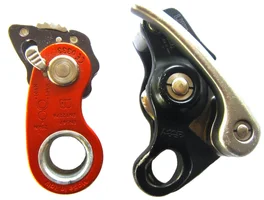
This statement is false.Comparing the Safeguard to a Grigri is a close approximation, although the Safeguard is only slightly smaller.
The Safeguard is significantly smaller than a GriGri (all iterations of GriGri).
Also, the Safeguard is approximately the same size as a Roll N Lock.
This is also false.Using a Safeguard to replace the RollNLock as a bridge adjuster may seem like a good idea, from a shock loading standpoint, but there are other drawbacks, including the added bulk of the Safeguard and the way rope can slide through the device when it's not properly loaded.
The Safeguard is approximately the same size as the Roll N Lock (refer photo for proof of this). It's footprint is only slightly larger than a Roll N Lock.
Also, the Safeguard has an 'instantaneous catch' - in that it locks onto the rope immediately.
The Lifeguard allows rope slippage in its unloaded state. Same goes for all GriGri's - you will experience rope slippage/creep when the device is in its unloaded state.
In contrast, the Safeguard can be subject to cyclic loading (load off/on/off/on again) and there will be negligible rope slip. This makes it ideal for use as a personal adjustable lanyard (PAL) near an exposed edge (eg a cliff top).
This statement is false - same as above.Because the Safeguard isn't spring loaded, rope slides through when it's not weight loaded.
The opposite applies...in that, the removal of the spring in the 'Safeguard' actually converts the device to an 'instantaneous catch'. There is negligible rope slippage/creep through an unloaded Safeguard.
The 'instantaneous catch' of the Safeguard does have it caveats. In severe drop tests with smaller diameter static 8mm cord, testing has shown that the instantaneous catch can result in sheath damage to the cord. However, these are drops at or above FF 1.0.
FF of this magnitude is highly unlikely to occur in work positioning contexts.
Safeguard isn't 'fragile' - that is false.but when using a Safeguard on a lanyard in a SRT system for vertical descents, it's just way too jerky and fragile for my taste.
In terms of inducing a 'jerky' vertical descent - yes, this is possible. Practice comes to mind - that is, gaining familiarity with the device and how it performs with various rope diameters and types.
I would comment that it isn't meant to be used as a primary abseil descent device - that is not its intended purpose. Although it does of course allow abseil descents.
John@TreeXP
Branched out member
- Location
- Bainbridge Island
It was never intended to do a lot of things, but that doesn't stop us from trying new stuff. If you prefer the Lifeguard or Safeguard as a bridge adjuster that's great. I'm not one to argue, but it's obvious that the weight of the Safeguard is more than the RNL, is fragile compared to a Petzl ID, and if you include a Grigri2 in your photo with a proper point of reference for size, and offer front and side facing views, you'll see how they all compare.per John@TreeXP:
This statement is false.
The Safeguard is significantly smaller than a GriGri (all iterations of GriGri).
Also, the Safeguard is approximately the same size as a Roll N Lock.
This is also false.
The Safeguard is approximately the same size as the Roll N Lock (refer photo for proof of this). It's footprint is only slightly larger than a Roll N Lock.
Also, the Safeguard has an 'instantaneous catch' - in that it locks onto the rope immediately.
The Lifeguard allows rope slippage in its unloaded state. Same goes for all GriGri's - you will experience rope slippage/creep when the device is in its unloaded state.
In contrast, the Safeguard can be subject to cyclic loading (load off/on/off/on again) and there will be negligible rope slip. This makes it ideal for use as a personal adjustable lanyard (PAL) near an exposed edge (eg a cliff top).
This statement is false - same as above.
The opposite applies...in that, the removal of the spring in the 'Safeguard' actually converts the device to an 'instantaneous catch'. There is negligible rope slippage/creep through an unloaded Safeguard.
The 'instantaneous catch' of the Safeguard does have it caveats. In severe drop tests with smaller diameter static 8mm cord, testing has shown that the instantaneous catch can result in sheath damage to the cord. However, these are drops at or above FF 1.0.
FF of this magnitude is highly unlikely to occur in work positioning contexts.
Safeguard isn't 'fragile' - that is false.
In terms of inducing a 'jerky' vertical descent - yes, this is possible. Practice comes to mind - that is, gaining familiarity with the device and how it performs with various rope diameters and types.
I would comment that it isn't meant to be used as a primary abseil descent device - that is not its intended purpose. Although it does of course allow abseil descents.
View attachment 62414
Last edited:
agent_smith
New member
- Location
- Townsville
Weight of Roll N Lock = 80 gramsI'm not one to argue, but it's obvious that the weight the Lifeguard is way more than the RNL, is fragile compared to a Petzl ID,
Weight of Safeguard = 154 grams
So yes, it is true to state that the Safeguard weighs more than a Roll N Lock.
But that is a different proposition from your original post.
I would comment that 154 grams is not significant (it isn't a show stopper).
You have now introduced the Petzl ID into your line of argument.
Curious?
You are now attempting to compare a heavy duty industrial abseil device against a much smaller 'Safeguard' belay device. Obviously a Petzl ID is more robust than a Safeguard. But many other devices are not what I would regard as 'heavy duty' industrial devices - and that doesn't imply they are not fit for their intended purpose. The ID is intended for rope access work - and the rope access industry is the target market. It can also be used in vertical rescue applications (but so can other devices eg The CT Sparrow 200R).
For example, I would not employ a Petzl ID into my harness rope bridge!
You should be comparing apples against apples...
?????and if you include a Grigri in your photo with a point of reference for size, like a quarter, you'll see how they all compare.
The Safeguard is significantly smaller than a GriGri!
Look at my previous photo - unless my eyes are deceiving me - a Safeguard is only slightly larger than a CT Roll N Lock.
I am holding a Roll N Lock and a Safeguard in my hand right now...(pause in typing)... the size difference is not significant. Yes - the Safeguard weighs more, but 154 grams is not a show stopper.
Try holding both in your hands at the same time - and compare (have you done this?).
John@TreeXP
Branched out member
- Location
- Bainbridge Island
OK, so we've digressed to insulting and belittling, but still the main point when comparing the two devices as a bridge adjuster, and for no other purpose, is that the RNL weighs almost half of the Safeguard and without further shock-load testing to prove whether one or the other is a safer option, we can only compare issues like ease of installation, compactness, performance, reliability, etc. Connecting one or the other device onto or into a D-ring is another important factor, so there is no perfect setup that works with all bridge styles on various saddles. Rope type and diameter used for a rope bridge also varies among climbers, but for the sake of argument, lets go with ropes in the 10-11.5 mm range.
Last edited:
agent_smith
New member
- Location
- Townsville
???OK, so we've digressed to insulting and belittling
There is no insulting.
You are confusing facts with false statements.
I would say you don't like being corrected, and so you view this as insulting?
All I am doing is pointing out facts. You may not like this?
You are coming back to weight as an argument.is that the RNL weighs almost half of the Lifeguard
I would comment that 154 grams is not significant.
Weight was not the issue in your original post - you have introduced this as a possible escape clause.
I would also comment that I am discussing the Safeguard, not the Lifeguard.
In the context of work positioning, a significant free-fall is very unlikely.Lifeguard and without further shock-load testing to prove whether one or the other is a safer option
Also, force on the Safeguard is spread 50/50 to either side of the harness bridge (force is divided between 2 points on harness...it isn't directed solely to one side).
To induce a free-fall with high FF, this implies something has catastrophically failed. Richard Delaney's high impact drop tests with Safeguard device on 8.0mm Sterling cord does induce significant sheath damage. Larger diameter cords would obvious fare better.
Yes; with larger diameter ropes, the issues of severe sheath damage largely disappear.but for the sake of argument, lets agree that most bridges will be in the 10-11.5mm range.
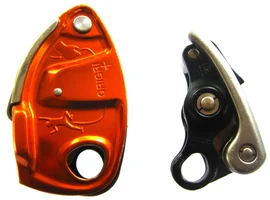
See attached image for comparison between 3rd generation GriGri (GriGri +) against Safeguard. You will see that a GriGri has a significantly larger footprint.
EDIT: images tidied up and sharpened for clarity.
Last edited:
John@TreeXP
Branched out member
- Location
- Bainbridge Island
When I open the grigri and the safeguard, the sizes of the cams are similar, but only slightly bigger and better (imho) on the Grigri. They both serve a similar purpose effectively, as they were designed to do. I don't have a Grigri3, but for my needs I'd rather own that than the Safeguard I have. We're no longer talking about bridge adjusters now, or are we?
agent_smith
New member
- Location
- Townsville
The title and conceptual background to this topic thread was a rope bridge in a tree climbing harness. It then progressed to an adjustable rope bridge versus a fixed (non adjustable) rope bridge. The Roll N Lock gadget was suggested as an ideal adjustment device.
I offered up an alternative gadget to the Roll N Lock.
I suggested a 'Safeguard' device.
The Safeguard allows adjustment in both directions even while under load.
The Safeguard is approximately the same size as a Roll N Lock.
In my personal opinion, a Safeguard is fit for purpose if employed in a tree climbing harness rope bridge. I also hold the view that the Safeguard is a better gadget in this particular application than the Roll N Lock.
Previously, you were suggesting that a Safeguard device is a lot bigger than a Roll N Lock and roughly the same size as a GriGri.
I corrected you on this point.
The Safeguard is approximately the same size as a Roll N Lock. A GriGri is significantly larger than a Safeguard (all iterations of GriGri's are larger than a Safeguard).
Specifically in terms of the cam size, I confirm that the overall cam size of a GriGri is almost twice as large compared to a Safeguard. And this is true for all iterations of GriGri's - in that their cam size is almost double that of the Safeguard.
So your comment re cam sizes is also false.
Are you actually holding a GriGri in your hand and comparing it to a Safeguard?
The Safeguard has the spring removed - so it provides an instantaneous lock. Not so with all iterations of GriGri. In any type of GriGri - rope can slip/creep through the device in the unloaded state. This makes them unsuitable as a travel restraint or positioning device - as cyclic slippage will cause you to fall over an exposed edge (ie if you were using a GriGri as a personal adjustable lanyard near an exposed edge). The Safeguard locks instantly - with negligible to zero rope slip/creep.
I would suggest that you compare a Grillon to a GriGri - notice any difference?
Most of what you have stated is actually incorrect.
The only comment that you have made that is correct is with regard to weight difference between a Roll N Lock and a Safeguard.
Although I would suggest that 154 grams is trivial. If 154 grams was an issue, I would say that you have bigger problems to contend with!
I offered up an alternative gadget to the Roll N Lock.
I suggested a 'Safeguard' device.
The Safeguard allows adjustment in both directions even while under load.
The Safeguard is approximately the same size as a Roll N Lock.
In my personal opinion, a Safeguard is fit for purpose if employed in a tree climbing harness rope bridge. I also hold the view that the Safeguard is a better gadget in this particular application than the Roll N Lock.
This is a different subject area.When I open the grigri and the safeguard, the sizes of the cams are similar, but only slightly bigger and better (imho) on the Grigri.
Previously, you were suggesting that a Safeguard device is a lot bigger than a Roll N Lock and roughly the same size as a GriGri.
I corrected you on this point.
The Safeguard is approximately the same size as a Roll N Lock. A GriGri is significantly larger than a Safeguard (all iterations of GriGri's are larger than a Safeguard).
Specifically in terms of the cam size, I confirm that the overall cam size of a GriGri is almost twice as large compared to a Safeguard. And this is true for all iterations of GriGri's - in that their cam size is almost double that of the Safeguard.
So your comment re cam sizes is also false.
Are you actually holding a GriGri in your hand and comparing it to a Safeguard?
Similar only in the sense that all of these types of mechanical designs are designed to lock to the rope hands-free.They both serve a similar purpose effectively, as they were designed to do.
The Safeguard has the spring removed - so it provides an instantaneous lock. Not so with all iterations of GriGri. In any type of GriGri - rope can slip/creep through the device in the unloaded state. This makes them unsuitable as a travel restraint or positioning device - as cyclic slippage will cause you to fall over an exposed edge (ie if you were using a GriGri as a personal adjustable lanyard near an exposed edge). The Safeguard locks instantly - with negligible to zero rope slip/creep.
I would suggest that you compare a Grillon to a GriGri - notice any difference?
You are jumping all over the place - and are not consistent with what your line of argument is.We're no longer talking about bridge adjusters now, or are we?
Most of what you have stated is actually incorrect.
The only comment that you have made that is correct is with regard to weight difference between a Roll N Lock and a Safeguard.
Although I would suggest that 154 grams is trivial. If 154 grams was an issue, I would say that you have bigger problems to contend with!
Last edited:
John@TreeXP
Branched out member
- Location
- Bainbridge Island
Unless your planning to rappel off your rope bridge, using a Safeguard as a bridge adjuster is a waste of hardware, subject to slippage, unduly bulky, overweight and lame, but go for it and good luck convincing anyone to follow suit. The unsubstantiated point that the Safeguard may not cause as much damage to a rope when shock loaded, compared to the RNL and when used as a bridge adjuster, may be the only possible positive aspect to using it. Again, we're being subjective and discussing personal preferences, not hardened facts.
Last edited:
Joeybagodonuts
Participating member
- Location
- Boondocks
"subject to slippage"
John.. you keep mentioning slippage.. I'm still not following where your getting this from.. With a Lifeguard, yes.. it will run until enough force is applied to it.. But the Safeguard, no, it locks right up the way it's supposed to.. that is unless your counting slippage as miniscule amounts movement when loading & unloading the device.. or a super heavy tail pulling slack through it when unweighted..(which i haven't experienced with this device yet, BUT HAVE experienced even with devices that have a positive spring setup helping to keep the cam/clamp closed.)
I think there's some confusion here as to what a spring is supposed to be doing.. there's positive & negative spring designs with these things & it all depends on what type of device you have that dictates which type of spring should or should not be used. In the case of the Lifeguard & Rock Climbing belay devices, I personally consider it a negative spring, where as it removes clamping force or holds cam open. Obviously as stated a few times already, in the case of the Safeguard, there is neither... & for good reason. I believe a "positive" spring would have adverse effects on this device
Also, i don't see AgentSmith citing personal preference nor insulting anyone by any means... he's mearly citing the obvious differences between devices & correcting some misconceptions.. regardless, if that in itself can be construed as lobbing "insults" , then we're in a world of trouble.
John@TreeXP
Branched out member
- Location
- Bainbridge Island
I have a Safeguard and the rope when unweighted can slide back and forth through the device. When intentionally loaded or shock loaded it holds the line, the same way the Grigri does. Perhaps the issue is how the device is designed without the tension spring used on the Lifeguard, which keeps the cam fully open when unweighted which makes it totally impractical for climbing, vs belaying when a shock load purposefully sets the device. The Safeguard, without the spring works like the Grigri and it closes automatically whenever there's tension, as it should. However, when unweighted, the device can still allow rope to slide in a bidirectional direction, which is a dangerous condition for climbers who may inadvertently unweighted their rope bridge and later discover an "unintentional" adjustment happened after making an earlier "intentional" size adjustment to the rope bridge. If the Safeguard had a spring in its cam going in the opposite direction than the Lifeguard, it might not allow the rope to slip and it would be a more reliable device, when used in this context.
Last edited:
A side note, the Lifeguard is designed to release quickly when unloaded so that the belayer can feed rope to the climber and not restrict their upward movement by short roping them.
I’ve used the Lifeguard as a primary multiscender on a stationary rope, it and the Smart 2.0 were able to lock onto the rope with only a short amount of tail rope, without having to pull down on it.
I’ve used the Lifeguard as a primary multiscender on a stationary rope, it and the Smart 2.0 were able to lock onto the rope with only a short amount of tail rope, without having to pull down on it.
John@TreeXP
Branched out member
- Location
- Bainbridge Island
If there were a reverse-spring, just strong enough to hold a bit more than the weight of an unloaded Safeguard on a slacked rope, I think it could resolve the slippage issue. I love the idea of a compact solid little device like a Safeguard that could work in this way, especially if it worked on 11mm-12.5mm ropes. It could effectively take on the out-of-production and well renowned Trango Cinch, arguably the best mechanical lanyard adjuster ever made. When it comes to using it as a rope-bridge adjuster, I'm still in favor of the RNL.
agent_smith
New member
- Location
- Townsville
per John@TreeXP:
I can confirm that the Safeguard will work with 11mm - 12.5mm diameter ropes!
I have abseiled many times with a Safeguard using Sterling half inch (12.5mm) HTP rope. No problem. I have also used 11mm ropes - no problem.
And, I have used 8.0mm Sterling high strength cord - no problem.
Part of my job is product testing and evaluation. I deliberately push the envelope with various gadgets to see how they perform. I have heard many times over the past year or so from people claiming that you cant use 12.5mm ropes with a Safeguard. As soon as I first heard this, I thought to myself... "Challenge accepted!"
I like being a mythbuster - and so I was pleased when the Safeguard worked just fine with 12.5mm diameter Sterling HTP rope
However, as per Richard Delaney's high impact force drop tests on 8.0mm diameter cord (using 100kg mass) - due to the instantaneous catch of the Safeguard, it severely damages the 8.0mm cord.
However, in the context of a rope bridge in a tree climbing harness, each side of the bridge only experiences 50% of the load. Also, most rope bridges would be using cord/rope greater than 8.0mm diameter.
I have a feeling that some don't realize that load on a rope bridge is spread 50/50 to each side termination on the harness. For example, if you were using a 'Safeguard' device as a rope bridge adjuster, it would only see 50/50 split of the shared load (based on included abgle created by rope bridge).
Also, in the context of work positioning (or just 'positioning'), you are not in free-fall - your PPE is supporting you under continuous tension. To generate the kind of impact force necessary to damage 8.0mm cord on a harness rope bridge, you would have to suffer a significant free-fall greater than FF 1.0. Again, only 50% of the impact force is transmitted through to the Safeguard.
I would further comment that I don't experience rope slippage/creep through a Safeguard device - this being due to the fact that it is springless (ie the spring has been removed). This distinguishes it from its sister product - the 'Lifeguard' (which has a spring and allows the rope to slip/creep).
Also, the Safeguard only weighs 154 grams. Yes, you could shout very loud and state that it weighs almost double that of a Roll N Lock (at 80 grams) - my comment would be that if 154 grams was a major concern - you have much bigger issues going on with your rig!
I love the idea of a compact solid little device like a Safeguard that could work in this way, especially if it worked on 11mm-12.5mm ropes.
I can confirm that the Safeguard will work with 11mm - 12.5mm diameter ropes!
I have abseiled many times with a Safeguard using Sterling half inch (12.5mm) HTP rope. No problem. I have also used 11mm ropes - no problem.
And, I have used 8.0mm Sterling high strength cord - no problem.
Part of my job is product testing and evaluation. I deliberately push the envelope with various gadgets to see how they perform. I have heard many times over the past year or so from people claiming that you cant use 12.5mm ropes with a Safeguard. As soon as I first heard this, I thought to myself... "Challenge accepted!"
I like being a mythbuster - and so I was pleased when the Safeguard worked just fine with 12.5mm diameter Sterling HTP rope
However, as per Richard Delaney's high impact force drop tests on 8.0mm diameter cord (using 100kg mass) - due to the instantaneous catch of the Safeguard, it severely damages the 8.0mm cord.
However, in the context of a rope bridge in a tree climbing harness, each side of the bridge only experiences 50% of the load. Also, most rope bridges would be using cord/rope greater than 8.0mm diameter.
I have a feeling that some don't realize that load on a rope bridge is spread 50/50 to each side termination on the harness. For example, if you were using a 'Safeguard' device as a rope bridge adjuster, it would only see 50/50 split of the shared load (based on included abgle created by rope bridge).
Also, in the context of work positioning (or just 'positioning'), you are not in free-fall - your PPE is supporting you under continuous tension. To generate the kind of impact force necessary to damage 8.0mm cord on a harness rope bridge, you would have to suffer a significant free-fall greater than FF 1.0. Again, only 50% of the impact force is transmitted through to the Safeguard.
I would further comment that I don't experience rope slippage/creep through a Safeguard device - this being due to the fact that it is springless (ie the spring has been removed). This distinguishes it from its sister product - the 'Lifeguard' (which has a spring and allows the rope to slip/creep).
Also, the Safeguard only weighs 154 grams. Yes, you could shout very loud and state that it weighs almost double that of a Roll N Lock (at 80 grams) - my comment would be that if 154 grams was a major concern - you have much bigger issues going on with your rig!
Last edited:

... I have a feeling that some don't realize that load on a rope bridge is spread 50/50 to each side termination on the harness...
Is it? When loaded, the bridge on a harness is in a basket configuration and the two legs are not parallel.
agent_smith
New member
- Location
- Townsville
Not 50% of the total load at the focal point!Is it? When loaded, the bridge on a harness is in a basket configuration and the two legs are not parallel.
Its split 50/50 between each side termination.
The actual force measured at each side termination will be dictated by the included angle.
But whatever that included angle is, the load will then transmit to each side termination in a 50/50 split.
The point being, one side termination does not take all of the load by itself...it is shared between each side of the rope bridge.
New threads New posts
-
test
-
 Alternatives to standard asphalt around roots
- Started by southsoundtree
- Replies: 5
-
-

-

-
 For Sale: 2018 Vermeer BC1000XL Chipper | 918 Run Hours | Deutz Diesel
- Started by Blue Ribbon Tree
- Replies: 2
-

