Rigging Tip Failure

Why the second rigging point? Particularly causing lateral torsion on an included bark union.
Unless there was a reason otherwise, just rig it normally and maybe cut slightly higher... redirect at the base if necessary. The tree appeared to have fine twigs so it couldn't be all THAT dead.
 
The tree they took the top out of was sure strong enough. Not only did it hold the top but for a while it held the failed lead too!
 
Stupid, stupid, stupid.

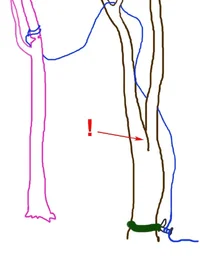
This is what I got from the video.

I think I'm close.
376755-stupidRigging.jpg
 

Attachments

  • 376755-stupidRigging.webp
    376755-stupidRigging.webp
    20.5 KB · Views: 20
My mind goes to, what would work? (Even though I wouldn’t go big like that.)

Xman, in your drawing (as it looks close to the vid to me) , if I put an XRR a couple of feet higher in the right most spar and an XRR hanging just under the middle natural crotch and a third (three ring) XRR hanging just under the left top to be taken, wouldn’t you expect that to be a totally doable set up?

Any possibility of you showing an unedited portion of your multiple redirect car lowering vid? Doesn't that perfectly illustrate what could work?
 
[ QUOTE ]
I wonder how many wraps he put on the portawrap

[/ QUOTE ]

Looks like 3 during the aftermath. The groundie had either added on or taken one off by then, so my guess is 4... two wouldn't have been enough..
 
[ QUOTE ]

I agree natural rigging was a factor

[/ QUOTE ]

Given that the failure occurred after the piece had stopped, I wonder if using blocks would have allowed enough lift during the recoil to prevent failure. Using natural crotch there is no way to lift a heavy piece, so there was no give back after the piece stops ...

ps.. thanks X for the diagram, I didn't realize it was all natural crotch til taking another look..

[ QUOTE ]
To me its amazing how much the small things add up into a monstrous failure. Who's to say one small thing changed and there isn't success.

[/ QUOTE ]

That' a point I've been making around here for years.. You throw everything possible to your favor... knots, rigging points, lacing, rope dynamics, no slop in the sling etc... make it all work for you on the light stuff, so you have it down when you need it....
 
You don't need to be a pro tree worker to see why that was going to go wrong, I reckon if an engineer (or anyone who was practically minded) had a look at the setup prior to them making the cut he would've said, 'bad idea', due to the excessive friction, excessive forces, excessive weight, poor rigging anchor point

Everything about it was wrong.

.
 
Yeah, that was one of my exact thoughts too.

I posted a response several days ago on youtube and the poster has let it stay posted thus far. I tried to be as nice as I could in order that they might leave it posted.

glad to see it is still up:

"I hope all of you figured out WHY that happened. Just in case you didn't, here is a quick list of what I see happend, in the order of importance: 1) Picked a rigging point on a spar that had a tight V-crotch attachment (these are weak), 2) If you HAD to use that spar(which should be avoided), it could have been backed up to another lower rigging point to strengthen that weak crotch. 3) natural crotch rigged: no block or rigging rings where used to allow rope to run well and use the whole rope for stretch. 4) ground person did not let piece run to remove the shock load. 5) The piece was big (but if proper rigging set up, it could have been done safely and still taken that size. 6) After the break was over, the piece was still, if the groundperson held fast and didn't let the rope move, the bucket operator could have put on more ropes and kept the spar from falling on the truck.
Posted here in case it gets deleted.

Merle, yeah, if a piece needed to be lowered that big, it could be done several safe ways for sure.

No, I can't put up the car video yet, it would take too much time. If I had time I should spend it on updating the XtremeArborist site on the XRR's. (way overdue and lacking the new adjustables and the beast rings, STILL).

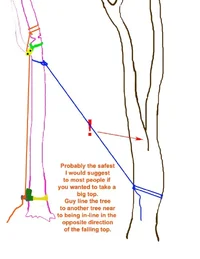
Did some quick sketches of this though.

Here is what I would recommend to the masses if they felt they needed to take a big top like that.

376961-stupidRiggingNotStupid.jpg
 

Attachments

  • 376961-stupidRiggingNotStupid.webp
    376961-stupidRiggingNotStupid.webp
    33.4 KB · Views: 27
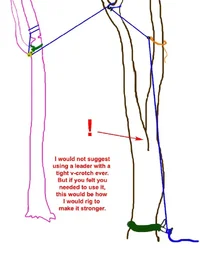
if you have a situation where you feel you have to use a weak leader, this would help that weak leader if done right.
376962-stupidRiggingLittleBetter.jpg
 

Attachments

  • 376962-stupidRiggingLittleBetter.webp
    376962-stupidRiggingLittleBetter.webp
    33 KB · Views: 13
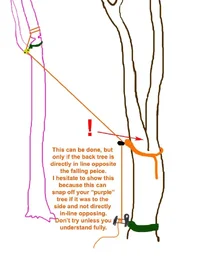
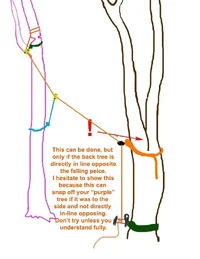
I hesitate to show this one attached here, because you can snap off your rigging tree by doing it wrong.

Doing it right, all IN-Line, you can help your rigging tree remain strong. But doing it out of line, you can make it very dangerous.

Forget this sketch if I'm not explaining it well.
 

Attachments

  • 376964-stupidRiggingUsingBackTreeInline.webp
    376964-stupidRiggingUsingBackTreeInline.webp
    36.2 KB · Views: 90
[ QUOTE ]
I hesitate to show this one attached here, because you can snap off your rigging tree by doing it wrong.

Doing it right, all IN-Line, you can help your rigging tree remain strong. But doing it out of line, you can make it very dangerous.

Forget this sketch if I'm not explaining it well.

[/ QUOTE ]

We have done this before. Like you said only if it is in line. Made the upper rigging point significantly stronger. Almost like setting up a backyard crane.
 
Nice summary! Great to see what others are thinking. Can't help, but feel that this Tree Company would benefit by participating and learning more options.

What about adding a second redirect onto the removal tree ? This would shift some of the loading to the tree they were taking down. Something like this picture.
 

Attachments

  • 376981-376964-stupidRiggingUsingBackTreeInline-B2.webp
    376981-376964-stupidRiggingUsingBackTreeInline-B2.webp
    36.3 KB · Views: 75
Back
Top Bottom