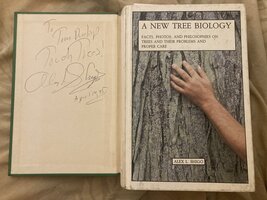
Oh it just dawned on me when I picked it up. The fact that late wood is often darker and denser fibers, due to increased defense chemicals, that and reaction woods. I just thought that was common knowledge. Wood impregnated with defenses looks different.
I’d love to hear more about it, if Daniel knows something too secret.
I’m sure most all of us have come across a hollowed out log, where the branch ‘spikes’ look like an Iron Maiden. Around here one can pick these out of old decayed deadfall where all else has turned to dust, or find them all over on a beach.
great sharing..
Tom doesn't get it... what I have to say about discolration is that Shigo mistakenly used it as a measure to indicate proper pruning. Shigo believed that a perfect target cut would create less discoloration than either a flusher cut, or a stub cut. But neither he nor anyone else has followed through to the only measure that really counts in suburban arboriculture, which is tree failure.
That's very short sited as discoloration and decay account for only one factor in structural stability. The other major factor is how the new wood forms post pruning or post branch drying to stabilize the trunk. Here we run into one of many scenarios where science is not well suited to the task of providing guidance, because of the length of time involved in these processes and the difficulty in measuring outcomes, etc.
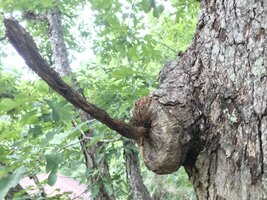
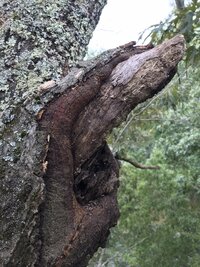
Fortunately we have common sense and logic which can provide some excellent insight where science is lacking... Just look some old gnarly trees in the woods and you'll find without question that trees have the ability to shed large limbs and maintain their structural stability without the need of target cut. And look at the structure of the new wood that grows around a large dry stub.... The way the new wood grows out and around the stub creates a very strong structure even as there is decay going on internally, even added decay from the "Sugar stick".
Also leaving a live stub allows the tree a choice of growing new sprouts from latent buds or dyingoff the limb. In the latter case, the tree has time to prepare and set up chemical defenses before while there is a physical barrier between the wood decaying organisms and the main stem.
And last but certainly not least, while those target cuts shown in the text books look so pretty, in the real world them targets ain't so easy to determine... So why take a chance on violating the BPZ when you can leave a stub, wait a few years, or more, until the tree has developed an obvious collar of new wood around an obvious dry stub and then go back and make the cut when it's so clear that even a shirtless toothless uneducated tree climber can't fuck it up.