Question about felling technique

The simple answer is that you are making things hard on yourself, and if you did experience some kickback while doing this, it could get sketchy. Why not just learn how to properly make a Humboldt, then put it into practice. Problem solved.
Always make your horizontal cut first, setting your lay, then pivot off your dawgs, pull your bar out and flow right into the angled portion of your undercut. When done properly it is a fluid thing of beauty. Watch some vids of pro fallers on YouTube to see how it’s done.

Hey go ahead and learn to cut a proper humboldt if you think you'll need it...

I was simply looking for ways to avoid holding my 23lb (661 + 114DL b/c) saw upside down after a long day climbing while trying to make one cut align on both sides of the tree one half of which was out of view. I had a light bulb moment, I tried it out, I saw a relative concern, brought it to attention here. If we were handing out stars like my daughter's K class, I'd get one for that.

On the flip, I do appreciate the discussions, because someone who doesn't know heads from tails will get to read about the ups & downs of our trials; and we're all fortunate to know that's what makes this place most valuable.

#topbarhumboldtFTWlol

edit: took out some ill-mannered comments ;)
 
Last edited:
its a 20lb saw approx. peanuts really, 660 is my main saw for ground work. you get used to the weight and enjoy fast cutting high performance.
Goll dang it why are there so many know it alls around here?
ms661 powerhead: 16.3lbs; 114DL .063 E Super bar: 5.05lbs; 114DL .063 chain = 2.075lbs
= 23.something lbs dude.
Why is everyone on here so hellbent to go after one another. Don't ya all listen to Bob Marley's music every once in a while?
 
Curious: in what situations would you use the three different notches? Are they only dependent on when you want the hinge to separate or do you find other uses for each notch?
Cheers[/QUOTE
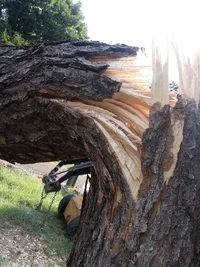
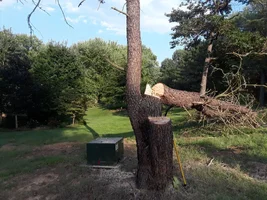
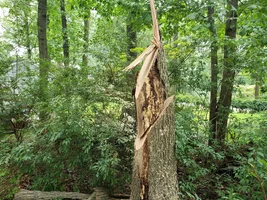
Not sure where your at in your cutting ability, so just know that you really shouldn't try this cut until your pretty proficient at notching and back cuts. I used this cut today and thought of this thread because I use this notch in certain situations, it's called a triple hinge. It allows for you to get a little more directional pull out of your hinge when you need to steer your tree. This lead on the tree had trunk lean and limb weight right over a welcome sign next to the driveway. The sign was in concrete so there was no way to move it. The notch did close but not until the top hit the ground keeping some of the hinge fibers from breaking loose, which was also beneficial as it kept the butt from jumping off of the high stump and possibly hitting the electrical junction box.

The holding fibers also help with landing the top a lot softer than normal. It ended up out in the street a little with no damage to the blacktop. Infact after cutting the top free the hinge wood lifted the trunk a little, showing that it not only held the brakes as the tree went down, but also held some of the weight up off of the blacktop.

Just another tool to have when for when it is needed.
 

Attachments

  • 20180918_165906.webp
    20180918_165906.webp
    723.4 KB · Views: 42
  • 20180918_165841.webp
    20180918_165841.webp
    851.5 KB · Views: 42
I used this cut today and thought of this thread because I use this notch in certain situations, it's called a triple hinge. It allows for you to get a little more directional pull out of your hinge when you need to steer your tree.
Thanks for sharing. I have watched a couple videos on the triple hinge but never tried it myself.
 
And try not to read into things so much! We say what we can when we can how we can in the time we can afford.
Just tryin to help so relax
Understood. Do you remember Thumper the rabbit? "If you can't say something nice, don't say nothing at all" Words to live & grow old by, I'll say.
 
Goll dang it why are there so many know it alls around here?
ms661 powerhead: 16.3lbs; 114DL .063 E Super bar: 5.05lbs; 114DL .063 chain = 2.075lbs
= 23.something lbs dude.
Why is everyone on here so hellbent to go after one another. Don't ya all listen to Bob Marley's music every once in a while?
I want to see those numbers in metric damnit! Cant be right unless it's in freakin metric, the imperial system is a conspiracy against the working man.
 
This.

Put your outside dawg back in OP.


I was simply looking for ways to avoid holding my 23lb (661 + 114DL b/c) saw upside down after a long day climbing while trying to make one cut align on both sides of the tree one half of which was out of view. I had a light bulb moment, I tried it out, I saw a relative concern, brought it to attention here. If we were handing out stars like my daughter's K class, I'd get one for that.

On the flip, I do appreciate the discussions, because someone who doesn't know heads from tails will get to read about the ups & downs of our trials; and we're all fortunate to know that's what makes this place most valuable.

#topbarhumboldtFTWlol

edit: took out some ill-mannered comments ;)

#BigDogsFullWrapFTW

I have one 1/2 wrap MS 261 and one 1/2 wrap husky 576xp bought off Treebay.

Full wraps make saws sooo much more functional and ergonomic.
Can't say I like the large husky dogs too much. I've run 100% stihl is mid to large saws, aside from this saw, which I've had in service a short while. I might not be used to the geometry. Seems like the husky dogs don't pivot for transitioning from horizontal to humboldt-sloping cut, as well as the Stihl.

I have cut a hecka lotta root-disease trees. High-face cuts often give stronger hinges, so we got good at high faces. Humboldts are way easier when cutting up high. Dog pivot geometry is important.

Being able to bump an MS660/ 36" off your leg up head-high against the trunk saves a lot of lifting. Wiggling into position between stationary chain and dogs, pivoting back to get the chain running, and then pivoting into the horizontal, then the sloping cut was routine. The saw is too heavy to lift and position. Dogs are critical in some situations.

Yes, recommendation are to not cut that high. Recommendation are not fell dead trees amongst lots of other dead trees, or climb dead trees, or...


I cut two trees today at 6- 6 1/2' to shorten them up to just squeek in short of the oaks trees the homeowners' son planted, 15 years ago. Slapped a branch. I saw an oak branch move and was worried I had torn a branch. No sign of damage.
 
Understood. Do you remember Thumper the rabbit? "If you can't say something nice, don't say nothing at all" Words to live & grow old by, I'll say.
You come on here and ask a question that shows you are fairly green. As usual you get a few helpful answers, and a few not so helpful ones. Now your undies are in a bunch? WTF.

Go learn the proper mechanics from a Real Timber Faller. Get Douglas Dent's books on the subject (you will thank me later). This is an arborist website, and probably not the best place to learn proper cutting skills. No offense, but some of the stumpies around here would/do make a pro faller cringe.


IMG_0427.webp
 
Last edited:
I was simply looking for ways to avoid holding my 23lb (661 + 114DL b/c) saw upside down after a long day climbing while trying to make one cut align on both sides of the tree one half of which was out of view. ;)

That's valid, and worth talking about and has led to some variety of viewpoints getting shared which is cool!

If you are looking to avoid holding the saw upside down the simplest way to do that is to ditch the Humboldt... Cutting an open face is 10x easier, though probably I just need to learn to pivot the saw properly.. the west coast guys make it look easy...

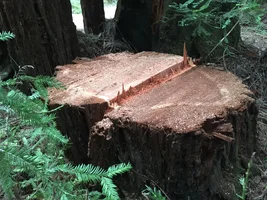
I was surprised to hear Sean say he thought it was easier to cut a humboldt at head height.. I guess that makes sense, never really thought about it as an option before.. I cut high notches A LOT too... Sometimes to get above decay, but mostly to shorten up the drop. If the object is to shorten the drop, then the humboldt is not recommended. Humboldt leads to earlier separation and more jump off the stump...

Nice wide open face keeps the tree on the stump as long as possible.... as seen on that hemlock notch earlier in this thread... That tree was getting dropped across a sidewalk with no pull line... There were two padding logs on either side of the sidewalk so there wasn't much chance of sidewalk getting damaged, but I like to use everything to my advantage
 
Please correct me if I’m wrong Daniel, but that looks like a fairly fucked up, double take on the old slice-cut? Any youngster who grew up working in the woods would have learned it at an early age. A very useful tool for clearing hung up trees, or getting upright leaders or tops to fall straight down when needed.
Or maybe you really are a child prodigy, idiot savant at the stump, and it went right over my head?
 
Last edited:
  • Like
Reactions: evo

I published this video demonstrating said technique with the staggered vertical plunge cut in Sept 18, 2010, some 8 years and a day ago. I believe that was the first time any version of it was published other than the following two sentences found on page on page 169 of "Fundanmentals of general tree work, by Gerry Beranek "The diagonal cut is used exclusively when keeping the cuts level with gravity in the leaning parts of the tree. The diagonal cut is sometimes called the salami cut when used for the purposes of getting the cuts to slide apart."

You may have grown up working in the woods and more power to you for it, BUT a lot if us didn't.. I had to figure that cut out for myself... (necessity is the mother of invention and all)... But a lot of other people didn't have to because they saw it done on YouTube in the above video first...

SO you can go on making out like its just second nature, but you're not dealing with loggers here.. Go find that thread from 2010 where I introduced this cut and you'll see that there was almost universal outrage that I was some reckless maniac trying to kill myself with this dangerous cut.

I first used this cut in 1989 and had used it many hundreds of times before making the video... Since then I have published several other videos demonstrating the technique as have others who learned it from me.


Last edited:

I published this video demonstrating said technique with the staggered vertical plunge cut in Sept 18, 2010, some 8 years and a day ago. I believe that was the first time any version of it was published other than the following two sentences found on page on page 169 of "Fundanmentals of general tree work, by Gerry Beranek "The diagonal cut is used exclusively when keeping the cuts level with gravity in the leaning parts of the tree. The diagonal cut is sometimes called the salami cut when used for the purposes of getting the cuts to slide apart."

You may have grown up working in the woods and more power to you for it, BUT a lot if us didn't.. I had to figure that cut out for myself... (necessity is the mother of invention and all)... But a lot of other people didn't have to because they saw it done on YouTube in the above video first...

SO you can go on making out like its just second nature, but you're not dealing with loggers here.. Go find that thread from 2010 where I introduced this cut and you'll see that there was almost universal outrage that I was some reckless maniac trying to kill myself with this dangerous cut.
Good for you sweetheart, good for you. Nuttin revolutionary here Daniel..
 

New threads New posts

Back
Top Bottom