One Handing a Top Handle Chain Saw? Yes or No

Private Tree Ordinances, good, bad, or ugly?

  • Good for the trees but a pain for me

    Votes: 0 0.0%

  • Total voters
    13
Like my brudda Prime Ape I've asked the same question...and gotten the same reply. Getting cut with a chainsaw, running or not, is a conversion experience.

Why isn't being cut with a handsaw the same conversion experience? I know more people who have been cut bad with Japanese-style pull saws than I do being cut with chainsaws. Loosing some blood isn't the biggest concern. Whacking tendons leads to long term/life time injury.

The memory of my conversion experience is still vivid. No, it wasn't after being cut. It was when my friend and mentor Gary Albig said to me, 'You make a lot of one-handed cuts, don't you?' That's all he said...no lecture. I knew Gary well enough to know that what he didn't say was more important than what he said. I took some time to think...and then turned to him with a smile and told him that I got what he was saying...end of one-handing.

Touch wood...my sawdust filled noggin...I've only been cut by a non-running saw when it slid off the ATV rack and snagged the back of my calf. Off to get 6 stitches! Bad meat cut.
 
Gerry: One day I will be half as smart as you. Always good advice.

Tom,

I hope my post didn't portrait me as a 1 handing maniac. Really I'm not. To tell you truth 80% of the time when I'm using a saw in the tree it is a rear handled saw. I'm certainly not manly enough to pull 1 handing off with one of those. Certainly if you are rigging there really isn't an excuse to 1 hand. If there is a 6" stub that I can easily handle then yeah it's going to get 1 handed.

I do get what you are saying though Tom. Don't worry you're smart like Gerry too.
 
There is clearly a reason "top handled" saws were enginered, designed and built to be so perfectly balanced while holding them with your "one" right hand- BECAUSE THEY WERE ORIGINALLY DESIGED TO BE OPERATED WITH YOUR ONE RIGHT HAND! Regardless of what any new publication, manual, or literature states- that is what they were purpose built for. It was assumed that the professionals they were designed for would be able to understand their dangers and risk and act accordingly (ie: when due to the situation the risk of one handed operation was too great- use two hands!) Do we really need to be continually babysat by the latest ANSI standard or the OSHA roundtable, or are we capable and highly skilled professionals that know how to safely do our job- situation dependent!
 
A point I haven't seen mentioned is the ergonomics of using a top handled saw with one hand. Sure it might be balanced to be held in your hand, but what about the strain on the shoulders and elbows when you are lifting an 8lbs saw above your head and or away from you at full extension to avoid the hazard of cutting yourself and your ropes?
Personally work positioning and using the right tool for the job makes more sense to me.
Our job is physically demanding and there are enough repetitive motion injuries we deal with as climbers without compounding them with a bad work practice.
 
Wheel,

Could you back up what you're saying? Have you had talks with the design teams from the saw manufacturers?

The first saw that I ever used was a Mac6...a real power house for its day!
 
Let's delve into when one handing a top handle trimsaw makes sense?

You're in a decurrent multi leader tree with a prime high midpoint tie in. You venture out onto a separate upright leader and need to butt hang and lower the heavy terminal head, and rig accordingly with your lowering line, ok?

Now what do you think is going to happen once you make that final release cut in terms of your TIP support?

It's going to change quickly putting lots of slack into your lifeline for a few seconds until the load settles. How will you maintain your balance and positioned stance without using one hand on that lifeline to compensate for the sudden slackening and tightening as the load goes dynamic?

Believe it or not, I've gone to the extreme of standing on one gaff, then putting my knee and shin against the leader to make dang sure I move as one with that leader when the load catches it.

I've had lots of east coast climbers get real pale in the face when they see their first skinny giant eucs out west. There are true giants in the bay area of SF that reach 200 feet in the Palo Alto region. Some of the most challenging removals in the world there without a crane.

I submit that there are valid practical reasons for one handing a trimsaw in certain dynamic removal situations that require your other hand on your lifeline to maintain balance and stance at your work station. Without it gravity would put you under the leader you're rigging off, and lanyarded onto.

I've even kept my trimsaw running in one hand during dynamic rigging rides specifically for the purpose of cutting my own lanyard if the leader I'm rigging off splits or fails below me when I have an independent TIP elsewhere in the tree.

And I seriously doubt I'm the only climber who does the stuff I've described.

Just an old fool's opinion of course!

jomoco
 
J...i didn't even take the time to read your whole reply. This has been hashed out before.

There are very rare and controlled times for one-handing. Read Z133, the exception is clear and spelled out. Thank Don Blair for looking out for West Coast interests.

Part of the exception is to make sure that the climber is well protected...lanyard...second attachment...let ground crew know what is going on, then, most importantly...listen to them, if they say that it can be done safer...do it differently.

Too often the climbers who rationalize the 'safety' of one-handing seem to bee the ones who use the chainsaw like a power machete and slash.

Carry on
 
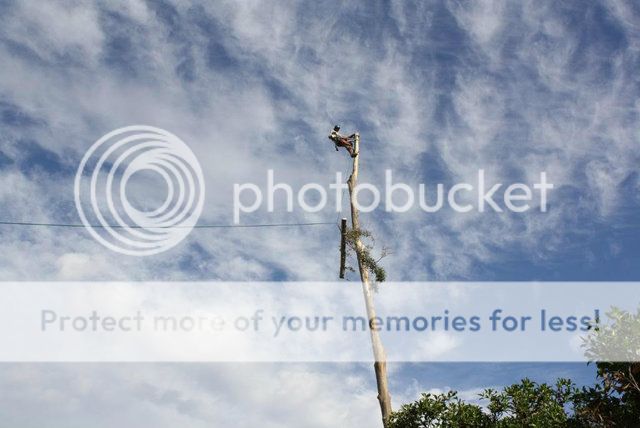
Do you mind my posting a pic of the foul deed old friend?

OneHanding.jpg


jomoco
 
I think when they engineered the top handle saw, the effort was put on getting the handles closer together to help with the leverage problem when your hands get above your waist. Seriously don't think the intent was to balance the saw such that it could be used with one hand. All opinion of course, I would love to have a conversation with the engineer.

Everyone that gets themselves off the ground and operates a saw should really focus on position and cutting practices. What it sounds like most of the time is that when one hand is used, you are doing something scary. My solution for a dead limb that must be chucked over a house - break cut. My solution for taking a cut that I know is going to rock the tree, cut through some, put the saw down and get the hand saw on it. Last thing in the world I want with crazy motion of the tree with my finger on the throttle of the saw in one hand. When you grab that thing with the top handle and make a one handed cut, you palm must be on the throttle safety and the index finger will likely be on the throttle. Body response to O sh@# is a closing of the hand. What happens to the saw when your hand closes? Why does law enforcement and every body else that trains with guns insist that your finger isn't on the trigger?

Then there is that whole wear and tear issue on your body. Your body, your choice.
 
I have spent time with the engineers and you are exactly right. By placing the handles closer together it gives you more strength when making a reaching cut aloft. Therefore more control. I use the same cuuting techniques as you do in those situations. I also will place my notch on a stem, bore cut to set up the hinge leaving a back strap, then put the chainsaw away before releasing with the handsaw. Plenty of time to stow the handsaw and brace for the ride, if there is one.
Oh yeah, Tom, I'm pretty sure that the Don Blair exception was declined in the Z 133 2006 version. Are you saying he won out this go around for the 2012 version?
 
Unless I'm mistaken there is always the exception that states following the guidelines is required unless the employer can show that following the guideline puts the employee at greater risk.

The definition of 'employer' has been clarified to mean an owner or supervisor.
 
I just realized that most of my onehanders are reaches to do the final cut on twigs. Twigs that have to be (IMHO) cut off that I can't easily reach to make the final cut in the correct angle. Usually have done the first part of the trick with the hand saw and make the final 'complementary' cut with a full throttle surgical precision onehander.
At that moment I am happy that my hands and arms are not slender and sleek. ;-)
 
[ QUOTE ]


There are very rare and controlled times for one-handing. Read Z133, the exception is clear and spelled out. Thank Don Blair for looking out for West Coast interests.

Part of the exception is to make sure that the climber is well protected...lanyard...second attachment...let ground crew know what is going on, then, most importantly...listen to them, if they say that it can be done safer...do it differently.


[/ QUOTE ]

Tom, where exactly in the Z is there an exception to allow one handing?
 
Making a nasty rip cut on a small whipping twig that gets stuck between the teeth of the Zubat Tom. C'mon , don't tell me you don't ever use your chainsaw for that purpose. I don't keep a secateurs on my body, so when a precision tool is needed, what better to use than a light and gentile touch of a 100 foot per second running chain.

Think of it. You don't necessary need to use that machine for brute force only. Or is that just me being a relic from the tree surgeons era knowing how to use the chainsaws sweet spot.
 
the push for TWO HAND USE at ALL TIMES is an attempt to prevent more accidents to general workers. The push has been quite successful, as many pro's even believe it.

I think one hand has it's place in certain situations and I definitely do it a few times a day.


It's just like the push to convince people that the coating on wires is just weather proofing and not insulation. Well, if it wasn't insulation, then they would not braid all three wires in a loop drop to a house. They would not run primaries, called tree wire over limbs and touching limbs if it was not insulation. If it wasn't insulation, it would be blasting sparks.

But, if we tell the tree guys, it's weather proofing, and never trust it to insulate, then it will save lives.

Same with saying NEVER ONE HAND A CHAINSAW, EVER. It will save more lives and injuries saying that, than saying it is okay sometimes. The few people that get hurt using two hands, just because of the teaching; will be very few.

Me, I don't lie, I don't think I manipulate no matter the possible outcome, i say it how I see it.

One handing is okay if you use it correctly and you are strong enough.

Actually, even if you were weak, you could still one hand in a few situations and the loss of control would not result in an injury.
 
Why does an image of a trigger controlled chainbrake keep buggin me?

Seems like that one doable feature would prevent accidental trimsaw injuries far more effectively than a telephone book of regulations.

Saw's running, you've got electricity to engage or disengage magnetic servos.

Are we in the 21st century yet guys and gals?

jomoco
 
It's already done man. Well.... in the bigger saws.

We have two Stihl 441's with a second brake on the trigger.

I love them for crane work with big wood.

You have to concentrate at first to let go of the top trigger to stop the chain quick after the cut at first.

once you master using it, it is super safe.

the cost was around $100 more for the option if i remember correctly

also great cutting on the chipper tray, etc.
 

New threads New posts

Back
Top Bottom