New Technique for weight reduction of Hazard Tree

Re: New Technique for Hazard Tree Removal.

[ QUOTE ]
It would take a little math but working out the numbers for determining the green weight and then the weight when it has reached equilibrium you'd find that it isn't too large.

I've milled and dried lumber. It takes a LONG time to dry lumber. Wood in the log takes forever. The intercellular water takes a while to move out. The intercellular water doesn't move very fast.

Good thought, but not really practical. Take smaller pieces and use larger rigging gear.

[/ QUOTE ]

In attempt to put a <u>rough</u> number to 'standing' drying time: I have an artist friend, who buys green rounds for his wood sculpture. He seals the cut ends and waits a minimum of five (5) years before the wood is dry enough to work without checking. Some species take even longer. So, Tom nailed it ... takes forever ... or longer.
 
Re: New Technique for Hazard Tree Removal.

Few more points for consideration.

ISA Arborist Certification Study Guide. Have a look at pgs 4 and 5.

Arboriculture Integrated manaagement of landscape Tree, Shrubs, and Vinees Richard W. harris, Regents/Prentice Hall
Pg 22,23 more deail

http://en.wikipedia.org/wiki/Wood_drying.
How drying can be adverse and how it can maintain strength and how it can add stregnth.

A New Tree Biology Alex L.Shigo Shigo and Tree Associates
Chapter 16
Heartwood is not involved with active transport for the tree.

Last point. A tree in essence is a candle. The wick being transporting Xylem, and the flame being transpiration/respiration and the fuel being water.
Leaves, twig and branches will continue to loose water and if the source of the water is impeded, the drying will increase.
How much?
We all have opinions on this based on our own experiences the point is collectively we can gather the information, analize the data and conclude that there is more experimenting and fact gathering to do.
 
Re: New Technique for Hazard Tree Removal.

[ QUOTE ]
....the point is collectively we can gather the information, analize the data....

[/ QUOTE ]

Well, somebody is stubborn. :)

I don't believe anybody here that has responded, does not understand the biological reactions of removing water from the living cells of trees.

What the collective responses are pointing out is the structural and strength repercussions of dry/dead vs live/wet wood. Yes, one is lighter than the other. But your purpose for doing this, as stated, is to increase safety. On an average, not only is this not going to happen, the premise is not true.

Dry and brittle is not safer. There are many other ways to reduce the weight and compensate for structural weaknesses in a tree.

Dave
 
Re: New Technique for Hazard Tree Removal.

[/ QUOTE ]

Dry and brittle is not safer. There are many other ways to reduce the weight and compensate for structural weaknesses in a tree.

Dave

[/ QUOTE ]

I concur...
 
Re: New Technique for Hazard Tree Removal.

Dry and brittle is a qualitative observation/opinion. Dry does not make brittle. Peanutbutter brittle my favorite sweet is not dry.
laugh.gif

We have many different opinions here. Mine is stubborn!
The are many varialbles to consider. If I am gathering nuts on said tree am I doubley nuts.
crazy.gif

Are there other techniques to reduce weight of a tree/leader/limb to be safe for a climber to work in? A Tree with limited or no access for use with a crane or mewp?
Guying, Shoring, are two anyone with something else to contribute? Is there another way.

What we have said so far is;
1. A tree will not loose enough water weight to warrant the technique.
2. A tree will become dry and brittle with the proposed technique and be to dangerous.
3. A tree will lose some weight and be safer.
Stubborn guy says Yes.
smirk.gif

Please consider all the facts. Apply them how you will.

Two points to reiterate; a droughted tree dies from the top down. Proof there is less water weight at what was the weighted levers ends of a limb/leader/tree.

The quantitative answers with regards to wood strength has been researched. We use dry timbers for construction, Hydro pole etc.
Dry wood can be stronger or weaker. It varies. The truth is most times it is stronger.
So why is this concept/technique or change in perception important. Because I say it is.
grin.gif

Change challenges and we have an inherent tendency to resist change to conserve energy or stay alive or maintain status quo..
We've always done it this way, our daddy and his daddy did it that way and at some point something presents itself and challenges us to rethink. We did it our way!
shocked.gif

[ QUOTE ]


[/ QUOTE ]

Dry and brittle is not safer. There are many other ways to reduce the weight and compensate for structural weaknesses in a tree.

Dave

[/ QUOTE ]

I concur...

[/ QUOTE ]
parry.gif
pirate.gif
 
Re: New Technique for Hazard Tree Removal.

Okay yes we use dried wood for structural purposes, but these are trees we're talking about so we need to think about whats below ground too. What made this a hazard tree to begin with? What was the condition of the root system before and what will the effects of this technique be?

I'm not discouraging your idea, but we do need to look at the whole hypothetical tree.
 
Re: New Technique for Hazard Tree Removal.

there is a difference between thinking outside the box and thinking outside the igloo. Go shoot the horse , it's food . Hungry will eat . If this isn't the dumbest thing i ever took the time to read than this is the dumbest thing I ever replied to. The only hazard here was reading this whole thread . OMG &lt; WTF I'll leave religion out of it .... I'm going back to snow plowing ........hazard snow plowing , with my new technique, sunshine , over forty degrees . don't tell anyone!
 
Re: New Technique for Hazard Tree Removal.

I came up with an amazing solution, remove deciduous trees in the dormant season. You save on all the weight of the leaf matter and still have flexible green wood to work with! Best of both worlds really.
 
Re: New Technique for Hazard Tree Removal.

[ QUOTE ]
there is a difference between thinking outside the box and thinking outside the igloo. Go shoot the horse , it's food . Hungry will eat . If this isn't the dumbest thing i ever took the time to read than this is the dumbest thing I ever replied to. The only hazard here was reading this whole thread .

[/ QUOTE ]

I concur.
9lame.gif
 
Re: New Technique for Hazard Tree Removal.

I learned from an Arborist in the UK.
"Wood gains strength as it dries. Oak up to 50%. In a controlled Kiln dry process." A potential of 50%!
That in its self is worth further discussion.
Next time we have to climb a hazard tree and prune or remove with the knowledge you potential increased the wood strength and reduced the weight at the levers end, add to the validity of a new practice.
Here is an opportunity to create a safer tree with a new technique.
I think we can make this technique work with some basic research.
Things we need to know
1. how slow or fast can we reduce weight and drying
2. the depth and length of the tissue/xylem removal
3. species considerations
4. season
etc.
 
Re: New Technique for Hazard Tree Removal.

[ QUOTE ]
I learned from an Arborist in the UK.
"Wood gains strength as it dries. Oak up to 50%. In a controlled Kiln dry process." A potential of 50%!
That in its self is worth further discussion.


[/ QUOTE ]

I think thats going to be refering to the structural strength of a piece of wood/timber.

Very different to the structural integrity of a complete tree in situ.
 
Re: New Technique for Hazard Tree Removal.

Can you imagine.
We will just bag that tree up and apply some drying fans and will be back in few weeks to dismantle.
$ for Kiln and $ money for pre dried lumber.
too funny
laugh.gif

[ QUOTE ]
Where are you going to find a kiln big enough to put an entire standing tree in?

[/ QUOTE ]
 
Re: New Technique for Hazard Tree Removal.

If I may add, the structural integrity of hazardous tree in situ.
[ QUOTE ]
[ QUOTE ]
I learned from an Arborist in the UK.
"Wood gains strength as it dries. Oak up to 50%. In a controlled Kiln dry process." A potential of 50%!
That in its self is worth further discussion.


[/ QUOTE ]

I think thats going to be refering to the structural strength of a piece of wood/timber.

Very different to the structural integrity of a complete tree in situ.

[/ QUOTE ]
 
Re: New Technique for Hazard Tree Removal.

Water Oak no I'm not sure, White, Red, Black or Bur for sure
Rock Elm, Poplar how would they compare.

Yeah its a good point.
Whats with Poplar its a soft wood but needs predrilling to take a nail.
Soft is much better for spurin.
beerchug.gif

[ QUOTE ]
Have you ever tried to get a spike in a dead water oak? Or any oak??

[/ QUOTE ]
 
Re: New Technique for Hazard Tree Removal.

If you were going to attempt a whole-tree drying process vacuum drying would seem better than blowing air on it.

There is sooo much difference between wood and lumber. Girdling limbs or the tree to attempt a weight reduction would work. Along the way there are processes that change strength and flexibility that would make removal a much more complicated process.

I've never done a dead removal that I didn't wish was alive. Dead wood is quirky and responds to the forces of removal in undependable ways. Live wood is much more predictable.

RS...have you done girdling then removal? Give it a shot, let us know what you think. Find a codominant or two sided tree. Gridle one side and leave the other. Then compare the process. How would you quantify the differences?
 
Re: New Technique for Hazard Tree Removal.

The new technique does not have to be a complicated process it can be a compliment to or part of the Remove/Prune plan to to dry/reduce weight of the levers end of the limbs and add to the strength of said limbs for working in or rigging on.

3 years ago was my first large girdled Norway(5 hour removal)
The homeowner did a chain saw girdle about 2" deep into the wood. I do not know exactly how much time occurred between the girdle and the removal. Maybe a few weeks
The tree was still in leaf, no wilting the day of the removal.
Typical muliple leader with incuded bark and plenty of decay. Supporting ropes on my TIP had to be installed and another rope installed to support the tree.
The majority of the pieces cut had to be roped or handled because of communication cables, fence, sheds and landscaping.
I clearly remember the wood and limbs being lighter. Alot lighter? Not really. But enough to notice.
My crew also commented on the weight being less. The reomoval went well and the rot in the main crotches was at the wet rot stage, can't remember exactly how much but I think close to 3o% or more.

Please if I may share my dead wood experience.
5 yers experience has occurred on fence lines along the Trans Canada Trail and road side Veteran planted Sugars. The trees along an old rail line and road side are some of the worst I have ever worked in. Soils are poor in every way imaginable from the developement from both sides.
Crown structure is poor. Trees lean more with no structural pruning combined with trying to find sun light out from the row of trees.
Many of these trees being removed where dead or dying. They would survive to about 40 or 80 years and consisted primarily fast growing species Elm, Maple, Scots Pine Poplar etc. I learned early on I could trust dead/dry wood to be stronger than green wood if rot is not present.

I will continue to be cautious with this technique with the added knowledge gained here and from others.
I will also do my best to observe and document my findings for all to benefit.
Greatly appreciate your reply and thoughfullnes.
 
Re: New Technique for Hazard Tree Removal.

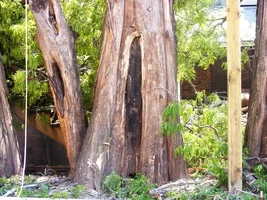
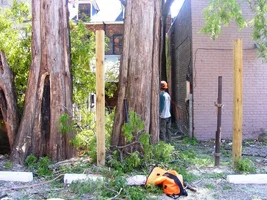
Here are some picks of the most dangerous tree removed by me and 3 really good men. For the record I brought them to the job a week in advance for some mental preparation and one man said there was no way we could or should do it.

The Trees were removed from downtown Hamilton between multistorey brown stones. Full set of infrasture lines on one side of the tree and bulding on the other side a small tight landing zone with about a dozen parking spots for the ground works.

Tree had rot from top to bottom and needed careful and thorough inspection to determine tie in points for life and rig.

The job was completed on time with damage only to a trailer dolly handle.
It was fairly dry tree during a dry spell in mid summer and afforded me greater confidence..
Robinia pseudoacacia Black Locust
 

Attachments

  • 265968-simonkick009-Copy.webp
    265968-simonkick009-Copy.webp
    161.7 KB · Views: 88

New threads New posts

Back
Top Bottom