New Technique for weight reduction of Hazard Tree

Re: New Technique for Hazard Tree Removal.

There are other conditions that could lead to tree wood being lighter. Drought is the most obvious. Without before/after moisture content testing of the trees/limbs its likely that there isn't really a weight difference.

There could be a lightening...but, I wonder, how much?

How would we go about measuring the weight difference? Since those of us in the northern hemisphere are in the middle of winter this would be an ideal time to gather some samples to measure weight loss.
 
Re: New Technique for Hazard Tree Removal.

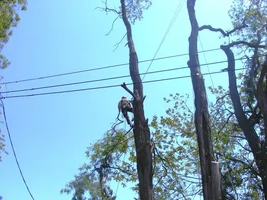
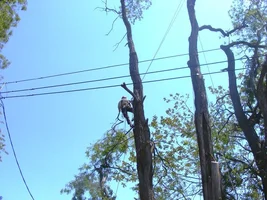
You can see the amount of decay and dead wood in thes trees.
Dryer and lighter from my experience has worked to my advantage.
Knock on Wood!
wink.gif
 

Attachments

  • 265973-simonkick012-Copy.webp
    265973-simonkick012-Copy.webp
    105.4 KB · Views: 92
Re: New Technique for Hazard Tree Removal.

Thanks for humoring me. This thread and your "outside the box" technique has given me a good laugh this morning.
 
Re: New Technique for Hazard Tree Removal.

Yes so many variables and considerations.
Tip of the ice berg and the last thing we want to happen is some one being injured because of a lack of research including me.

Dormant versus Full Leaf.
Species ability to acclimate. Reduced respirations and Photosynthesis
Funny how during a drought I tree will dry up more quickly when it is over cast and temps are high then in full sun.

I am running a biz and supporting another right now.
I am at my limits of what is manageable.
Is there some one you could suggest who is best to take this to the next level?
 
Re: New Technique for Hazard Tree Removal.

I do believe I took some of those pics! and I remember that job what a that was!
 
Re: New Technique for Hazard Tree Removal.

Knockin them down was the easy part.Eh!
The stumpin was insane, 4 foot underdig the ailanthus away from the building, atleast we were in the shade of building.
Adolan, thanks for soldiering on with that one.

[ QUOTE ]
I do believe I took some of those pics! and I remember that job what a that was!

[/ QUOTE ]
 
Re: New Technique for Hazard Tree Removal.

Instead of the traditional rig point of natural or false crotch up in the tree and with the friction control device at the base.
We can place the lowering device on the piece to be rigged and anchor tie up in the tree and pulley/redirect at the base of the tree.
What you have created is Rigging Srt and vertical speed line.
The forces at the anchor are single line load rather than the typical double line load.
 
Re: New Technique for Hazard Tree Removal.

[ QUOTE ]
[ QUOTE ]
Wow! No poison ivy, that's great!

I learned something.

[/ QUOTE ]

Well, we have poison ivy, but is more like a broad leaf grass, it doesn't really grow over 6" but it does cover the ground.

[/ QUOTE ]

Watch the braod brush when painting. I've seen PI climb 12-15 feet in woodlots in Halton and Peel Region. Granted they are Carolynian Zones, but you hardly care about that when you're praying to God you contracted it after you took a leak in the chips.
 
Re: New Technique for Hazard Tree Removal.

Ropeshield is the new Daniel I think.

zbanghead.gif


Thanks for posting the pictures of your most hazardous tree removal ever, those pictures told me a lot.

can't believe this thread is still alive

Mangos, good job trying to change it to a poison ivy discussion.

Sorry ropeshield, but as someone smart said earlier, it's fine to think outside the box on a new idea, but when you discover it's not a good idea, let it go, don't try to make it work when it won't.
 
Re: New Technique for Hazard Tree Removal.

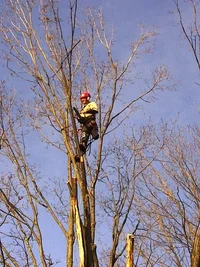
Here is another picture example.
As long as there is little to no rot, I am comfortable working in dead/dry trees.
smile.gif
 

Attachments

  • 267930-DnD.webp
    267930-DnD.webp
    131.5 KB · Views: 82
Re: New Technique for Hazard Tree Removal.

I've often times imagined how effective it would be to remove a standing tree with the use of fire. I imagine the basis for success would be how large of pieces fell off as it burned.

Maybe ill start a thread on it. Its the epitomy of safety, you don't even need to wear chaps. Just bring marshmallows.
 
SAFELY EFFECIENTLY EFFECTIVELY WITHOUT FEAR
Why are you here?
Because you are serious about learning more and there are questions in need of answers.
The TRUTH’s
1. DEATH and serious injury is a reality in our industry.
2. The WISE Investigate, gather data and experiment before concluding.
3. CONSULTATION with experts in Engineering, Bio-mechanics, Physicists, Plant scientists is crucial for full comprehension in a subject that involves tree workers lives.
4. Time is limited. Decay progresses thus increasing to hazard potential
5. Time is valuable.
6. Flexibility does not ensure strength. Wet wood versus Dry(er) wood.
7. Wood will gain strength as it dries.
8. The strength of wood can be compromised when it dries too quickly.
9. Decay organisms are affected by moisture. Decay Organisms dormancy/vigor is reduced with a decrease in moisture.
10. Trees/limbs are material conducting living levers. Greater moisture/weight at the levers end of hazard tree/limb can increase hazard potential of said limb
11. Water in a trees system can be reduced with the strategic removal of water conducting Xylem
The Problem(s)
As a trainer and Arborist, I have learned about one problem that every single serious Arborist faces and this problem will definitively help you, or break you from accomplishing your goals!
Our problem is to confidently know what a given tree or limb is capable of supporting.
Supporting the working weight of the climber including the working weight of the rigging.

What can a limb support? Green versus dry(er).
A new technique that when strategically applied can accomplish both Weight reduction and a net gain in structural strength.

We are trying to solve a problem for all climbing arborists! The problem is with knowing what to expect from trees. We can put a man on the moon yet the life of arborists is consistently being sacrificed.
Specifically with hazardous trees and the forces we apply to them.

Example:
A highly Skilled, Knowledgeable and Athletic Arborist is in charge of the removal or dismantling of parts or of the whole tree.

In the process of dismantling a tree with incorporation and application of all the most up to date equipment and practices present today, the tree fails at or below the rigging point and the climber is seriously wounded or KIA.
It has happened and continues to happen.

Please, thoughtfully consider your system. Now step back in time and consider situations where you or a colleague has been injured or killed. Now imagine the same scenario with an increase in structural strength and loss of weight from a compliment technique added to the system.
Preventable?

I really look forward to your feedback!

[ QUOTE ]
Stem trace or Girdle limbs, leaders or root flare to a few mm beyond the cambium. Removal of atleast a few rings for efficacy.
Depending on species up to 20 rings will translocate H20. The more effecient rings closest to the cambium and less so progressing further into the heart wood.
Girdling technique creates a gap for the movement of H2O thus reducing the water weight of the tree/limb.

Green log weight and dead wood weight differs enough to warrant the effort?
Less load on rigging gear, crane, ropes, rigging or tie in point etc.
Any unanticipated draw back to this practice?

Is this a viable option for future consideration?
Should this be researched?

[/ QUOTE ]
 

New threads New posts

Back
Top Bottom