Loading the tree

[ QUOTE ]
[ QUOTE ]
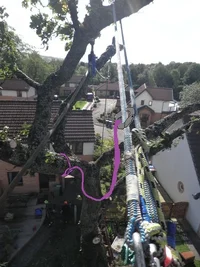
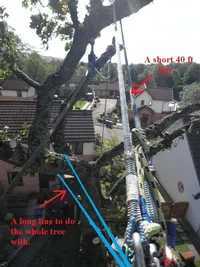
I nearly always use two blocks when rigging a tree down - not only to help dissipate the forces throughout the crown but it also gives you more options for lowering.

Lower a few branches down one side then switch to the other end of the rigging line a lower a few branches down the other side of the tree. This way your not putting too much pressure on one side of the root plate....your keeping the tree almost perfecty balanced as the crown is dismantled.

If I'm keeping the loads light I'll just re-direct through a suitable natural crotch instead of a 3rd pulley.

[image.../image]
[image.../image]

[/ QUOTE ]
this technique sounds like it has the potential to cause cofusion for the groundie and kinda complicate what looks to be normal removal. i've found keeping the work simple makes for a smoother and more efficient job. use the more complicated techniques where it's needed.

[/ QUOTE ]
Gotta agree with Grover ... really like the post, pix, & technique. This is a perfect solution if it's necessary to keep balanced to prevent failure at the root plate. I remember one unfortunate root plate failure on a multi-stemmed maple, when one stem was dropped completely and the remaining coppice went severely unbalanced -- not good.

Conversely, I have deliberately unbalanced a large oak, recently, to give sufficient head-lean to the lay. Sure, keep it simple if at all possible but if it needs to get complicated -- so be it. Whatever works for the job.
 
I usually use multiple rigging points in order to space out the debris so ground personnel can more effectively keep up. If it all comes down in one spot, at a pretty good rate, it's easy to swamp them. If you take out a piece or two, then switch to another rigging point, you can make it easier on them. Especially if you're taking out big pieces that require working up before moving.

I tend to worry less about balance and root failure, though in certain instances, I'm sure those would be reasonable concerns.
 
Not to get off the point of multiple blocks to keep the loads under control(which I think is good when given the oportunity), but in the photo I notice your Tie in point is on the same limb as the block and it is above the block, which I think you need to address.
OTHERWISE EXECELLENT JOB!!!
 
sometimes the best rigging point and best (highest) tie in point are the same place.

If they are, and YES, sometimes they really have to be (as I pointed out to TCIA and they put in the rigging manual) then you better rig light and right.

Saying you can NEVER tie into and rig from the same leader is naive and impractical.
 
not the best picture to use, but i took his picture and drew this on it.

This is showing too much drop potential and another problem, but it shows the idea that I do sometimes.

If i feel i need to tie above and into the same limb with the rigging point, sometimes I will add a long loop runner or series of loop runners that attach to a lower thicker diameter and clip that to one side of my climbing line.

It needs to be long enough not to restrict your horizontal movement through the tree though, or else you are defeating your high tie in point.

Idea is, if groundperson breaks out the rigging point which is also your tie in point, you have a second tie in point that will catch.

I wouldn't want to ever test it out though. ;)

308565-307210-rigger1backup.jpg
 

Attachments

  • 308565-307210-rigger1backup.webp
    308565-307210-rigger1backup.webp
    85.3 KB · Views: 54
now, the problem is, with that exact picture, if that top broke out, it would not likely flip out of your upper tie in point; it would likely yank you and the falling top and you would meet.

my above example would work best when you are tied into a skinny thin top, say a silver maple top or a tulip tree top after a topping. Where if it broke out, the top would flip around and slip out of your climbing line.

If you are tied into what is shown in the picture and for some reason worried about it breaking out (which I would not in the case shown unless there was a huge defect in it) then this is an idea I've had that would work better I think:

308571-307210-rigger1BetterBackup.jpg


Now, the upper climbing line is short, but long enough to allow you to go out on the upper limbs and get around.

Now, say the top gets broken out while rigging...

You gotta scramble and grab ahold of that prussic to release it! The falling top will pull the rope through the prussic and likely you'll burn your hand, but the rope will end soon and you will be free of the falling top. (make sure no stopper knot in the end of your short line of course).

I've set this up like this on really decayed trees where I was worried they may break off at the ground. I tied into a tall stable tree, but the stable tree was far away and I needed another climbing line in the rotten tree to work in the rotten tree. In my mind the whole time is: if this thing starts to go, I'm grabbing that prussic and letting that thing go without me and get my feet ready for impacting the good tree when I swing back to it.

I guess i would not have to deal with these things if I just walked away from certain trees. Walking away is a good sure safe way to do it, I just haven't seen one yet.
 

Attachments

  • 308571-307210-rigger1BetterBackup.webp
    308571-307210-rigger1BetterBackup.webp
    91.9 KB · Views: 22
That actually happened to a climber I know.. it's a wild story.. he was ready for it. Had a byunch of slack ion the line and let his friction hitch out fast enough... Also agreed that it is often the case to tie in above the lowering anchor point.. no biggie 99.9% of the time.
 
Me too.. I had 4 blocks set across 2 trees in a removal just before Christmas.. came down and asked the new guy how he liked the "rigging clinic".. When the bucket runs out of stick, I'd rather take big pieces than jump out, whenever possible (which is almsost all the time).. It wouldn't be safe without multiple blocks or rigging points..
 
[ QUOTE ]
now, the problem is, with that exact picture, if that top broke out, it would not likely flip out of your upper tie in point; it would likely yank you and the falling top and you would meet.

my above example would work best when you are tied into a skinny thin top, say a silver maple top or a tulip tree top after a topping. Where if it broke out, the top would flip around and slip out of your climbing line.

If you are tied into what is shown in the picture and for some reason worried about it breaking out (which I would not in the case shown unless there was a huge defect in it) then this is an idea I've had that would work better I think:

308571-307210-rigger1BetterBackup.jpg


Now, the upper climbing line is short, but long enough to allow you to go out on the upper limbs and get around.

Now, say the top gets broken out while rigging...

You gotta scramble and grab ahold of that prussic to release it! The falling top will pull the rope through the prussic and likely you'll burn your hand, but the rope will end soon and you will be free of the falling top. (make sure no stopper knot in the end of your short line of course).

I've set this up like this on really decayed trees where I was worried they may break off at the ground. I tied into a tall stable tree, but the stable tree was far away and I needed another climbing line in the rotten tree to work in the rotten tree. In my mind the whole time is: if this thing starts to go, I'm grabbing that prussic and letting that thing go without me and get my feet ready for impacting the good tree when I swing back to it.

I guess i would not have to deal with these things if I just walked away from certain trees. Walking away is a good sure safe way to do it, I just haven't seen one yet.

[/ QUOTE ]

I also tie into the same limb as the tie in point and whenever possible I will tie in below the block.
Also I will use a second tie in point as well for security but, your drawing shows the second point within the rigging, I would do the second point as shown but would run the rope over the rigging so if the tip breaks my second line is above the rigging rope and the chances are less that my rope will be dragged down by the rigging line. If you know what I mean :)
 
good eye and good point.

I did notice it when i looked at it the next morning, but said "forget it" I'm not drawing it over again and I can't draw it to look right with the rigging line where it is.

good to point out.
 
This was an interesting read, but it seems to me that some people do not understand vectors, forces, and pulleys as much as they should or want to. I would encourage everyone to find the information, just find a book that covers kinematics they can be algebra and calculus based depending on how much of a math geek you are. Another option is your local college, most offer the ability to sit in on the class for super cheap, you just wont get the credits.
 

New threads New posts

Back
Top Bottom