Insect & Disease ID Trivia

Re: What Did This?

Good tip on the ceu piece, great job by luley as usual. amazing how fast the whole issue loads up; an awesome treatise on chainsaw carving in that issue as well haha... I am not from canada, but those lil brown ants do not look like tree eaters to me. they are about 1/3 the size of NC carpenter ants, or the big black glossy guys in the article..


Maybe just try to manage their populations by evicting them via pressurized air or water, then focus back on the real tree issues..

fooled me; that dusted ant sure looked like a termite.
 
Re: What Did This?

I Would agree with Richard and Guy.

Saying the ants are "destroying" the tree is like saying the garbage man "filled" your garbage can. The ants are only taking out the trash.

In essence their presence follows the problem but does not precede it. In the same way the pileated woodpecker follows the problem and does not create it.

Both the ants and peckers remove diseased wood from the cavity. By some accounts that is considered beneficial as it removes a source of innoculum for the decay fungi.

As for the invasion of sound wood the pecker does cut into sound wood on the way into the decayed section. However, I've seen little or no evidence of the ants digging into good wood. Even with their access tunnels ants will walk the outside of the tree looking for a compromised entry point rather than penetrate good wood for a secure tunnel.

We cannot dismiss the possibility that they damage bordering good wood but, at least in pinus strobus, I have yet to see them even come close.

FWIW in P. strobus it appears that ants are mostly associated with pink rot and brown rot. I don't recall seeing them with white rot.
 
Re: What Did This?

[ QUOTE ]
Vince, those do not look like carpenter ants, which are typically bigger and glossier. early in the vid there was a white ant aka termite.

I agree with richard, except to say that based on inspecting galleries that carpenter ants do occasionally expand into living wood. Not enough to go medieval on them imo. I can't guess what that white powder is, but i would not want to be downwind of it.


Frax, we have pileateds here too. As in your pic they prefer dead wood, even houses, to living trees.

[/ QUOTE ]

The carpenter ants in my pix are excavating dead wood in live trees. I think the relationships here are possibly complex. Is the tree being harmed or helped? Both maybe. Is the local habitat being harmed or helped. Neither, it is simply changing, and when the spruce eventually falls a whole new thing begins.
When these potential natural changes occur over our homes and heads we may need to intervene.
grin.gif
 
Re: What Did This?

[ QUOTE ]
Is the tree being harmed or helped? Both maybe. Is the local habitat being harmed or helped. Neither, it is simply changing, and when the spruce eventually falls a whole new thing begins.
When these potential natural changes occur over our homes and heads we may need to intervene.
grin.gif


[/ QUOTE ]

I tend to agree with your reasoning and also your action threshold. C ants are seldom present in numbers and location to excavate enough dead (and occasionally live) wood to be a destabilizing threat, but when they are, control seems warranted.

The other kind of ants imo do no harm and probably help so like shigo i tend to see them as associates. typically i remove loose dead wood anyway, which has the side benefit of relocating the ants along with the compost toward the dripline, and mitigating client insectophobia.
 
Re: What Did This?

[ QUOTE ]
I've seen little or no evidence of the ants digging into good wood. Even with their access tunnels ants will walk the outside of the tree looking for a compromised entry point rather than penetrate good wood for a secure tunnel.

We cannot dismiss the possibility that they damage bordering good wood but, at least in pinus strobus, I have yet to see them even come close.

FWIW in P. strobus it appears that ants are mostly associated with pink rot and brown rot. I don't recall seeing them with white rot.

[/ QUOTE ]

I disagree with the thinking that carpenter ants are only excavating diseased wood. I have seen many trees with ant cavities that have mined away a large section of the heartwood of a tree. In fact, i just burned a nice piece of strobus firewood (it was cold at our camp (you call them cottages)) and there were ant tunnels in it. The wood was dry, solid and free of decay. Such wood would add to the stability of a tree.

Even though the heartwood of a tree is dead, it still adds to the strength of the trunk. Even if some decay is present.

I feel that there is no treatment threshold for carpenter ants. If they are present in a tree that the owner wishes to keep in the vertical position, the ants should be controlled.

Using Drione dust is relatively harmless to non target pests. The dust moves remarkably well through the cavities and offers pretty darn good control.
 
Re: What Did This?

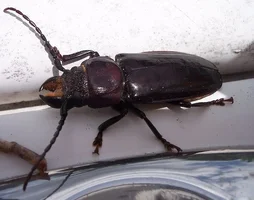
common name 'giant root borer'.

or looks very close to the ones around here.

don't know latin of that one off top of my head

eyes wrapping around from top to bottom, plus antanae and plus thorax bumps on side, many here have points on side of thorax here.

gotta be it, or extremely closely related.

big buggas

just played with one last night with my daughter, showed her how his passing mandibles cut paper
 
Re: What Did This?

There are similar species that get big and eat roots, like Derobrachus hovorei - Palo Verde Root Borer (which gets seriously big too) But this one isn't a root borer.

Another hint. (actually a couple) The Australian pine in which this specimen was found, had the top blown out in 2004 by Hurricane Jean. This one is not quite as long as the short side of a business card.
 
Re: What Did This?

I just figured it out but,I'm going to see if someone can get it cuz I don't have any photos of "bugs". Cervi, what are you calling an "Austalian pine"?
 
Re: What Did This?

Damn. I'm supposed to be working! But I can't leave this alone. dammitdammit dammit.

Atypical looking Cerambycid?

Subfamily Prioninae? I don't know if there is a common name for this group.

One of those beetles anyway. Some of them associated with pine. Stump borers.
 
Re: What Did This?

Alright Cervi, I'm heading up to Big, Wonderful, Wyo to do some camping on my B-day sans computer, so I'm going to try to decipher your critter:

subfamily: Parandrinae
genus: Parandra
 

New threads New posts

Back
Top Bottom