[ QUOTE ]
[ QUOTE ]
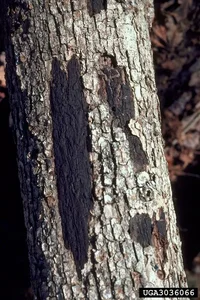
It's Hypoxylon canker. Here's a photo by Robert L. Anderson, USDA Forest Service, taken from Bugwood.org
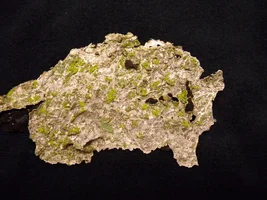
[/ QUOTE ]Your pic in post 323190 had green stuff on the bark, with a couple black patches on top of the green stuff.
Which are you saying is the pathogen formerly known as Hypoxylon (briefly Ustulina, now Kretzschmaeria deusta)--the green stuff, or the black patches? I am a tad skeptical of either--wood decay fungus growing on top of an epiphyte??
[/ QUOTE ]
The black pustules breaking through the bark, is the Hypoxylon. The green are lichens.
Not all Hypoxylon species had a name change to Kretzschaeria. The Hypoxylon genus is still being used.
According to Alexopoulos, Mims, and Blackwell in Introductory Mycology 1996: "Many species of Hypoxylon, as it once was circumscribed, have been placed in other genera (e.g., taxa with bipartite stromata and dark, smooth ascospores with germ slits are placed in Biscogniauxia and Camillea includes forms with pale, ornamented ascospores without germ slits). Only species with flattened or spherical stromata and dark, relatively smooth-walled ascospores with germ slits and lacking appendages now are included in Hypoxylon."
What Alexopoulos, et.al. Say about Kretzschmaria: "Kretzschmaria contains species with flat-topped stomata on short stipes. San Martin Gonzales and Rogers (1993) expressed the opinion that the genus is closely related to some species of Xylaria. It also intergrades with Ustulina in the tropics, and some mycologist have placed that genus in synonomy with Kretzschmaria."
The Hypoxylon isn't growing on the lichen and the lichen isn't growing on the Hypoxylon. I'm sure the lichen was growing on the bark and the Hypoxylon grew through the bark disrupting the lichen.