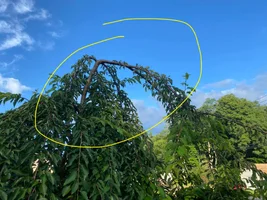
Fruit tree holding on by a thread, client wants to get another year out of it. Thoughts?

I have a weeping blue atlas cedar- very different tree type I know, but follow me for a sec- and I have been weening it off supplemental water for many years, and this year, I thought it should be established well enough to cut it off from direct water. There are enough irrigated plantings up the hill that I am betting it still gets a little deep water near the bedrock-soil transition, and the bedrock is full of cracks and seams that give trees access to the watertable- my well driller told me he first started hitting water only 7 feet down, and he drilled in August. This cedar was very floppy and required substantial support to guide it into the shape I wanted, but by the 5th year, I was able to let it stand on it's own, and this year, after the grasses died, it started to grow basically upright! I never expected it to do that, as it is sold as a weeping cultivar, but it got me wondering if the issue is that these weepy cultivars are assumed to be going into heavily irrigated and managed landscapes, but maybe if they get left to figure themselves out they can produce a more natural shape. Obviously my single tree anecdote isn't enough to base a whole property management plan on, but I would love to know if anyone else has ever observed this phenomenon.
 
Last edited:
Wow that is a wild ass tree. I bet it’s gorgeous in flower.

Best to ID it and make sure it’s not a flowering tree (kinda crazy saying like that but yall get it).

Any chance it’s a weeping fruit plum? Anyway there is an upright cherry, while I couldn’t tell you the variety it’s very upright with larger than a soft ball sized pink flowers clusters. One wet snow and that day tree bent right to the ground, it kinda sprung back up a little by the end of the growing season. A couple years later it’s nearly upright…

Point is some of them can have very elastic wood qualities, or probably better said to have an excellent response growth with strong tension wood.

Either way you can train vertical elements, it’s just a crap load of work. Allow for a sprout to grow vertical. Near the end of thr growing season cut by about 1/3 or near where you’d like some branching.
Next year stake this and whatever sprouts develop train into a new vertical leader and the remainder train into a limb.
Then repeat that process.
 
When I asked the customer what they would like going forward, basically they said they would like it to get as tall as it can, and they’re fine with the width.

The way they described it was that width-wise it sort of matches up with what was described when they bought the tree to plant, but not as much with the height. When it started growing a little crooked at the top, that’s when they staked it to try and get it to grow more vertical. I’m not side whether the stakes were evaluated and re-adjusted during those few years, but whatever was done sounds like it contributed to this growth at the top.

So if we were to maintain it, should we reduce the upper part that’s growing at odd angles, see if it pushes out new shoots and then train that to be more vertical as @Evo mentioned….

It’s two trees altogether, and both have that same bend at the top.

I scanned the tree with a plant id app I have and came back with Japanese Cherry / Sweet Cherry.


AAE0730C-8FF2-4857-91F7-F8A12CC22269.webp
 
I ended up suggesting that going forward, focusing on management, so trimming as needed for appearance, and pruning to remove dead, damaged, or diseased branches (as needed) would be a good plan for the trees; that because they’re a weeping variety, they’re only going to get as tall as they want to.

With the way the growth is, I’m not sure there’s really much to be done in terms of training it to be more vertical / taller at this point, if it would even grow taller.
 

New threads New posts

Back
Top Bottom