Risk assessment – fungi

macrocarpa

Branched out member
Location
Midwest
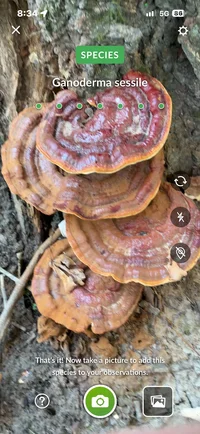
I’ve been seeing a lot of ganoderma this year, I assume partially due to the unusual wet summer we had.

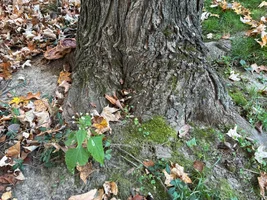
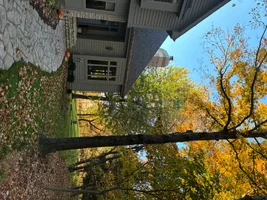
Just curious how others would communicate a risk assessment to a customer with this sugar maple? I didn’t see any other red flags just the fungal growth. Good structure, minimal root flare decay, full healthy canopy. It sits in a low area that can accumulate water.
 

Attachments

  • IMG_1778.webp
    IMG_1778.webp
    162.1 KB · Views: 16
  • IMG_1779.webp
    IMG_1779.webp
    523.1 KB · Views: 16
  • IMG_1781.webp
    IMG_1781.webp
    518.2 KB · Views: 16
  • IMG_1782.webp
    IMG_1782.webp
    421.2 KB · Views: 15
Any drill/ resistograph type testing?

By the time I am seeing Ganoderma applanatum conks, there is a considerable about of decay.
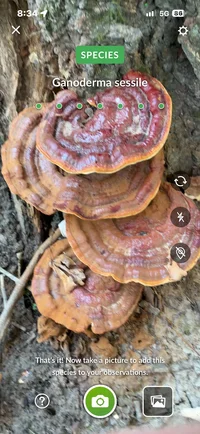
No drilling yet. This is what Seek says it is. The root flares look solid except for the very small section where the conks are growing. But I know that can be deceiving.
 

Attachments

  • IMG_1778.webp
    IMG_1778.webp
    162.1 KB · Views: 3
I'd be sure to not give positive opinions in any written way. "It has healthy crown and no visible dieback, but actively fruiting conks indicating advanced decay. If you folks decide to keep it I recommend XYZ"... We can't guarantee stability but can do a mild crown reduction and air spade if you want to save it...

Instead of "many sugar maples live for hundreds of years with rot and this one is most likely fine with regular inspections" etc.
 
Ganoderma sessile is on Chris Luley's "Big Five Must-Know Decay Fungi". In a book with dozens of decay fungi, he lists the ones that are the most significant to health and structure.

However, it is pretty common in the landscape. In Wood Decay Fungi he mentions that 20% of declining Norway maples in NYC had conks. and "Honey Locust is a common host" All that to say, if we removed every tree with Ganoderma sessile conks, that's a lot of trees lost from the urban forest. Quoting Luley again: "Trees with G. sessile conks should be tested for decay , mindful that root decay is likely. Infected trees that are retained in the urban setting should be tested and monitored."
 
I’ve been seeing a lot of ganoderma this year, I assume partially due to the unusual wet summer we had.

Just curious how others would communicate a risk assessment to a customer with this sugar maple? I didn’t see any other red flags just the fungal growth. Good structure, minimal root flare decay, full healthy canopy. It sits in a low area that can accumulate water.
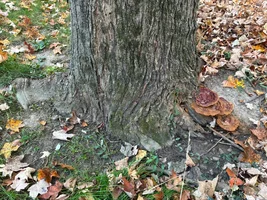
Looking at your 2nd and last Photos on my large PC screen, it appears that there was damage to the Root Flair (looks dead) where the Fungi are now decomposing the dead wood.

Another observation is the Slaked soil near the dead Flair, as well as what appears to be a newer stone/concreate walkway within the Critical Root Zone and somewhat newly seeded area.

Possible that the wound where the Fungi is now active, was caused by equipment.....

That close to the home, it's likely possible to probable that a blowover will happen down the road.

Always sucks to see within the Urban Forest/Landscape to see something that could have been avoided.
 
mallet for sure. If you are getting excessive bole movement in a big tree with a pull line, that's really bad news!
I've had many trees just feel weird climbing them, often due to a rot pocket or defect in the mid stem so the tree is flexing odd. Setting the climb line often gives a feel to it too, so setting a line to check flex etc would be easy too as a mallet doesn't give ample info about defects higher up. Maybe sometimes. Super dead or rotten have this clunky moment to the sway while climbing which is real disconcerting!
 
  • Like
Reactions: ATH
This red oak had lush canopy with some fruiting maitake at its base. Inside was next to weightless due to rotView attachment 103218
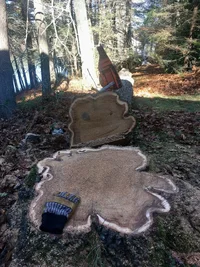
That is what a typical oak with Ganoderma looks like around here, once we cut into it. I ground a stump on one a couple years ago, found that it only had 6 inches of cambium, on a 40 inch diameter tree, and below ground level the whole thing was nothing but a sponge. Up top however, it looked perfectly healthy.
 
Ganoderma sessile is on Chris Luley's "Big Five Must-Know Decay Fungi". In a book with dozens of decay fungi, he lists the ones that are the most significant to health and structure.

However, it is pretty common in the landscape. In Wood Decay Fungi he mentions that 20% of declining Norway maples in NYC had conks. and "Honey Locust is a common host" All that to say, if we removed every tree with Ganoderma sessile conks, that's a lot of trees lost from the urban forest. Quoting Luley again: "Trees with G. sessile conks should be tested for decay , mindful that root decay is likely. Infected trees that are retained in the urban setting should be tested and monitored."
Interesting you mentioned honey locust, when we see Ganoderma on a honey locust, it's usually growing on deadwood. I don't know that I've ever seen it growing on living wood, and it does not seem to affect the integrity of the tree the way it does on oaks.
 
  • Like
Reactions: ATH
Interesting you mentioned honey locust, when we see Ganoderma on a honey locust, it's usually growing on deadwood. I don't know that I've ever seen it growing on living wood, and it does not seem to affect the integrity of the tree the way it does on oaks.
I was just quoting the book.

I certainly see it on Honey locust. However, anecdotally, I think I see Armillaria more frequently on declining Honey locust.
 

New threads New posts

Back
Top Bottom