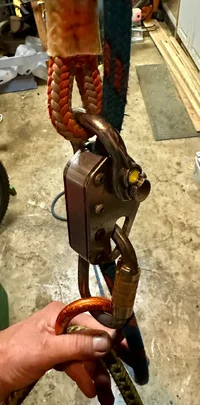
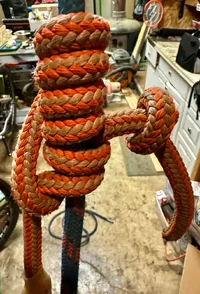
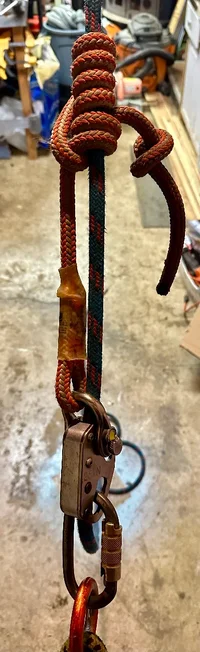
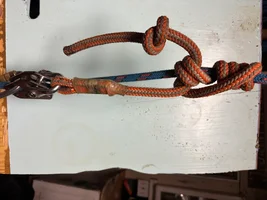
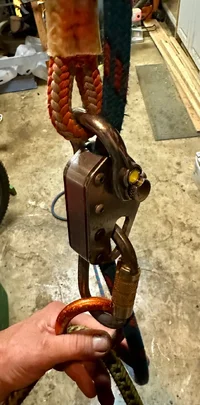
Hitchhiker 2 on a shackle

hitch hiker 2 with isc ultralink connected to a 16 strand dead eye tied onto a blakes hitch. srt. a lot of sitback. questionable slack tending.. Not expert at blakes hitch but I used 2 extra top wraps on the top. it actually feels nice messing around in the garage.
 

Attachments

  • IMG_2431.webp
    IMG_2431.webp
    119.1 KB · Views: 9
  • IMG_2430.webp
    IMG_2430.webp
    185.2 KB · Views: 11
The use of shackles is a nice approach for quick, everyday use.
Here are some more Hitch Hiker hi-jinks. Started by using the short pieces of tube, or pipe to replace the dogbone and carabiner. Thought about cutting a couple of slots in a Climb Right rope clamp, and then about cutting out a triangle instead. That lead using just one tube, included in the hitch. Then wanted to go smaller, and finally to reduce the device to the bare minimum. Made a prototype and realized I was making another form of the Sticht Hitch, r.i.p. Nano HH.
IMG_7849.webp
 
The use of shackles is a nice approach for quick, everyday use.
Here are some more Hitch Hiker hi-jinks. Started by using the short pieces of tube, or pipe to replace the dogbone and carabiner. Thought about cutting a couple of slots in a Climb Right rope clamp, and then about cutting out a triangle instead. That lead using just one tube, included in the hitch. Then wanted to go smaller, and finally to reduce the device to the bare minimum. Made a prototype and realized I was making another form of the Sticht Hitch, r.i.p. Nano HH.
View attachment 103310
what if there were a mechanical bit on the top of the HH2 that provides the bite to engage the top pin. The new zig zag and the reflex both have this flat top piece that provides bite which engages the links. the links need a signal from the top to engage. same as the HH2, it needs a signal from the top to engage the dogbone part. so basically like the top link off the reflex connected to the dogbone
 
The two devices work on different principles, HH uses pinch points, the Reflex deflection with bollards. A bird would engage the dogbone, but there wouldn’t be enough friction to hold you. The hitch is needed for more friction, and it acts as the bird.
The Sticht hitch can be pinching when using a Sticht plate, or deflecting when using a ring. It seems to release easier with the ring.
I feel they work on the same principles. As most SRT devices have two functions you have termed pinch and deflection. The akimbo, bdb, and rope runner arguably follow cues from hitch+rope wrench with pinch on bottom and deflection on top. The reflex sorta has a pinch. deflection, pinch stack, and the flat bit on very top that initiates friction. Without that flat bit on top, nothing but luck would signal the lower parts to grip the rope. with the new petzl, that spring loaded flat bit on top starts the initial grip and yanks up the top link, the climber weight opposing force causing the links to get tighter. So it seems the petzl shift only has one of the two functions (the links pinch) and the magic is the flat bit. surely the flat bit cannot support the weight, it's purpose is to initiate the grip action.

back to the HH2, the tighter the hitch pulls up, the tighter the dogbone (and steel carabiner) pull down. the hitch is not supporting the climber weight, it is causing the dogbone to pinch, which in turn supports climber weight. Honestly, I suspect the top two plates off the unicender would do the job.

 
I agree up until the end. The hitch is doing the holding, the pinch points create friction to take some of the weight off of it. Drop a couple wraps and it won’t hold. Linking several HHs together would probably slip, I tried four of the lower parts of the Sticht with one wrap at the top to act as a drag, and it wouldn’t hold.
 
I agree up until the end. The hitch is doing the holding, the pinch points create friction to take some of the weight off of it. Drop a couple wraps and it won’t hold. Linking several HHs together would probably slip, I tried four of the lower parts of the Sticht with one wrap at the top to act as a drag, and it wouldn’t hold.
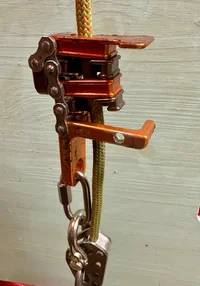
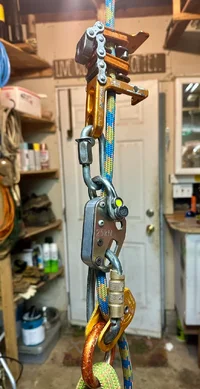
it is a logical observation for sure. I experimented in the garage today. To test my theory, used the isc ultralink (in place of the dogbone) to connect a rope wrench above the hh body. no hitch cord at all, just metal. obviously neither device will support my weight alone. but together they seem to make a really smooth device. I want to go actually climb on this configuration now and find out. the more you pull down on the rw, the more bend in the rope creating more friction. the more you pull up on the hh dogbone, the more it and the steel carabiner squeezes and creates more friction.
 
I feel they work on the same principles. As most SRT devices have two functions you have termed pinch and deflection. The akimbo, bdb, and rope runner arguably follow cues from hitch+rope wrench with pinch on bottom and deflection on top. The reflex sorta has a pinch. deflection, pinch stack, and the flat bit on very top that initiates friction. Without that flat bit on top, nothing but luck would signal the lower parts to grip the rope. with the new petzl, that spring loaded flat bit on top starts the initial grip and yanks up the top link, the climber weight opposing force causing the links to get tighter. So it seems the petzl shift only has one of the two functions (the links pinch) and the magic is the flat bit. surely the flat bit cannot support the weight, it's purpose is to initiate the grip action.

back to the HH2, the tighter the hitch pulls up, the tighter the dogbone (and steel carabiner) pull down. the hitch is not supporting the climber weight, it is causing the dogbone to pinch, which in turn supports climber weight. Honestly, I suspect the top two plates off the unicender would do the job.
did some testing and yes, the unicender above the HH2 works for srt using one or all of the links. it is super jumpy with only a single link, but it works. tending is an absolute nightmare, it's super bulky and gets convoluted in slack, but descending is smooth as butter. it puts the uni backwards. I would 100% not climb on it, would be exhausting.
 

Attachments

  • IMG_2532.webp
    IMG_2532.webp
    126.5 KB · Views: 10
  • IMG_2528.webp
    IMG_2528.webp
    111.8 KB · Views: 9

New threads New posts

Back
Top Bottom