Forces on a cinched carabiner

If you can watch your solution converge, as it converges, do you start with the biner angled as a straight extension of the rope tangent at the green dot and let the math settle it downwards to a final angle? This would match the rope tension reduction across the yellow dot.

I believe starting with the biner contacting the log at the yellow dot would result in a different convergent answer due to the reversal of friction direction at the yellow dot.

I think the two answers form limiting boundaries for how it could settle out.
 
Last edited:
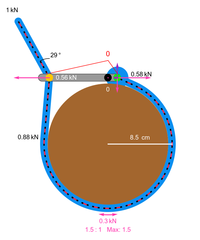
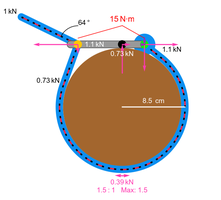
@Bart_ I have it structured a little differently. Seeking a geometry with simple math I made the bollard a unit circle and fixed the carabiner in a horizontal orientation, then figured out the rope alignment and tensions from there. Of course it is more complicated now but I think it was a reasonable foundation.

I may not understand the point you make in the second paragraph. I don't think the contact point can be closer to the yellow dot than to the green dot in a stable orientation, so I interpret your advice as starting from the other direction which in my model would be starting from the opposite extreme of the the angle of the rope entering the system. (If you prefer to fix the rope origin then rotation of the entire system relative to it.)

In addition to constraints of the geometry itself I can bound what is possible by tracking frictions within the system. I calculate the capstan friction of the rope on the carabiner to determine the angle of force acting upon it, but I also calculate the limit of the capstan friction of the rope on the bollard and now that of the termination (knot) and carabiner against the bollard. If the ratio of tensions on the left and right sides exceeds the combined maximum friction I know it is a false solution and I have the simulation advance the angle, though at present there are still bugs in that process.

I'll post examples tomorrow in case this is all poorly explained.
 
For this geometry and rope-bollard mu of 0.085 representing a slick rope around a steel bollard the system can be at equilibrium between these two limits. Angles outside this range would require more tension to be carried by friction than I calculate as possible.

cinch limits steel min.pngcinch limits steel max.png
 
With friction direction reversal at the biner the .88 or .73 could be greater than 1.0. Mind experiment: imagine you grab the biner at the yellow dot, reef it upwards and let it skid back down to equilibrium position, Now part 2, grab the biner at the yellow dot, reef it downwards and let it skid back up to an equilibrium position. The direction of rope skid is different in each case and there are two different equilibriums. The second case will get you the greater than 1.0.

It could be as simple as enabling a sign change at the yellow dot bollard friction equation. Or it would be reversing assignment of in/out rope tensions in the bollard equation. 2nd seems more likely to me

Did you get a chance to read the basal srt tip force thread? 1st post delves a bit into friction reversal
 
Last edited:
Mind experiment: imagine you grab the biner at the yellow dot, reef it upwards and let it skid back down to equilibrium position, Now part 2, grab the biner at the yellow dot, reef it downwards and let it skid back up to an equilibrium position. The direction of rope skid is different in each case and there are two different equilibriums. The second case will get you the greater than 1.0.

I tried this physically now as I wanted to get a feel for it. I see how the friction can be used to hold more tension within the loop than the system settles into naturally, by manually cinching it down.

Does this have real-world implications however? I could not produce the effect by merely starting with the yellow point close the bollard before loading the system, I had to first load the system and then "reef downwards" on it as described.

I believe any serious addition of load will cause rope to slip through the carabiner passing away from the system, reversing the reversal. This is seen dramatically in the pull test with the nylon rope and knotted termination at 3:47, but even with the extremely static Dyneema loop and steel bollard of the later pulls. To have the friction-reversed configuration play a role at breaking I believe one would need to load the system heavily and then pry (with implement) the carabiner downward, either until it breaks or leaving the system near failure such that with a further short pull there is a different tension ratio on either side of the carabiner at the moment of failure.

Perhaps modeling the rope tensions 1:1 is a sufficient bound.
 
Last edited:
Later I thought it possible to also reverse the bollard friction direction on the stem bark. Rough bark 180 degree wrap 2.5 tension ratio is pretty good grip. That's like 1 kN and 2.5 kN at the green and yellow dots - or more because there's more than 180 degrees of wrap, maybe 3.0 tension ratio. back calc mu and scale per degrees wrap? (using bollard eqn)

Makes for more condition checking, finding slippage point angles. Just dotting i's crossing t's to put quantities to how the friction affects the geometry. In practice configuration could start anywhere within the boundaries but would be limited in configuration it can settle to under load by the analysis.

You could double apply this analysis to beachcombers rolling logs off the beach;)

oh and yup that's the thread
 
Later I thought it possible to also reverse the bollard friction direction on the stem bark. Rough bark 180 degree wrap 2.5 tension ratio is pretty good grip. That's like 1 kN and 2.5 kN at the green and yellow dots - or more because there's more than 180 degrees of wrap, maybe 3.0 tension ratio. back calc mu and scale per degrees wrap? (using bollard eqn)

I think I already have this. In the images in post #23 and you will see that the first one has more tension on the yellow side while the second one has more tension on the green side.

According to my simulation high bollard friction makes it easy to break a carabiner as the system will support extreme rope angles. This is a potentially misleading aspect of the HowNOT2 test with a steel drum and Dyneema.
 
Here's a brain teaser. Near equal tensions around the trunk, rope elasticity considered, find minimum rope tension on/near center of backside of trunk wrap:) Then picture the rope stress distribution change as you increase the tension on one side. Now the T1/T2 assignments in the bollard equation get really messed up, as the minimum point moves.
 

New threads New posts

Back
Top Bottom