DWT

Isaac,

Have you had a chance to view the "Articles" page here? Specifically the "Engineering a tree removal" article I wrote a few years ago? I would love to here what you think of my thoughts. It is kinda related to what your diagram shows.
 
[ QUOTE ]
I am putting together a spreadsheet that will take into account shock loaded systems but I need k values.

[/ QUOTE ]

Check out http://www.amrg.org/Rope_system_analysis_Attaway.pdf

Or you might be able to calculate K or modulus values from:

static rope = <6% stretch at 10% MBS
low stretch = 6-10% stretch at 10% MBS
dynamic rope = >10% stretch at 10% MBS
(from Cordage Institute)

- Robert
 
Hey Isaac-

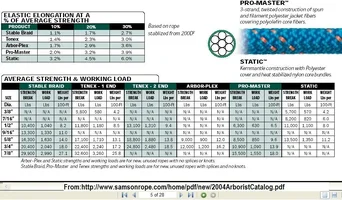
Check your mail; but there is also this Samson data from page 5 of their free, excellent, even downloadable Samson Arborist Rope Catalog.

Elasticity is one of the most important componenets of line used in rigging non-static 'events'. Elasticity for these purposes is the 'life' of the line. The elasticity is the first to get damaged in overstretching by pull or time, heat damage, cycles of use etc.

Elasticities are different, at different % Tensile loaded. The list of 5 Elastiticities for :Stable Braid, Tenex, Arbor-Plex, Pro-Master, Static actually expands to more. For each named line as a rigging device is available in different tensile strengths. So it becomes set charachteristics for a specific braid and composition; then the specific tensile vs. the load to extract the elasticity. The named lines average 4 different tensiles each; thereby data representing 20 differnt lines.

Elasticity is a dynamic component, and needs a dynamic componenet (movement)to conjure it up. So, what is good at static hang, might not be at dynamic movment, in fact, inverse properties from the same strategy may be invoked on the powerband's graphed curve of usabilty for the strategy.

In DWT vs. simple 1-1 pulley redirect. The 1-1 at a static hang will load the support 2xLoad, the DWT only 1.5xLoad. But, with real movement, elasticty component becomes engaged. Due to the higher SWL of the DWT, there is less elasticity, by definition. Thereby, the single, simple 1:1, that gave more support load at a static hang, can give less support load than DWT at movement, due to more elasticity component drawn out of the single line, that the doubled line.

A support has an SWL too. Because movment gives higher loading, that is point we guard most. As tensile goes up, so does the line's SWL, as it's elasticity goes down. ::In our dynamic rigs, as the SWL of the line goes up, the SWL of the support comes down reciprocally. For, what the elasticity doesn't absorb, the line transfers to the support. ::A weaker line of same design and materials(or single line instead of DWT as virtually the same thing), can give safer dynamic loading on weaker, or more 'springy' supports, shake climber less etc.

Dave started a DWT angled line and support load spreadsheet/calculator here a while back. The link gives a version that you can adjust the values on to watch the loading calculations automatically changed for you on on the spreadsheet. The line and the supports at different weights and spreads of the line.

Okay, this rant is over! /forum/images/graemlins/crazy.gif

 

Attachments

  • 19633-Rope Data.webp
    19633-Rope Data.webp
    114.9 KB · Views: 42
Engineering a Tree Removal

Howdi Mark,

Great article! I wouldn't say it relates to what I said, it said it. I am now eating my own rule about reading up on a forum before posting so as to reduce repeated threads. Oops.

A couple comments:

Under the "Multiple-block rigging section on page 2 (or page 25 of TCI), you state "And since branches are more strongly attached on the underside than the top, groups of pulleys can be arranged in a monner that will exploit this anatomical strength...," (third to last sentence). I think I understand what you reffer to; the bottom of the branch is stiffer so the limb can support more weight from the top than it can force from the bottom? In other words pulling up on a branch is more likely to break it than pushing down. Let me know if I am totally wrong. ;-)

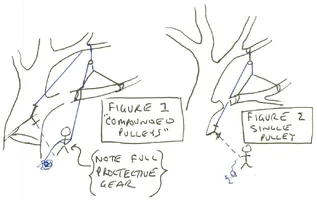
The second thing I noticed is on the last page (very top), "It will see approximately half of the force than the other case." This is right if I follow you correctly; in the first case a pulley is supported by a rope running over a branch and tied lower on the tree (See Attached: Figure 1). The second case is a pulley attached to the branch directly, using webbing for example (see Figure 2). In the second case the branch holding the pulley will need to hold up twice the weight (neglecting friction, etc.) than in the first.

In both cases I believe what you are saying is correct; I just want to clarify your wording. Otherwise the article is good! Rigging can reduce the tension in ropes and at lowering devices if used correctly, which is safer for the climber and the ground crew. Just a basic understanding of physics means jobs get done faster and with less effort by everyone involved. The climber must be cautious however, as compounding false crotches can increase the forces in a tree exponentially.

Isaac
 

Attachments

  • 19692-IsaacsEngineeringaTreeRemov.webp
    19692-IsaacsEngineeringaTreeRemov.webp
    45.8 KB · Views: 65
Re: Engineering a Tree Removal

Nice drawings Isaac! I think we agree?

[ QUOTE ]
The climber must be cautious however, as compounding false crotches can increase the forces in a tree exponentially.


[/ QUOTE ]

Not sure if I am saying the exact same thing as you, but I would say that multiple rigging points may help to strengthen each other, but adding another point will put more force into the tree overall. Do you agree?

More clearly, if we have one point displacing 2x Load and we add a point at 90* then we add more force overall. Each point will see 1.41 x Load which equals 2.82 rathe than just 2. In most scenarios I would say that 1.41 is better per/point than just 2x in the overall scheme. Anyone care to comment?
 
Re: Engineering a Tree Removal

[ QUOTE ]
... the bottom of the branch is stiffer so the limb can support more weight from the top than it can force from the bottom? In other words pulling up on a branch is more likely to break it than pushing down. Let me know if I am totally wrong. ;-)

[/ QUOTE ]
I've notice when making my firewood that splitting the piece through a crotch is relatively effortless when splitting in the direction from bottom to top; as if the tree never "considered" the possibility so made no preparations for it. Splitting through the crotch from top to bottom is relatively impossible, by contrast. I believe that in the scenario you preset, the tree's "hmm, I never considered that might happen" probably is a factor.

Glen
 
Re: Engineering a Tree Removal

[ QUOTE ]
More clearly, if we have one point displacing 2x Load and we add a point at 90* then we add more force overall. Each point will see 1.41 x Load which equals 2.82 rathe than just 2. In most scenarios I would say that 1.41 is better per/point than just 2x in the overall scheme. Anyone care to comment?

[/ QUOTE ]
I think I agree.

See, Mark? If you'd enable HTML code here, you could use 90° instead of 90* and get a pretty 90°.

Glen
 
Re: Engineering a Tree Removal

[ QUOTE ]
In most scenarios I would say that 1.41 is better per/point than just 2x in the overall scheme. Anyone care to comment?

[/ QUOTE ]

As you point out in the article, Mark, it's not simply how much force is at each point but what are the directions of force (the resultant vectors)?

If the forces can be redirected into the long axis of each limb, using their columnar strength, instead of perpendicular to the limbs, then the tree can withstand much more overall force because it is both spread out and properly directed.

- Robert
 
Re: Engineering a Tree Removal

[ QUOTE ]
[ QUOTE ]
In most scenarios I would say that 1.41 is better per/point than just 2x in the overall scheme. Anyone care to comment?

[/ QUOTE ]

As you point out in the article, Mark, it's not simply how much force is at each point but what are the directions of force (the resultant vectors)?

If the forces can be redirected into the long axis of each limb, using their columnar strength, instead of perpendicular to the limbs, then the tree can withstand much more overall force because it is both spread out and properly directed.

- Robert

[/ QUOTE ]

Well put Robert. You just summed up my entire article in one sentence! /forum/images/graemlins/cool.gif
 
Re: Engineering a Tree Removal

Very nice Rescue! Columnar strength is one of my favorite imageries of expression in rigging; even used on rope. But even on that axis, we must watch direction of force too, compressing wood would be more fortifying/better,than tensioned by the columnar pull.

[ QUOTE ]

Not sure if I am saying the exact same thing as you, but I would say that multiple rigging points may help to strengthen each other, but adding another point will put more force into the tree overall. Do you agree? -Mark Chisholm

[/ QUOTE ]
Also could be more fortifying to structure they were run on, to use the lowering force to brace.

The leveraged force is just not in the line, but how the connection recieves that passed force.

The Spyder Leg (ouch!) is under most load i think.
 
Re: Engineering a Tree Removal

[ QUOTE ]
[ QUOTE ]
and get a pretty 90°.

[/ QUOTE ]

Hey, how'd you do that? /forum/images/graemlins/thinking.gif

[/ QUOTE ]

Well, I'd showed you the easy way, which we currently cannot do here, using the HTML entity for the character.

What I had to do to stuff it into the post was cut and paste it from the output of an HTML file I threw together for just such purposes (though there is likely at least a dozen other ways). I'll see if I can attach it for you so you can refer to it for when you enable HTML code input here...

Okay, I had to append ".txt" to the filename to be able to attach it. When you save it to disk, remove that spurious extension so it becomes just "chars.html".

Glen
 

Attachments

Re: Engineering a Tree Removal

Good to know I can get away with spelling protective wrong without anyone saying anything. So much for being a better speller than typer.

Mark:

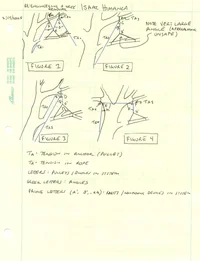
I am not sure I follow your example, where in the setup are you trying to add a point at 90º? What I am saying is this (and this is how I understood your article): supporting a pulley (at any angle) using another pulley (also at any angle) increases the force on the branch that the top pulley is attached to. See Figure 1 in IsaacsEngineeringaTreeFigs1.jpg", Attached. Note that Tr4 is two times Tr5, and there is two times Tr4 on the supporting branch, which is four times the weight of the load. Compare this to Figure 2, in which the same pulley is tied directly to the tree. Now Tr3 equals the weight of the load, so there is two times the weight of the load on the supporting branch. I am, of course, assuming that all angles gamma, epsilon, and zeta are all zero, i.e.: there are no angles introduced in the system. I apologize if the diagrams are hard to read for all of the variable names..what can I say, college is taking it's toll on me. :-D

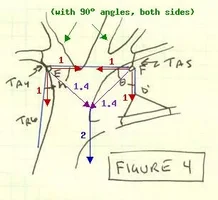
Yes, multiple rigging points can be very beneficial, for example using two or three blocks in a tree can direct forces down the length of the branch. (As seems to be the consensus in the forum, branches are strongest in this direction.) A rope going through two 90º angles also means that the force on either of the blocks is only 1.4 times that of the load being supported, versus 2 times the load it would be if it were 180ºs. (See Figure 4).

I attached a few more drawings showing different rigging situations, maybe you are referring to something similar to one of those? I would like to point out that in Figure 2, the sling attaching the limb to the rope is at a very obtuse angle. This is where angles over 160º (and thus very large forces) are most likely to occur in rigging situations, please correct me if I'm wrong. (To those of you who are taking out your protractors, yes that angle is only around 112º and therefore the tension in the rope is only .89 times the weight of the load, but I wanted to use this as an example.)

By the way if you want to use the º symbol there is a MUCH easier way (provided you are using windows, although I know this works on some other platforms too, try it if in doubt. There are similar shortcuts for mac and Linux I know if anyone uses them). Press and *hold* "Alt", then type "167", and let go of "Alt". This is often shown Alt+167.

< = Press key
> = Release Key

<1> <6> <7>
<----Alt---->


Play around with other numbers too, all ASCII text characters are available in this way. Here is a pdf file with a whole list of them:

http://safariexamples.informit.com/0789725428/Reference/Technical.pdf

Isaac
 

Attachments

  • 19749-IsaacsEngineeringaTreeFigS1.webp
    19749-IsaacsEngineeringaTreeFigS1.webp
    56.2 KB · Views: 65
Re: Engineering a Tree Removal

No offense, but that Microsoft business of giving you º for entering Alt+167 is just plain whacked-out. Look at #167 in this list and you'll see that value is for the "section sign". The "masculine ordinal indicator" you're providing is at position #186 in the 8-bit "code page" used as the standard (for quite some time now) in virtually every Western language. The symbol you're getting is indeed assigned, at the location you're entering, within the old US ASCII "code pages" 437, 850, and 860, but any "modern" operating system should be using ISO 8859-1 around these parts (this web server is sending its data in it, as well as it being declared a second time in the generated pages). How it comes to be the character at position #186 on its way out of your computer is a question only Bill Gates could answer, if he could. No wonder he needs to provide "wizards" to handle all his magical computer stuff. Heaven forbid they did anything by the standards so their users could easily learn what's going on in their magical computer-thingies (pay no attention to the man behind the curtain, Dorothy!) and sit down to be relatively productive on just about any type of computer they might encounter in their day-to-day lives. (It's rather akin to Darin's stance, as recently discussed in another forum/thread here).

If Mark would enable HTML code entry in the forums, the absolute simplest method to get ° would be to type the characters ° and it would then be rendered as the proper degree sign. What you're using is hardly less funny-looking than *.

Of course, if Mark were to enable HTML code entry, it's possible the few posts such as this would lose meaning since the HTML entities contained within would be sent out "properly" in the future. I'm willing, and pleading, to take that risk.

<font class="small">Code:</font><hr /><pre>
+---------------------------------+
| Special HTML character entities |
| for ISO 8859-1 |
|---------------------------------|
| &amp;#160; | | &amp;nbsp; | NO-BREAK SPACE
|------------+------+-------------|
| &amp;#161; | ¡ | &amp;iexcl; | INVERTED EXCLAMATION MARK
|------------+------+-------------|
| &amp;#162; | ¢ | &amp;cent; | CENT SIGN
|------------+------+-------------|
| &amp;#163; | £ | &amp;pound; | POUND SIGN
|------------+------+-------------|
| &amp;#164; | ¤ | &amp;curren; | CURRENCY SIGN
|------------+------+-------------|
| &amp;#165; | ¥ | &amp;yen; | YEN SIGN
|------------+------+-------------|
| &amp;#166; | ¦ | &amp;brvbar; | BROKEN BAR
|------------+------+-------------|
| &amp;#167; | § | &amp;sect; | SECTION SIGN
|------------+------+-------------|
| &amp;#168; | ¨ | &amp;uml; | DIAERESIS
|------------+------+-------------|
| &amp;#169; | © | &amp;copy; | COPYRIGHT SIGN
|------------+------+-------------|
| &amp;#170; | ª | &amp;ordf; | FEMININE ORDINAL INDICATOR
|------------+------+-------------|
| &amp;#171; | « | &amp;laquo; | LEFT-POINTING DOUBLE ANGLE QUOTATION MARK
|------------+------+-------------|
| &amp;#172; | ¬ | &amp;not; | NOT SIGN
|------------+------+-------------|
| &amp;#173; | ­ | &amp;shy; | SOFT HYPHEN
|------------+------+-------------|
| &amp;#174; | ® | &amp;reg; | REGISTERED SIGN
|------------+------+-------------|
| &amp;#175; | ¯ | &amp;macr; | MACRON
|------------+------+-------------|
| &amp;#176; | ° | &amp;deg; | DEGREE SIGN
|------------+------+-------------|
| &amp;#177; | ± | &amp;plusmn; | PLUS-MINUS SIGN
|------------+------+-------------|
| &amp;#178; | ² | &amp;sup2; | SUPERSCRIPT TWO
|------------+------+-------------|
| &amp;#179; | ³ | &amp;sup3; | SUPERSCRIPT THREE
|------------+------+-------------|
| &amp;#180; | ´ | &amp;acute; | ACUTE ACCENT
|------------+------+-------------|
| &amp;#181; | µ | &amp;micro; | MICRO SIGN
|------------+------+-------------|
| &amp;#182; | ¶ | &amp;para; | PILCROW SIGN
|------------+------+-------------|
| &amp;#183; | · | &amp;middot; | MIDDLE DOT
|------------+------+-------------|
| &amp;#184; | ¸ | &amp;cedil; | CEDILLA
|------------+------+-------------|
| &amp;#185; | ¹ | &amp;sup1; | SUPERSCRIPT ONE
|------------+------+-------------|
| &amp;#186; | º | &amp;ordm; | MASCULINE ORDINAL INDICATOR
|------------+------+-------------|
| &amp;#187; | » | &amp;raquo; | RIGHT-POINTING DOUBLE ANGLE QUOTATION MARK
|------------+------+-------------|
| &amp;#188; | ¼ | &amp;frac14; | VULGAR FRACTION ONE QUARTER
|------------+------+-------------|
| &amp;#189; | ½ | &amp;frac12; | VULGAR FRACTION ONE HALF
|------------+------+-------------|
| &amp;#190; | ¾ | &amp;frac34; | VULGAR FRACTION THREE QUARTERS
|------------+------+-------------|
| &amp;#191; | ¿ | &amp;iquest; | INVERTED QUESTION MARK
|------------+------+-------------|
| &amp;#192; | À | &amp;Agrave; | LATIN CAPITAL LETTER A WITH GRAVE
|------------+------+-------------|
| &amp;#193; | Á | &amp;Aacute; | LATIN CAPITAL LETTER A WITH ACUTE
|------------+------+-------------|
| &amp;#194; | Â | &amp;Acirc; | LATIN CAPITAL LETTER A WITH CIRCUMFLEX
|------------+------+-------------|
| &amp;#195; | Ã | &amp;Atilde; | LATIN CAPITAL LETTER A WITH TILDE
|------------+------+-------------|
| &amp;#196; | Ä | &amp;Auml; | LATIN CAPITAL LETTER A WITH DIAERESIS
|------------+------+-------------|
| &amp;#197; | Å | &amp;Aring; | LATIN CAPITAL LETTER A WITH RING ABOVE
|------------+------+-------------|
| &amp;#198; | Æ | &amp;AElig; | LATIN CAPITAL LETTER AE
|------------+------+-------------|
| &amp;#199; | Ç | &amp;Ccedil; | LATIN CAPITAL LETTER C WITH CEDILLA
|------------+------+-------------|
| &amp;#200; | È | &amp;Egrave; | LATIN CAPITAL LETTER E WITH GRAVE
|------------+------+-------------|
| &amp;#201; | É | &amp;Eacute; | LATIN CAPITAL LETTER E WITH ACUTE
|------------+------+-------------|
| &amp;#202; | Ê | &amp;Ecirc; | LATIN CAPITAL LETTER E WITH CIRCUMFLEX
|------------+------+-------------|
| &amp;#203; | Ë | &amp;Euml; | LATIN CAPITAL LETTER E WITH DIAERESIS
|------------+------+-------------|
| &amp;#204; | Ì | &amp;Igrave; | LATIN CAPITAL LETTER I WITH GRAVE
|------------+------+-------------|
| &amp;#205; | Í | &amp;Iacute; | LATIN CAPITAL LETTER I WITH ACUTE
|------------+------+-------------|
| &amp;#206; | Î | &amp;Icirc; | LATIN CAPITAL LETTER I WITH CIRCUMFLEX
|------------+------+-------------|
| &amp;#207; | Ï | &amp;Iuml; | LATIN CAPITAL LETTER I WITH DIAERESIS
|------------+------+-------------|
| &amp;#208; | Ð | &amp;ETH; | LATIN CAPITAL LETTER ETH
|------------+------+-------------|
| &amp;#209; | Ñ | &amp;Ntilde; | LATIN CAPITAL LETTER N WITH TILDE
|------------+------+-------------|
| &amp;#210; | Ò | &amp;Ograve; | LATIN CAPITAL LETTER O WITH GRAVE
|------------+------+-------------|
| &amp;#211; | Ó | &amp;Oacute; | LATIN CAPITAL LETTER O WITH ACUTE
|------------+------+-------------|
| &amp;#212; | Ô | &amp;Ocirc; | LATIN CAPITAL LETTER O WITH CIRCUMFLEX
|------------+------+-------------|
| &amp;#213; | Õ | &amp;Otilde; | LATIN CAPITAL LETTER O WITH TILDE
|------------+------+-------------|
| &amp;#214; | Ö | &amp;Ouml; | LATIN CAPITAL LETTER O WITH DIAERESIS
|------------+------+-------------|
| &amp;#215; | × | &amp;times; | MULTIPLICATION SIGN
|------------+------+-------------|
| &amp;#216; | Ø | &amp;Oslash; | LATIN CAPITAL LETTER O WITH STROKE
|------------+------+-------------|
| &amp;#217; | Ù | &amp;Ugrave; | LATIN CAPITAL LETTER U WITH GRAVE
|------------+------+-------------|
| &amp;#218; | Ú | &amp;Uacute; | LATIN CAPITAL LETTER U WITH ACUTE
|------------+------+-------------|
| &amp;#219; | Û | &amp;Ucirc; | LATIN CAPITAL LETTER U WITH CIRCUMFLEX
|------------+------+-------------|
| &amp;#220; | Ü | &amp;Uuml; | LATIN CAPITAL LETTER U WITH DIAERESIS
|------------+------+-------------|
| &amp;#221; | Ý | &amp;Yacute; | LATIN CAPITAL LETTER Y WITH ACUTE
|------------+------+-------------|
| &amp;#222; | Þ | &amp;THORN; | LATIN CAPITAL LETTER THORN
|------------+------+-------------|
| &amp;#223; | ß | &amp;szlig; | LATIN SMALL LETTER SHARP S
|------------+------+-------------|
| &amp;#224; | à | &amp;agrave; | LATIN SMALL LETTER A WITH GRAVE
|------------+------+-------------|
| &amp;#225; | á | &amp;aacute; | LATIN SMALL LETTER A WITH ACUTE
|------------+------+-------------|
| &amp;#226; | â | &amp;acirc; | LATIN SMALL LETTER A WITH CIRCUMFLEX
|------------+------+-------------|
| &amp;#227; | ã | &amp;atilde; | LATIN SMALL LETTER A WITH TILDE
|------------+------+-------------|
| &amp;#228; | ä | &amp;auml; | LATIN SMALL LETTER A WITH DIAERESIS
|------------+------+-------------|
| &amp;#229; | å | &amp;aring; | LATIN SMALL LETTER A WITH RING ABOVE
|------------+------+-------------|
| &amp;#230; | æ | &amp;aelig; | LATIN SMALL LETTER AE
|------------+------+-------------|
| &amp;#231; | ç | &amp;ccedil; | LATIN SMALL LETTER C WITH CEDILLA
|------------+------+-------------|
| &amp;#232; | è | &amp;egrave; | LATIN SMALL LETTER E WITH GRAVE
|------------+------+-------------|
| &amp;#233; | é | &amp;eacute; | LATIN SMALL LETTER E WITH ACUTE
|------------+------+-------------|
| &amp;#234; | ê | &amp;ecirc; | LATIN SMALL LETTER E WITH CIRCUMFLEX
|------------+------+-------------|
| &amp;#235; | ë | &amp;euml; | LATIN SMALL LETTER E WITH DIAERESIS
|------------+------+-------------|
| &amp;#236; | ì | &amp;igrave; | LATIN SMALL LETTER I WITH GRAVE
|------------+------+-------------|
| &amp;#237; | í | &amp;iacute; | LATIN SMALL LETTER I WITH ACUTE
|------------+------+-------------|
| &amp;#238; | î | &amp;icirc; | LATIN SMALL LETTER I WITH CIRCUMFLEX
|------------+------+-------------|
| &amp;#239; | ï | &amp;iuml; | LATIN SMALL LETTER I WITH DIAERESIS
|------------+------+-------------|
| &amp;#240; | ð | &amp;eth; | LATIN SMALL LETTER ETH
|------------+------+-------------|
| &amp;#241; | ñ | &amp;ntilde; | LATIN SMALL LETTER N WITH TILDE
|------------+------+-------------|
| &amp;#242; | ò | &amp;ograve; | LATIN SMALL LETTER O WITH GRAVE
|------------+------+-------------|
| &amp;#243; | ó | &amp;oacute; | LATIN SMALL LETTER O WITH ACUTE
|------------+------+-------------|
| &amp;#244; | ô | &amp;ocirc; | LATIN SMALL LETTER O WITH CIRCUMFLEX
|------------+------+-------------|
| &amp;#245; | õ | &amp;otilde; | LATIN SMALL LETTER O WITH TILDE
|------------+------+-------------|
| &amp;#246; | ö | &amp;ouml; | LATIN SMALL LETTER O WITH DIAERESIS
|------------+------+-------------|
| &amp;#247; | ÷ | &amp;divide; | DIVISION SIGN
|------------+------+-------------|
| &amp;#248; | ø | &amp;oslash; | LATIN SMALL LETTER O WITH STROKE
|------------+------+-------------|
| &amp;#249; | ù | &amp;ugrave; | LATIN SMALL LETTER U WITH GRAVE
|------------+------+-------------|
| &amp;#250; | ú | &amp;uacute; | LATIN SMALL LETTER U WITH ACUTE
|------------+------+-------------|
| &amp;#251; | û | &amp;ucirc; | LATIN SMALL LETTER U WITH CIRCUMFLEX
|------------+------+-------------|
| &amp;#252; | ü | &amp;uuml; | LATIN SMALL LETTER U WITH DIAERESIS
|------------+------+-------------|
| &amp;#253; | ý | &amp;yacute; | LATIN SMALL LETTER Y WITH ACUTE
|------------+------+-------------|
| &amp;#254; | þ | &amp;thorn; | LATIN SMALL LETTER THORN
|------------+------+-------------|
| &amp;#255; | ÿ | &amp;yuml; | LATIN SMALL LETTER Y WITH DIAERESIS
+---------------------------------+
</pre><hr />
 
HTML in Messages

I realize I am new here so I cannot speak for the masses on this issue. However I frequent several boards and I would imagine my opinions on this matter are shared by at least a few other users on this board.

Allowing html in posts means a lot more will show up than just ºs (which, as both you and I demonstrated, require no programming skills to use anyway). I detest reading forums where every post is in a different font, there are random headers all over the place, and people make their whole post BOLD and RED and size 4572 font so it is noticed and people respond. On some boards this tendency is worse than others. Sometimes boards are able to use html properly, adding content to the board that can be very useful. Usually boards with a small group of "veteran" users.

I think you have made it clear you desire to have html enabled in messages. If Mark/Tom/whoever is going to enable it, they will do so of their own volition, not as a result of nagging by forum users. Now, I think this is precisely the off-topic issue that Darin was worried would ruin his threads. People who came to this forum to learn something now need to dig through both your post and mine to continue with the DWT thread. :-S

No hard feelings..?

Isaac

PS: I bought Microsoft Windows XP, I bought Microsoft Office Professional with Visio and Project and Frontpage, I bought Microsoft Money, I bought Windows Server 2003 Enterprise Edition, and I bought heaven knows what other Microsoft Products in the past. Why? because they were the best deal on the market for what I wanted to do with them. I also use a lot of other companies' products. But if I purchased Windows, and paid good money for it I might add even when there were other, cheaper, options available, I see no reason not to use all of the features that come with it.
 
Re: Engineering a Tree Removal

Isaac,

What I was referring to was the difference between fig.2 and fig.4 in your attachment. In 2, you have one anchor that (at 180*) would see 2xL. That is the total supported in the tree (in a perfect world).

In fig4, you have 2 anchors that have better angles. Each see 1.41xL (at 90*). Both anchors are helping each other, but the total force supported in the entire tree is now 2.82xL rather than just 2xL. Agree?
 
Re: Engineering a Tree Removal

i'm not Isaac but i think #1 is worsteder fer Dynamic Loading type complications.

i would think so Mark. Point i tried to make before; is that could be fortifiying compression though. Especially if main support limb was compromised by included bark etc.; #2 would be less load total, but more on main support, and would be weaker also. The extended pull in 4 could compress included bark weakness, or any branch union, etc. to fortify. So 4 is less load, and fortified structure too i think; a compound increase in SWL of support. Also this is delivered in total, more balanced over the ultimate support of the root crown.

#3 is double loaded if pulley in pulley (4xL); but here is less friction after standard 2x load; #1 loss of dynamic absorbtion/elasticity; part of which is placed out at farther leveraged, and weaker wood than the rest; with no compressive fortification; so could be the most loading at some dynamic loading range. If the total line area is not very long for the dynamic absorbtion, each of the 2 support points could bear almost as much force as #2's single point(one of which is weaker and more leveraged as another compounding factor of a single choice). The extra support line raises the SWL of the line system, :: elasticity drops, :: support takes more dynamic load. So, as the SWL of the line system goes up, the SWL of the support structure system goes down IFF elasticity matters.

Friction rather than pulleys could reduce forces. Unless very dynamic loading and needing lots of elastic length of line. Frictional/non-pulley support/redirect is also harder for ground control to pre-tighten. But on the flip side, a frictional position allows sweating the line, whereby a pulley position would jsut re-equalize and lose purchase of line from sweating effort. Using friction for force reduction would reduce compressive bracing effect of #4.

i think the way the fibers grow is the reason for Glen's noted wood splitting effect. In the 'smart' tree imagery, the tree is more fortified/dense against something dropping down into crotch; not very fortified against something dropping up into crotch! As another wise choice for our super survivor.
 
Re: HTML in Messages

[ QUOTE ]
No hard feelings..?

Isaac

[/ QUOTE ]
None!

And I hold similar feelings toward the examples of HTML abuse that you mentioned.

Glen
 
Re: Engineering a Tree Removal

[ QUOTE ]
In fig4, you [Isaac] have 2 anchors that have better angles. Each see 1.41xL (at 90*). Both anchors are helping each other, but the total force supported in the entire tree is now 2.82xL rather than just 2xL. Agree?

[/ QUOTE ]
Figure 2 approaches ×2 loading but in practice will be somewhat less (right?). There will be two ×1.4 vectors present, but they aren't additive, and they will (typically?) be in more advantageous directions.

Sorry about the spam earlier. I was feeling a bit punchy for some reason.

Attached is a quick "sketch" on a piece of "paper" I found lying around...

Glen
 

Attachments

  • 19832-annotated_Isaac_image.webp
    19832-annotated_Isaac_image.webp
    12.8 KB · Views: 52

New threads New posts

Back
Top Bottom