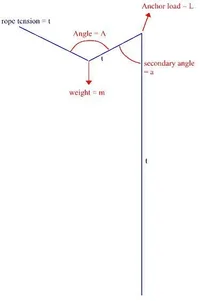
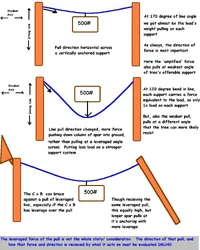
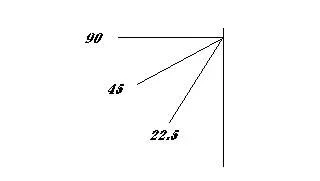
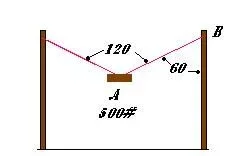
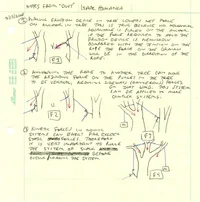
I think Dave is right, both of ya wonderful with the math, that loses me far enough back and have faith in both of you enough to figure that both paths lead to the same place. I think it is important to note, and more people take notice and try to understand the numbers you both lend. For you speak not of just figuring loads on a DWT, but; any center loaded line/sling etc. configuration. Meaning, this same lesson is the key to understanding : speedline loads, sweating in, angles on spiderleg jigs, angles on pulling a truck with 2 lines that meet in center, hoisting with crane and 2 legs of spread support, hanging a porch swing, lowering 1 load on 2 separate spread lines etc(all exactly the same numbers of angles and loads). In all cases, pulling with a single line, would carry the full load on that single line. With 2 same lines connected at same points(Prestretched the same) on support and load; will carry ½ load each; but spread apart 120deg., will each carry 1x load itself, like single line support example; from their it gits worse, more angle, increasing loads on each line above the weight above that of the load itself, on each line! That rule can stand to help, or ‘hurt’ your efforts; in the many ways above to apply the same math.
Even with the precise calculations on the angles exercise, we are guessing the strength of the supports/ interior condition of at least; then the elasticity of the line and said supports to absorb the worst part of the dynamic shock would vary, the slant to the ground of the support that caught the calculated force, the way the ropeman handled the load (running line slightly at high impact leveraged load stages of load travel, yet not building force badly, then ‘catching’ lower down at less leveraged position, but still not suddenly, then smooth on down, not stop/start until part of head touched ground or other branches etc.). Still, many variables that must be guessed at; so I maintain as Dave that we speak of patterns of guidance, for best decisions, and hard numbers as basis examples to these patterns and not everyday use. Pretty wimpy, but I guess I see room for both camps! Also, this microcosm, modular examination component by component, so that the components of a system’s patterns can be recognized, assessed individually, and how the affect each other in compounding combinations. If you can see ‘red line’ forces, leveraging on another set of leveraged forces (especially if they assess to be towards/at ‘redline’ ) ; ya know to back off, especially if those things don’t build for your favor, / cancel each other out; but rather compound against ya!
But, still, I think we should hang with the number search a little, to scout out the patterns of load and support as they drift up and from the precise measurements and become recognizable as a pattern. I think that pattern would be like on a metered scale, a feel for at what point the meter runs in the red etc.; to thumb rule decisions by; backed with the numbers we find here, confidence in superior decisions, and not letting things compound against us, but rather compound for us, by following the principals that are right here. To me, that is safety and productivity.
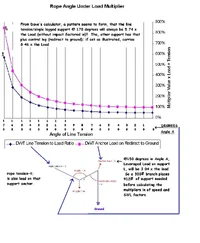
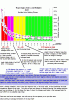
For those without Excel, i saved a screenshot of Dave's spreadsheet in HTML(with fake ".TXT extension/suffix that can be dropped). Dave's Excel version is a calculator that you can load different values into; here i took that and made a table of the different values from the calculator, so the effects of loading at different leveraged angles are visible, even though lacking the ability to change the numbers for the user to investigate themselves. i also added the multiplier that shows how many times the load each of the 2 supports takes on; these ratios/percentages only change with the angle, and are a key pattern i think! But all fairly from Dave's calculations, just carried on for more columns. The line tension "t" is also the load on the single legged support i believe.