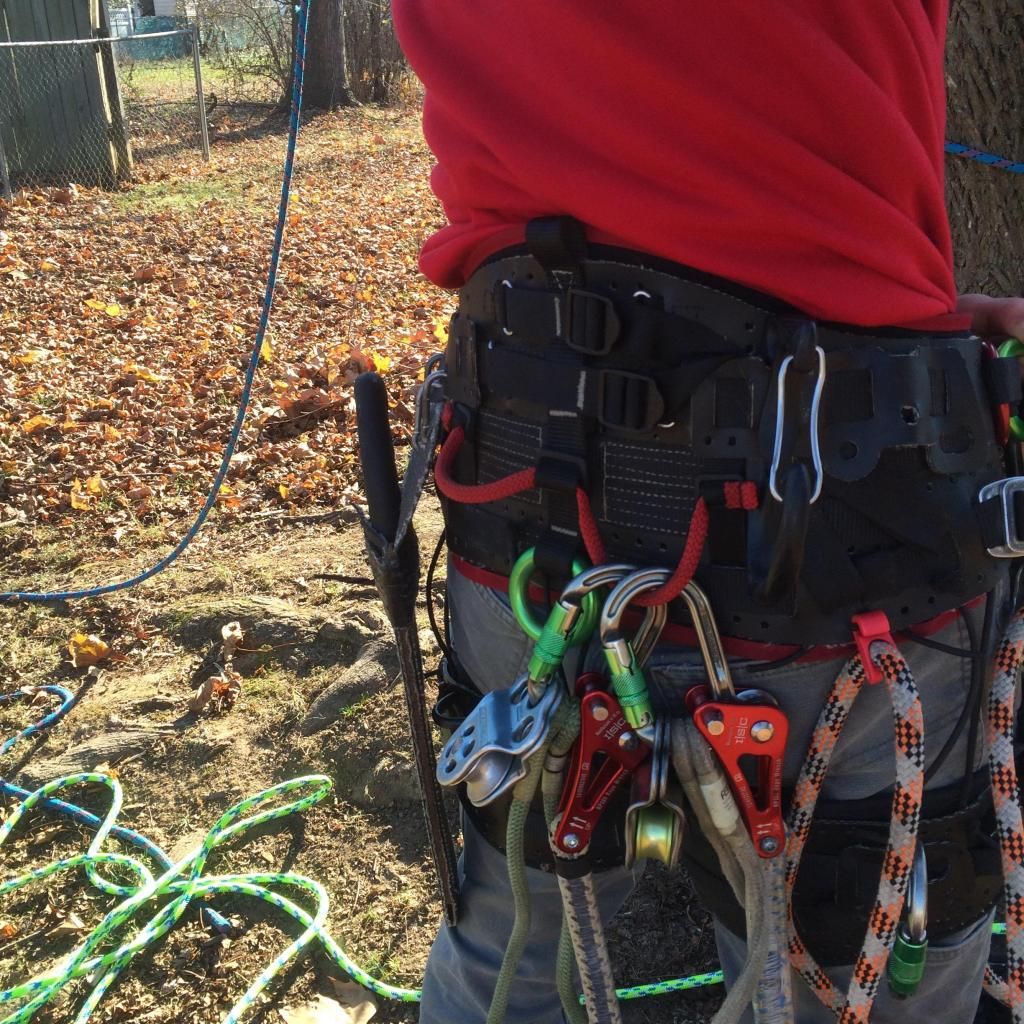
DRT

I doubt you would be able to be lowered anyways due to two ropes going through multiple redis, too much friction. My co worker did a multiple redi climb just srt and found slack in his line from anchor to first tip when he hit the ground. Something to ponder.
We've done successful DSRT lowering with one line going through a single union and the second line going through three.

The way the redirects are threaded will make all the difference, more so than the actual number of redirects.

Also, the load on each line will be shared to an extent, meaning less friction is applied in their respective unions than if a single line was in use.

Again, there is a great deal of physics involved in the canopy, all of which contribute to the possibility of a successful lowering.

I can actually imagine an advantage to 2 lowerable anchors with independant lines in asymmetrical redirects. The climber could be steered by the groundman while lowering.

All this being said, the best option is self rescue. Set up a lowerable system if you like, or don't. It really doesn't matter. As long as you and your crew have a plan in place for what to do if the S hits the fan.
 
Double wrenches... Twice the fun...
image_zpsc9f697eb.jpg
 
The ascent takes some working, kind of have to hold the tension with your hand as you as ascend, if you go one side to one side it is hard
Treebing I saw a new option on treestuff the triple threat and was curious if you had any insight on how this setup can help the DRT climber specially, if at all.(y)
Edit: help DRT climber specifically
 
Last edited:
I just saw that Treetop, $359 ain't chump change hopefully somebody has some insight or posts a video on its use.
My initial thought was one rope down to basal anchor with ring and other two ropes on climbing side of anchor point ready for climbers use however they choose . Setting and redirecting the two lines together or autonomously at will . Or even using one line with a second just for certain situations .. I just did a large sweetgum removal in an very poor from a rigging aspects location. I used two climbing lines alternativly as I worked out to each side of the 30 plus foot long limbs and it saved me dragging rope all over the tree as well as keeping a high tie in not being blocked by lower limbs as easy ..when returned from limb walk to trunk other line was waiting to go out the other side . just clip new rope on unclip one side and keep moving . through the tree.I have never thought to do that ,but DRT worked it well even if I didn't use them both simultaneously all the time ..just had to keep it clear of rigging which was not to hard to do for this particular tree.
 
I use a similar system with two ropes a midline knot and quick link. I'm sure that's practiced pretty commonly . Access and working lines are just becoming one and the same with stationary rope techniques.
 

DSRT CLIMBING
~ with the Bull Dog Bone ~

This video covers some of the advantages of DSRT with mechanical devices, including rope walking, symmetrical and asymmetrical redirects for solid work positioning, and planning for ease of traverse.

The work order was deadwood removal, lower lateral branch removal, and cable installation at 2/3 tree height. Much of the deadwood pruning was heavily edited out.

At 3:40 elapsed, the Secondary Line and Lead Line are threaded through TIP’s of Stem A & B, respectively. From here on, the Lead Line is advanced as a bight (pony tail) allowing remote redirect retrieval following limb removal. This allowed for immediate reverse-traverse for cable installation from Stem B to A. Unfortunately the battery died on the climber camera, losing some of the most desired footage of the cabling and traverse at the end of the climb.

A lower-able base anchor was set up for practice with the ground man (low & slow). When the lowering was done, the Secondary line was through a single TIP, and the Lead Line was through 3 redirects and fair led back to parallel.

Thanks to Ian for all the ground support and additional footage!

As far as the music goes, "three points where two lines meet"...."triangles are my favorite shape"... Come ON!!! Are you kidding me? I had no choice but to use it.
 
I've done something similar but with a pear quick link. I do still use it from time to time, but I usually prefer seperate anchors, just because then I have 2 true seperate lines incase the anchor got fouled.
 
I've done something similar but with a pear quick link. I do still use it from time to time, but I usually prefer seperate anchors, just because then I have 2 true seperate lines incase the anchor got fouled.
I believe it is derived from base anchor to quickly access with out needing isolation of particular T.I.P. , getting up there and setting canopy anchor or anchors up if desired or one in tree and on ground . in which you can place the anchor s to suit the situation . I prefer to get rid of basal anchor on removals and some pruning tasks all together ,but will almost always use base anchor for access. Then have ground take away base anchor after canopy anchor s setup
 
I just saw that Treetop, $359 ain't chump change hopefully somebody has some insight or posts a video on its use.
Seems like you could make your own with three climb lines you already own and two of Petzls open able rings (bridge rings from the Sequoia that they now sell individually) set with locktite. I suggest two because a Sequoia user has to use both bridge rings together for life support. I guess a quick link would be fine too.
 
DSRT CLIMBING
~ with the Bull Dog Bone ~

This video covers some of the advantages ....

A lower-able base anchor was set up for practice with the ground man (low & slow). When the lowering was done, the Secondary line was through ...
Just a note on the lowerable base anchor, ignoring added friction, that configuration puts 100 percent of the load on that hitch. ... hitch burn or lockup may be there.
Not saying to ignore it, it is just an unknown.
 
Last edited:
Just a note on the lowerable base anchor, ignoring added friction, that configuration puts 100 percent of the load on that hitch. ... hitch burn or lockup may be there.
Not saying to ignore it, it is just an unknown.
I use a very simple ,primitive lower able base anchor and I'm looking for a deeper perspective of what you are saying yoyoman .
 
Just a note on the lowerable base anchor, ignoring added friction, that configuration puts 100 percent of the load on that hitch. ... hitch burn or lockup may be there.
Not saying to ignore it, it is just an unknown.
There are plenty of ways to add friction below the hitch in this anchor. Which we normally do. We wanted to see how it worked in DSRT, and you can see Ian's brake hand in action. What we determined after that low & slow experiment was that holding tension with a brake hand would result in smooth hitch operation. I feel that my jump upon hitch release turned to immediate controlled lowering with just the pinch of the brake hand.
You can see that he untied two half hitches to release the system, and they were formed on a bight that was passed through the carabiner, not around the pulley. They serve to keep the hitch engaged if the standing end becomes unweighted, and to act as a stopper if the hitch was not grabbing.
Proper use, and plenty of practice is key if you're entering the lower-able base anchor territory. Ian has been a great climbing partner and we dig the practice and feed off observations. It's good stuff.
 
@yoyoman I thought the friction from the crotch was enough? Just like running DdRT through natural crotch. Correct me if I'm wrong.
Well that's what can fool people, it looks just like what we are used to, DdRT.
But in this case we start with 100 percent and friction can reduce from there, in DdRT we start at 50 percent and friction can reduce from there.
Depending on the bark it can be easy to overwork a hitch especially in an emergency or if someone is not aware and prepared like Eric was.
 
I use a very simple ,primitive lower able base anchor and I'm looking for a deeper perspective of what you are saying yoyoman .
I was a little quick on the draw there ,missed the fact that you were directing at the base anchor in the vid . Too much turkey and wine last night or something....
 
Last edited:
We get back to that hauling VS climbing thing I did a video about and figuring MA.
Same rope slung up over a limb, if you climb on it, it is 2:1, if you haul with it, 1:1, even if that "hauling" is actually lowering a climber for a base anchor rescue. I know some don't worry so much about being able to figure out MA but this is a great example of why knowing the difference here is so important.
 

New threads New posts

Back
Top Bottom