DRT

I'm thinking that would work. Although possibly cleaner to tie your alpine in the middle and attach the loop of the knot to a delta link in the eye of your basal tie. I'd think that would retrieve easier than two large rings.
So a base anchor and use the rings as a floating redirect?
 
So a base anchor and use the rings as a floating redirect?
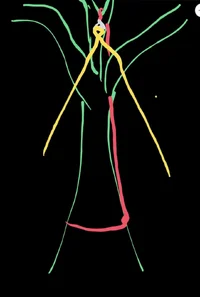
I'm not following there. My suggestion is as drawn in the very crude picture 20191108_173603.webp
The red is the basal tie with a delta link, the yellow is the climbing line with an alpine butterfly in the middle. Climb on both legs of yellow and retrieve after climbing by pulling the red.
 
I'm not following there. My suggestion is as drawn in the very crude picture
The red is the basal tie with a delta link, the yellow is the climbing line with an alpine butterfly in the middle. Climb on both legs of yellow and retrieve after climbing by pulling the red.

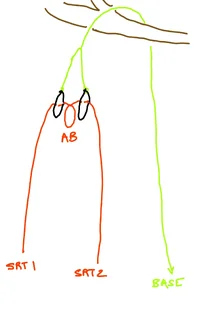
I knew what you meant, and it certainly is simpler. Here's a crude drawing of what I was thinking: alpine butterfly in the middle between the rings. I saw this on the internet today and was trying to think of another way to use it.

Screenshot 2019-11-08 at 19.03.50.webp
 
I'm not following there. My suggestion is as drawn in the very crude picture View attachment 63418
The red is the basal tie with a delta link, the yellow is the climbing line with an alpine butterfly in the middle. Climb on both legs of yellow and retrieve after climbing by pulling the red.
I must be missing something here because I am failing to see the advantage of using the setup in either of the drawings.. As I see it the 2 main reasons for running 2 SRT systems is redundancy as it pertains to safety, and better work positioning. You are running 2 systems off the same basal anchor while using the same climbing line, so I see almost zero safety benefit. Your TIP's are in the exact same location so unless you redirect one of those legs you certainly aren't bringing better work positioning to the game? Please enlighten me!
 
Yeah, the basal anchored rope gets severed, both working lines come down. Two climb lines, two retrievable canopy anchors in different parts of the tree, two retrieve lines (non life support, throwline works) and you have two seperate systems that are independant of each other, less chance of TIP failure, no chance of the client's dog chewing through something that will drop you on your head.

But then, I rarely use a basal tie... when I do, I use a similar method (seperate rope for the basal tie) and I only do it when it would be a long, tedious process to isolate a TIP. I'm a huge fan of the canopy anchor that can be installed/retrieved from the ground with no more work than installing a ring+ring FS and some throwline. For SRT, this is easy. For DdRT it involves slightly more steps and time, but is still doable (I'm assuming you don't want to use a R+R FS and want a pulley at the TIP).

The higher load on the TIP isn't actually my main concern with a base tie... it's a factor you have to consider... it's that very taught line down there at ground level where all manner of things can happen to it. Like some kid blasting into it with an ATV or some helpful homeowner "helping out" with his bow saw whacking the line. Ok, probably doesn't happen often enough to worry about, but that utter lack of control over the integrity of the system... leaving it at the mercy of pure chance and dumb luck... that really bugs me. I'd rather not have to worry about it.

A ground installable/retrievable canopy anchor that can handle two or three systems is fairly cheap and easy to make, if you want them all on the same anchor. I have some prototypes that I made with such a high level of overkill that I now use them to set rigging pulleys and blocks from the ground.

 
I must be missing something here because I am failing to see the advantage of using the setup in either of the drawings.. As I see it the 2 main reasons for running 2 SRT systems is redundancy as it pertains to safety, and better work positioning. You are running 2 systems off the same basal anchor while using the same climbing line, so I see almost zero safety benefit. Your TIP's are in the exact same location so unless you redirect one of those legs you certainly aren't bringing better work positioning to the game? Please enlighten me!

Just for clarity, I do not use this system or DRT at all unless I need a tie in point in two different trees, I'm just offering options for other who are looking to use it.

That said I do not think everyone using DRT is using it for redundancy so it's ok to use one tie in point. They are looking for better work positioning angles way out on a limb. With that thought process in mind, ascend one leg of the climb line up to the tie in point. Either tend your second device up or install it once your there. Redirect one leg to the left side of the tree and redirect the other to the right side. Then you have good rope angles in two directions when out on little wood for pruning.

This seems like a much better technique for a broad spread tree verse a conifer. As you mentioned, if both ropes follow the same path you may as well just be on one system as far as work positioning goes.
 
Oh, ok... yeah, then one anchor would make sense. If you used something like KM III 1/2" for the basal tie, you'd be good to go for weighting both lines when necessary/desired or even two climbers. That stuff has like 11,000 lbs. tensile, or something.
 
I must be missing something here because I am failing to see the advantage of using the setup in either of the drawings.. As I see it the 2 main reasons for running 2 SRT systems is redundancy as it pertains to safety, and better work positioning. You are running 2 systems off the same basal anchor while using the same climbing line, so I see almost zero safety benefit. Your TIP's are in the exact same location so unless you redirect one of those legs you certainly aren't bringing better work positioning to the game? Please enlighten me!
Thanks, that is why I wanted to run it by the brain trust here. I guess it goes back to the beginning of the thread about what DRT is. I thought it was more about positioning and movement through the crown. Farther back in the thread, there was a bit of discussion about using what Oceans calls a Y-system - spider legs or a triple threat for working the tree with two SRT devices. This set up seemed like it could be used in a similar way.
 
I keep meaning to try DRT one of these days. Meanwhile, any opinion on using this lowerable MRS false floating crotch as a floating anchor point for DRT? Thread a climbing line through the eyes, tie a midline blocking knot between the rings and maybe capture one leg with a biner. Haul it up to the desired union and base tie?

Climbing Lowering Anchor with Immediate Rescue

View attachment 63411
While cute I see no point in that line. Tie a knot, pulls or anything else and have a versatile second line.
 
I’m curious when pulling both lines up do you attach both to one throw line? A huge ass clove hitch over both? What is the method?
 
Last edited:

New threads New posts

Back
Top Bottom