
Navigation
Install the app
How to install the app on iOS
Follow along with the video below to see how to install our site as a web app on your home screen.
Note: This feature may not be available in some browsers.
More options
You are using an out of date browser. It may not display this or other websites correctly.
You should upgrade or use an alternative browser.
You should upgrade or use an alternative browser.
DRT
- Thread starter treebing
- Start date


treebing
Been here much more than a while
- Location
- Detroit, Mi.
I was actually able to convince the judges that since I was on two separate systems that I should be able to use a distel. I didn want to rock the boat too much so I used the yale kernmaster and the requisite beeline.
It was sad though because I saw many climbers who I know to be wrench climbers at work fly ddrt throughout the comp because they didn't have the kernmaster rope and beeline combo even though a house rope and prussic was on hand. A reaction I totally understand.
I made the plunge and spent a lot of money ahead of time to comply to the standards as much as possible and spent several weeks getting myself familiar with a foreign configuration. I was able to use the distel because I argued that I was tied into two separate anchors. I would have complied with a swabish if necessary and was familiar enough with its peculiarities that I could have made it work. For me personally a distel is better.
It was sad though because I saw many climbers who I know to be wrench climbers at work fly ddrt throughout the comp because they didn't have the kernmaster rope and beeline combo even though a house rope and prussic was on hand. A reaction I totally understand.
I made the plunge and spent a lot of money ahead of time to comply to the standards as much as possible and spent several weeks getting myself familiar with a foreign configuration. I was able to use the distel because I argued that I was tied into two separate anchors. I would have complied with a swabish if necessary and was familiar enough with its peculiarities that I could have made it work. For me personally a distel is better.
Last edited:

wyoclimber
Participating member
- Location
- Cody, WY
Nice Bing. Just got done with the Rocky Mountain Comp. I didn't run the wrench for exactly the reasons you stated. I didn't want to shell out for a system I wasn't sure I'd like and that I wasn't familiar with. Two of the masters guys ran a wrench, Luke Glines and Kevin Kelly and Luke won the masters. I think he won AR on the wrench as well but don't quote me on that.

Mangoes
Participating member
- Location
- Greater Toronto Area
Going to boast a little here. Yesterday competed in the michigan comp. Did work climb, aerial rescue, and masters climb all using double rope technique. Using two rope wrenches.
Second in AR, 4th in work climb, 1st in masters Proving that DRT is not necessarily a slow or cumbersome technique but can actually be quite helpful!
Question: due to the ITCC Rule book; did you still have to lanyard in at each work station, or unclip DRT line "A" to triangulate?
(FYI - our little conversation over on the other thread was the catalyst for reading nearly all of this thread - I have a better understanding of where you're coming from Kevin......though amicably disagree with you that DdRT is definable as SRT..... Cheers)
treebing
Been here much more than a while
- Location
- Detroit, Mi.
Yes I used my lanyard at every station. On the plumb Bob in the master's I lanyard ed into a twig about 1 inch in diameter which was my only option.

Paul Hedderly
New member
Are there videos from the event climbs?

Mangoes, I can appreciate your stance on the definitions, since some of them (along with their acronyms) have been in place for considerable lengths of time. I also grapple a bit with my own thoughts on the issue of terminology.Question: due to the ITCC Rule book; did you still have to lanyard in at each work station, or unclip DRT line "A" to triangulate?
(FYI - our little conversation over on the other thread was the catalyst for reading nearly all of this thread - I have a better understanding of where you're coming from Kevin......though amicably disagree with you that DdRT is definable as SRT..... Cheers)
I like Tony's simple references to systems being 1:1, 2:1, 3:1, etc..., as they can be clearly understood, and describe the configuration in its most basic form. Whether this thread is the place for it or not, I continue to harbor the opinion that as a whole, we need to build our language and terminology.
What do you feel would be some good definitions?
Last edited:
treebing
Been here much more than a while
- Location
- Detroit, Mi.
I later found out that being tied in twice is not even a requirement on the plumb Bob station in the master's challenge. I thought that was interesting
treebing
Been here much more than a while
- Location
- Detroit, Mi.
Just attended the PNW isa conference and attended a class put on by Ryan Senechal. I think I got the name right. He also attended a SPRAT training and came to bassically the same conclusions as I did. Really cool, they have instituted some of the same ideas of redundancy into their company training.
Last edited:

JontreeHI
Branched out member
- Location
- West Michigan lakeshore
Hey Kevin, if you have a chance would you be willing to post a photo of what a tree looks like when you're done? Or redirected many times way out in a limb?
It would be really interesting to see the route of your lines, especially in a situation where you start them both on the same crotch.
Thanks
It would be really interesting to see the route of your lines, especially in a situation where you start them both on the same crotch.
Thanks

macswan
Been here a while
- Location
- Champlain Valley, VT
Just did a big dead elm today, tied in to a maple above it and high up in the deceased's canopy. Rope runner on one line bulldog bone on the other. Crushed it. Have never felt safer in a stone dead tree. No rigging, was able to get way out on the limbs and cut small when necessary. DRT definitely has a place in my tool box.

TylerHoffman
Participating member
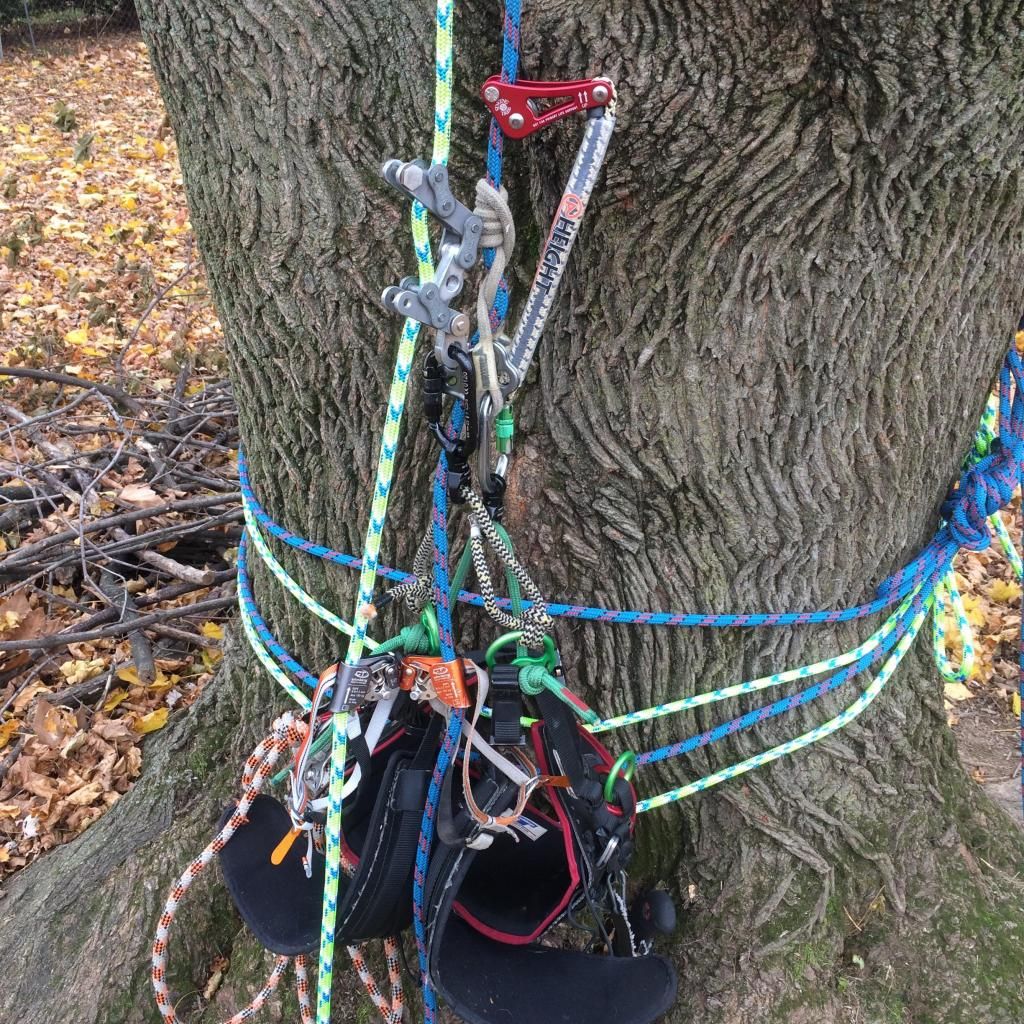
Played around with it alittle today...

Treetopflyer
Been here much more than a while
- Location
- Coastal N.J
I could see DRT as a good advantage if both of your lines can be tended easily with one hand . I am going to try DRT with that same setup as you Tyler. Not feeling the need to lanyard in all the time will be good enough reason for myself to give it a go ,not to mention the redundancy of having two ropes on separate bridges has got to feel very safe and what a change for redirecting in big trees,smoother transitions , Excellent thought going DRT IMO!

treebing
Been here much more than a while
- Location
- Detroit, Mi.
Thanks! Good to see people incorporating it a bit.
TylerHoffman
Participating member
I definately felt very safe. It would help a ton to have 2 of the same systems (2 bones or 2 wrenches or 2 runners) instead of a bone and a wrench. But it was still smooth. Ascent is alittle challenging. Thanks again Kevin for the pointers! I might make a vid if I feel up to it
TylerHoffman
Participating member

TreeLogic
Branched out member
- Location
- Coastal SC
Sweet Tyler. Never tried it but that vid gave me reason to want to.

dogwood
New member
- Location
- Garner, NC
Well done, Tyler. Makes me think about using DRT in the woods. Sometimes it can be difficult to judge the security of a TIP, when it's way up in a tree I haven't climbed.
TreeLogic
Branched out member
- Location
- Coastal SC
Since you're not using that lanyard anymore wanna send it to me? I'll pay shippingHere is my lanyard set up for this particular tree

New threads New posts
-
test
-
 Alternatives to standard asphalt around roots
- Started by southsoundtree
- Replies: 5
-
-

-

-
 For Sale: 2018 Vermeer BC1000XL Chipper | 918 Run Hours | Deutz Diesel
- Started by Blue Ribbon Tree
- Replies: 2
-

