DRT

Good stuff Kevin can't wait to play around with this in the winter when i have time to play around! I have used two systems in the past for dead or compromised tree removals and loved it. looking forward to trying to navigate through the big canopy's with this system.
Tyler thanks for the vid Nice work!
 
The ascent takes some working, kind of have to hold the tension with your hand as you as ascend, if you go one side to one side it is hard
 
I'm excited to try my first dueling stationary rope climb tomorrow. From what I'm reading,seeing,hearing,and feeling I believe I'm gonna do my main ascent off base tie,setup second rope on canopy anchor and let the game begin.
 
those of you toying around with this, are you setting your two PSPs close by / in a similar area or are you working with them as two totally different PSPs? say in a multi stem tree, one PSP on one stem and the the other elsewhere.
i understand you can do whatever you want. it just looks like from tyler's video (cool to see someone working it, thanks hoffman), the idea is more like just having another like for suspension when working in a similar manner to one rope (one TIP)
 
You could just rope walk up and clip the bone on your 2nd line when u get to the top or even if u stop to work.
That's my plan for my virgin run, being as I'm lacking left foot ascender , may try putting pantin on left foot backwards or use my Haas on one rope and ct on other ,but just to get into tree I'll access with one rope for now,unless my backwards pantin proves its worthy on my left foot ,canopy anchor second rope then start work. The main advantages I see with duel rope is the redirect passing simplified and the redundancy of two ropes is great as I am horrible about lanyard every cut . I've used two ropes in trees plenty, just never two stationary systems. Should be fun !
 
those of you toying around with this, are you setting your two PSPs close by / in a similar area or are you working with them as two totally different PSPs? say in a multi stem tree, one PSP on one stem and the the other elsewhere.
i understand you can do whatever you want. it just looks like from tyler's video (cool to see someone working it, thanks hoffman), the idea is more like just having another like for suspension when working in a similar manner to one rope (one TIP)
I think for some climbs the ropes running next to eachother over same crotch(s) will be common ,but the ability to go over /under/through redis that aren't commonly passed easily it will shine. Or set them far apart if need be for positioning will be awesome as well.
 
No reason this couldn't be daily work practice ,even with different hitches works awesome for myself ..found my second line short just enough so its up in tree with me not on ground is good for fast redirect not throwing 120 or 50 extra feet around helps but it beats lanyard in ..always tied in twice , excellent idea Duelstationary rope technique 14163256011120.webp
 
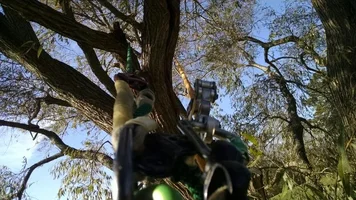
Just got done pruning wide decurrent weeping willow on a windy day and DRT was fantastic for me , I've been in this tree before with a 2:1 and 1:1 setup, but its not the same . The way you can move through redirect is faster for me. Felt super safe in 30m.p.h gusts very stable and my hitches lined up beautifully for one hand descents .Thumb controlled one, fingers on the other , tending was easy,had good grip on two ropes for going up . "Locked"hitches together with biner and footlocked when out in space and used the leverage of each rope to move up when feet were on tree. Rarely used foot ascender for this tree as its a curvy creature and it wasn't necessary with two ropes.Very good concept to undertake and learn IMO .
 
going to have to play around with that idea. i get what your saying about the redirect.

i think not having two of the same system would bother me. easily solved like any other thing in climbing right?
buy more gear.
 
going to have to play around with that idea. i get what your saying about the redirect.

i think not having two of the same system would bother me. easily solved like any other thing in climbing right?
buy more gear.
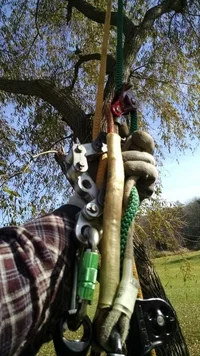
Climbed on a wrench and a bone today and as long as rope bridges are adjusted properly they line up well top of the hitch was even with bone and one hand control with bulky atlas was easy ..just worked bone with thumb hitch with fingers , but two of the same may be better , the way these two worked for me today i cant be sure.14163352522610.webp
 
I posted this in the Compact Bull Dog Bone thread and thought I'd copy/paste it here too...

OK, so today was a veteran Pin Oak climb and there was significant crown damage from a previous storm. I climbed DSRT with two Bones. The setup was as follows:

~ 200' Escalator bagged up and loaded into the base anchor.
~ 175' of KMIII and 120' of Tachyon pulled through the same union and connected to the Escalator.
~ 2 BD Bones with bollard sizing to match each climb line diameter.
~ Single rope bridge with Rock Exotica swivel, both Bones loaded into the same swivel eye.
~ 7' positioning lanyard.
~ HAAS 2.0/Clip'N combo.

What I found was that I could rope walk up a single line as normal in SRT, but I coiled up a bunch of tail weight before leaving the ground, so the second Bone just gobbled slack as I climbed. Nothing different than normal, just a touch slower for the first time with these tools. Footlocking would be a snap if anyone is even up for that anymore. You could easily tend both tails simultaneously with that method.

Having both units in the same swivel eye was really helpful numerous times during the climb.

This tree was WIDE and also fairly wide open for a Pin, but it's super old and pretty beat up. I had a nice central leader to tie into and the Tachyon sort of became the back line while the KMIII was the lead. I must have made that choice since the KMIII is a bit lighter and feels easier to advance around the crown. I had an absolute blast today with this setup.

Planning your route is so much fun, because it's so easy to travel wide distances once you have a couple complementary redi's loaded up. Quite literally, from the outer reaches of some leaders, I could hang glide right back towards the center and prepare to head out into another section. Passing limbs is great when you can alternate one 'scender at a time. You can also keep the lanyard quite short. I probably only used about 4' or 5' of working end the whole time so I could keep the lanyard tail daisied up and snag free. Trust me when I say that with the concept down and a bit of practice, it's easier to manage two main lines as one than messing around trying to stow/unstow a lanyard tail a couple handfuls of times during a climb.

I felt so secure at all times with all the redundancy, but navigating never felt like that. The two tails manage just like one, and even when you have the two lines in different redirects that spread the incoming rope angle above your multiscenders, you can still grab both lines together and tending both tails together on limb walk returns....this is obviously to a point, but needless to say, the farther away you are from your redi's, the easier it is to manage both systems as one. I'm thinking that it's even easier to work both Bones with one hand since the climber's load is shared between the two and maybe that helps. I think it's more than just perceived, even with slightly spread incoming rope angles.

There's a bit of video from my co-worker today, and I'll be sure to post it once it's sent to me.
 
Last edited:
I was DSRT again today with the same setup I described in an earlier post. It worked out really well, though there are some considerations to make. One thing I love is the 2 points of attachment at all times because I'm running a short lanyard, so passing redi's is totally secure. The other is that if your main lines are all parallel, and you want to make a quick handsaw cut, you can just slack out one line a bit and make the cut. In fact, at one point, I had to cut a piece of deadwood out of a union that one of the main lines was redid through. I bucked in, slacked that line out (still positioned with 2 points of contact) and hung it over a sprout to keep it away from the cut. It's the little things...(y)

One important thing is that if you want to be lowerable, and you plan to pass asymmetrical redi's, you'll need a separate anchoring system for each line. The kit I've been using lately will only be lowerable if I pass all symmetrical redi's because my two lines join into one lowering line at the base anchor. In this kit, if someone was to lower me and I had passed asymmetrical redi's, the attachment of the 2 mains and lowering line would eventually reach a branch union and be unable to go any further. A loop would be created in the crown.

Everything has its limitations.

 
I was DSRT again today with the same setup I described in an earlier post. It worked out really well, though there are some considerations to make. One thing I love is the 2 points of attachment at all times because I'm running a short lanyard, so passing redi's is totally secure. The other is that if your main lines are all parallel, and you want to make a quick handsaw cut, you can just slack out one line a bit and make the cut. In fact, at one point, I had to cut a piece of deadwood out of a union that one of the main lines was redid through. I bucked in, slacked that line out (still positioned with 2 points of contact) and hung it over a sprout to keep it away from the cut. It's the little things...(y)

One important thing is that if you want to be lowerable, and you plan to pass asymmetrical redi's, you'll need a separate anchoring system for each line. The kit I've been using lately will only be lowerable if I pass all symmetrical redi's because my two lines join into one lowering line at the base anchor. In this kit, if someone was to lower me and I had passed asymmetrical redi's, the attachment of the 2 mains and lowering line would eventually reach a branch union and be unable to go any further. A loop would be created in the crown.

Everything has its limitations.
I doubt you would be able to be lowered anyways due to two ropes going through multiple redis, too much friction. My co worker did a multiple redi climb just srt and found slack in his line from anchor to first tip when he hit the ground. Something to ponder.
 

New threads New posts

Back
Top Bottom