DRT

Ok but I don't think we can change what DRT and SRT mean. I am not suggesting we change anything just that we use them correctly.

 
And DRT is important to use as a term in our industry. There are certain times in our work day where we need to be under no uncertain terms be DRT. SRT is also acceptable for other situations

I cannot really think of a difference from a safety mentality where distinguishing 1:1 vs. 2:1 is helpful
 
Last edited:
So the ITCC recently came up with proposed rule changes to accommodate 1:1 SRT. They came up with in 1:1, tools need to be approved for use without a backup. And 2:1 can use 11 mm and 1:1 can use 10 mm. I'm not sure why 2:1 tools don't need to be approved for SRT.

Some people have said that you should never descend on a hitch 1:1 SRT. I don't see a problem with attempting it. I have attempted it a lot and did not find it dangerous at all. It doesn't work but is it a "never attempt?"

Kevin, I know you are not stupid, so I can only assume you are being stubbornly argumentative. Almost anything can be done, but for general tree work or even competition, can't you see how using an unassisted friction hitch on a one-to-one line would be a really bad choice for descending in most situations?

David
 
When people ask me what a wrench is for I tell them to go try descending a 1:1 line with a hitch an no wrench. I have no problem with people attempting it. I have tried and tried to make it work but it doesn't. I could also make it safely to the ground with just a hitch and a 1:1 line.
Performance is different than hazard

Kevin, I know you are not stupid, so I can only assume you are being stubbornly argumentative. Almost anything can be done, but for general tree work or even competition, can't you see how using an unassisted friction hitch on a one-to-one line would be a really bad choice for descending in most situations?

David[/QUOTE
 
Last edited:
A lanyard definitely counts as a rope

A rope it is for sure, but a lanyard tie in is not always (or maybe even rarely) a load bearing anchor.
You already wrote somewhere else about a lanyard and an SRT system qualifying for a DRT system, I disagree here. A true DRT system is something completely different as you know now after your Industrial Rope Access education, right? ;)
 
I believe We learned a lanyard applied correctly counts as a point of attachment. A lanyard to a sucker does not really count. There are definitely a lot of things that don't translate well from rope access to tree work.

What is the exact wording on the use of chainsaws and sharp tools in tree work?
 
For me DdRT is really not a good term, it doesnt even include the meaning that the rope is in movement.
You can also double a line and climb on it without the rope moving.
All the terms work just because of the definition given to them by the users.
Wasnt SRT in Tree Climbing just used for an access technique in the beginning?
 
http://www.treebuzz.com/forum/threads/ansi-climbing-code.27075/

Found this as in regard to handsaw and chainsaw use. I guess ansi concluded that handsaws are not as dangerous as chainsaws and you can use them SRT.

So I was not cheating as much as I thought I was. Especially in the last few years I usually have lanyarded in with my chainsaw.

I personally have come closer to cutting myself out of a tree using a handsaw than a chainsaw.
 
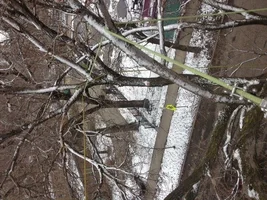
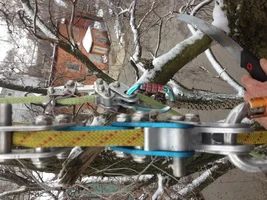
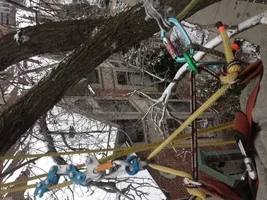
Here is something I found working DRT. That if I alternated my redirects it was easy to move through the tree and provides me with excellent work positioning. Moving through redirects is a dream.
 

Attachments

  • image.webp
    image.webp
    119.1 KB · Views: 105
Kevin, are both lines attached to your bridge? if so, this means if you cut your bridge there's no back up.
 
Just think outside the box but...

1SRT - 1 Single rope, 1 anchor point
2SRT - 2 Single ropes, 2 anchor points

1DRT - 1 Doubled rope, 1 anchor point
2DRT - 2 Doubled ropes, 2 anchor points

I am saying anchor point which may be Tie in point or something else. I am not sure what to call it but it is essentially the tree for simplification.

Frank
 
That actually kinda works, and would make even more sense if the S was for static and the D was for dynamic, but the commonly accepted terminology should be fine with the number. If letters don't fit, why not use numbers, right?
 

New threads New posts

Back
Top Bottom