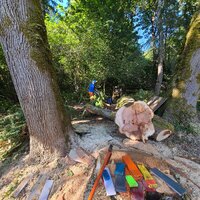
Does this cut violate ANSI srandards?

First I ever heard of an over center vertical spar chunk cut was Reg Coates magic cut. Fell over on it's own. Believe it was a youtube video. (?)) Remember some turmoil over european pruning standards vs A300 re Guy Meilleur.

Has anyone ever addressed "don't rely on or expect hinge behaviour in crispy old wood" in a standard? Maybe a list of fibrousness/brittleness of tree species. Perhaps important like hinge geometry.
Reg may well have used it.

I don't recall any video of it besides Gord's.
 
After reading the Gord‘s magic cut thread here and at the treehouse and getting a better understanding of the cut I came to the same conclusion Reg did-

”I would use that cut to replace snap cuts, if I thought the snap cut would he hard to break, say on a big wide log. But, I'm not sure about much more than that.”

Using the magic cut on slightly back leaning mill logs (12 ft +)? A complete non starter for me, as the potential hazards in this scenario heavily outweigh any benefit that this cut might bring to the table.
 
Last edited:
I have seen it done both ways.
Let me ask you, how many times have you gotten your bar pinched when cutting the deep dutchman?
Zero in over a decade. Maybe 13 years.

If one can't tell that the kerf is going to close and bind, and stop cutting when the kerf closes slightly, Don't use this cut.
If one is in that situation, one may choose to keep ones get on the ground.

Banging over backleaners and big tops is far more advanced and harder to perform easily and successfully than working with the lean on a log stood atop a spar.
 
Last edited:
After reading the Gord‘s magic cut thread here and at the treehouse and getting a better understanding of the cut I came to the same conclusion Regs did-

”I would use that cut to replace snap cuts, if I thought the snap cut would he hard to break, say on a big wide log. But, I'm not sure about much more than that.”

Using the magic cut on slightly back leaning mill logs (12 ft +)? A complete non starter for me, as the downsides heavily outweighs any benefit that this cut might bring to the table.
After reading the Gord‘s magic cut thread here and at the treehouse and getting a better understanding of the cut I came to the same conclusion Regs did-

”I would use that cut to replace snap cuts, if I thought the snap cut would he hard to break, say on a big wide log. But, I'm not sure about much more than that.”

Using the magic cut on slightly back leaning mill logs (12 ft +)? A complete non starter for me, as the downsides heavily outweighs any benefit that this cut might bring to the table.
Where do backleaners come in?
This is for neutral logs or going with the lean.
With enough lean, you can make a face cut and hinge easily.

I can reach an adjacent trunk with my bar and let gravity tip the log, or I could work one trunk then the other, climbing back up the second for chunking the second spar, but I don't care to.

If I'm working down a snag that I won't want to climb next to a strong tree I would then be dealing with pulling up pull rope, tying it on, and dropping logs onto the rope.

I've had to pole chainsaw snags from strong trees. Gravity and physics work a treat.


I'm not going to snapcut and push big logs. Sounds dicey.

The snipe can be pretty shallow angled, so far enough to cut.


What are the downsides?
A slightly longer time holding down the trigger for a bit longer sloping cut?


If you are cutting with a hinge, you need it to release cleanly. Don't accidentally cut off the hinge on a side or slip your bar nose through the middle of the hinge with a Humboldt face. You might lose the piece off to the side or lose your saw.


I'd be particularly interested to hear the negative from someone who has used the cut.


I have no horse in the race.

It's not my cut.

I've used it a Lot, with nothing bad to say about it.


I wouldn't use it on easy to push snap cuts.

What does a 12'x24" fir log weigh? Way more than I would try to walk to the edge of the spar and dump. It would be less accurate, too.

 
Last edited:
What does a 12'x24" fir log weigh? Way more than I would try to walk to the edge of the spar and dump. It would be less accurate, too.
What is beneficial about this cut as opposed to a standard over center notch? What is the dutchman doing for you? A standard hinge directs the log where you want it to go, not just gravity with your no-hinge dutchman cut. I don't get the benefits. Seem you are relying solely on making your snip perfect for where you want the log to end up because that is what it is going to be sliding on rather than letting your hinge make that determination. A bit confused, so please be patient.
 
What is beneficial about this cut as opposed to a standard over center notch? What is the dutchman doing for you? A standard hinge directs the log where you want it to go, not just gravity with your no-hinge dutchman cut. I don't get the benefits. Seem you are relying solely on making your snip perfect for where you want the log to end up because that is what it is going to be sliding on rather than letting your hinge make that determination. A bit confused, so please be patient.
HInge is for directional control...

the "magic cut" doesn't need help fromt he hinge.. it just falls right into the empty space... hinge just mkaes things harder. No need to fool around trying to break the hinge.
 
No need to fool around trying to break the hinge.
I don't know how you cut down trees, but I have never had to fool around trying to break a hinge. I let the falling piece do that on its own. Hinge is for directional control. Exactly! Letting it fall into an empty space does not control directional fall.
You are not selling me with this method one bit.
 
I don't know how you cut down trees, but I have never had to fool around trying to break a hinge. I let the falling piece do that on its own. Hinge is for directional control. Exactly! Letting it fall into an empty space does not control directional fall.
You are not selling me with this method one bit.
You asked a Question. I answered it.. if you want to learn, then try approaching the subject with curiosity and an open mind. I can assure you that the guy who introduced that cut, is a bad ass tree man, who knows more about tree work than your average bear.

And no one is trying to sell you anything. It's all physics. So yes, when the cut is made properly, letting it fall into the empty space provides 100% directional control. The fact that you can't see it is an indication of your limited perspective and experience.

I don't use the cut much either, but I have used it and can assure you it is a faster and easier way to bomb short chunks off a satraight spar, than going to the trouble of creating a hinge. And it's 100 percent effective at directional control. Particularly if you are woking solo, this might be a good trick to add to your tolbox.

Sounds like you're stuck in the box on hinges...

I probably made 100 cuts on this oak and only 1 hinge so far:

 
You asked a Question. I answered it.. if you want to learn, then try approaching the subject with curiosity and an open mind. I can assure you that the guy who introduced that cut, is a bad ass tree man, who knows more about tree work than your average bear.

And no one is trying to sell you anything. It's all physics. So yes, when the cut is made properly, letting it fall into the empty space provides 100% directional control. The fact that you can't see it is an indication of your limited perspective and experience.

I don't use the cut much either, but I have used it and can assure you it is a faster and easier way to bomb short chunks off a satraight spar, than going to the trouble of creating a hinge. And it's 100 percent effective at directional control. Particularly if you are woking solo, this might be a good trick to add to your tolbox.

Sounds like you're stuck in the box on hinges...

I probably made 100 cuts on this oak and only 1 hinge so far:

I don't suspect I will learn anything from you. My limited experience was felling trees before you were out of diapers. The only physics involved with a free falling object is gravity. So far all I have seen from you is, telling people how great you think you are. What I see is just an idiot with a saw and a camera and a big ego. And I am not watching your stupid videos.
 
Last edited:
Suit yourself... but please don't act like you know what you're talking about, becaue that's all it is.. an act.

You ask a question becasue you don't know, and then throw insults at someone who does know and is simply trying to answer your question.
 
What is beneficial about this cut as opposed to a standard over center notch? What is the dutchman doing for you? A standard hinge directs the log where you want it to go, not just gravity with your no-hinge dutchman cut. I don't get the benefits. Seem you are relying solely on making your snip perfect for where you want the log to end up because that is what it is going to be sliding on rather than letting your hinge make that determination. A bit confused, so please be patient.
You can do this at ground level with a small chunk to experiment.


You can use the snipe to direct straight off the stump, like @rico did, textbook, in a recent post of a big doug-fir.


In these parts, I've heard a former commercial feller call the obtuse (IIRC) snipe (angled relative to the hinge) a "kicker" as you can kick the tree to one side partway through the fall. A chunk of wood on one side of the face or an intentional one-side Dutchman can do similarly.

Some rare situations, without it being critical situations, can utilize these ways of changing course midway through the fall. You may need a tree to move north at the start of the fall to clear a conflicting canopy, trunk or other obstacle, then midway, want it to turn and land to the N-nw or N-ne.

Not precise like a typical hinge.


Seperately from an automatic early break of a hinge corner due to dutchman or a chunk of wood inside a standard face
if stood on hinge corners, no middle of the hinge, cutting one corner off, mid-fall, may allow a falling tree to roll off another tree with less/ no damage, rather than hang up.

Also, not my technique. I learned it from Stig, at the TH, like nylon stacking plates for wedging instead of stacking wedges that want to spit out.20230921_152632.jpg


The large, orange wedges, stacked head-to-toe, were not used this way. I just set one atop the other after the fall.
 
I've got old guy memory, but to me notch past CofG was the gist of it, and adding dutchman or bypass or perhaps chasing the hinge to thin/none was a part I can't recall. Maybe continuing to cut till motion onset seems like chasing the hinge if you're a bit slow stopping. Pretty sure there was motion onset before any sort of bypassing could occur.

Any takers on commenting on standards and crispy brittle wood? Is there any addressal of it anywhere?
 
1) ANgled top cut near or past 1/2 diameter...
2) bottom cut meets the top cut per normal hinge creation, (remove pie cut)
but instead of stoppping the bottom cut to avoid a bypass, the bottom cut intentionally continues past the top to bypass and continues until the piece is about to sit down and pinch the bar.
3) cut the back strap to trip the piece...

if you went past 1/2 way with the notch, it will fall right into the notch and keep going without help

if you are short or just at 1/2 diameter, just give the piece a very little push to get it moving...
 
This conversation has me thinking about an indispensable tool that I never leave home without, but don't recall being discussed on this forum-

When I get to the portion of my day where I am chunking logs the first thing that I have sent up is my bag with 4 items in it. A log tape, some wedges, a hatchet, and most importantly a plumb bob. If there is a shred of doubt as to the lean of a log my trusty old plumb bob will give me a definitive answer on how I proceed, mitigating the chances of me misjudging a lean and doing something stupid.
 
Last edited:
This conversation has me thinking about an indispensable tool that I never leave home without, but don't recall being discussed on this forum-

When I get to the portion of my day where I am chunking logs the first thing that I have sent up is my bag with 4 items in it. A log tape, some wedges, a hatchet, and most importantly a plumb bob. If there is a shred of doubt as to the lean of a log my trusty old plumb bob will give me a definitive answer on how I proceed, mitigating the chances of me misjudging a lean and doing something stupid.
Wisdom
 
This conversation has me thinking about an indispensable tool that I never leave home without, but don't recall being discussed on this forum-

When I get to the portion of my day where I am chunking logs the first thing that I have sent up is my bag with 4 items in it. A log tape, some wedges, a hatchet, and most importantly a plumb bob. If there is a shred of doubt as to the lean of a log my trusty old plumb bob will give me a definitive answer on how I proceed, mitigating the chances of me misjudging a lean and doing something stupid.
Perfect!!!
 
Had my wedges and short 5# ax. No need for a tape... everything was going to firewood.

A plumb bob is a good tool. A biner on an earplug cord will do in a pinch. If in doubt, use a tool.

My phone has a clinometer, level and likely a e-plumb bob. Good reminders.

Magic Cut a few chunks today.
Snap cut a couple.
Put a one or two logs down with a rear hinge.

Run of the mill, root disease tree. Maybe 120', nothing particularly tall.

Run of the mill, basic cutting

When I changed to a rear-handle, the chain sent up wasn't cutting straight.
A good time not to need to line up perfect hinges. All logs fell where I planned.


20231106_162653.jpg
Nice spot in the woods.
 

New threads New posts

Back
Top Bottom