Does this cut violate ANSI srandards?

Side note-
I was just reading in the October Arborist News that the FAA replaced "shall" with "must"
Well ther's something that makes a little sense... Why wouldn;t they have done that in the first place? ANother perfect example of how poorly produced these standards are.

And so yes Tom, I will send a quick note to the committee about deep notches...
@Daniel Your mode is to complain about things but not do anything but complain. There are many ways for you to share your ideas. Writing about them on websites is one of the less effective means. Getting involved in the Z133 is more effective.

If you have such a fantastic solution get to a committee meeting. Either that or take your complaints somewhere else.
This is elsewhere... That video has over 1,400 views last I checked.. those are mostly unique viewers. This thread presently has 602 views, mosty multi-repeats. So likely far less than 100 unique viewers here vs well over 1,000 on YouTube... Sorry to burst your bubble Tom, but TB isn't making so much of a buzz these days.

Your admonistion that I don't do anything but complain is, as usual, total garbage. I put out the video raising the subject to a larger community. MyYT channel has over 13K subs. And I should do better. Gotta get to some writing this winter. Your suggestion to start a webiste is a good one. Its on the to do list.
 
Well ther's something that makes a little sense... Why wouldn;t they have done that in the first place? ANother perfect example of how poorly produced these standards are.

And so yes Tom, I will send a quick note to the committee about deep notches...

This is elsewhere... That video has over 1,400 views last I checked.. those are mostly unique viewers. This thread presently has 602 views, mosty multi-repeats. So likely far less than 100 unique viewers here vs well over 1,000 on YouTube... Sorry to burst your bubble Tom, but TB isn't making so much of a buzz these days.

Your admonistion that I don't do anything but complain is, as usual, total garbage. I put out the video raising the subject to a larger community. MyYT channel has over 13K subs. And I should do better. Gotta get to some writing this winter. Your suggestion to start a webiste is a good one. Its on the to do list.
YouTube lacks substance.
Case in point 4.6 million people have waisted a few minutes of their lives watching this in the past 12 months.
Sounds like a pretty comfortable spot for you…
 
YouTube lacks substance.
That's complete nonsense... a more accurate criticism is YT has too much substance... Lots of crap there for sure. Popularity is not necessarily a measure of expertise...

That doesn't mean there aren't many examples of excellent tree work on almost all levels to be found... Have you never learned anything about tree work from YT?
 
Can’t remember the last time I made an undercut that was a 1/3 the diameter of the wood I was cutting. and don’t get me started on the 45 degrees on the angled portion of your undercut. I think the folks at ansi need to go actually work in the woods for awhile…
right...saying these guys are clueless isn't whining or complaining.. it's simply stating the obvious.
 
Here's a copy and paste from another thread abou th eletter Iwrote to the A100 committee circa 2006


I wrote to the ANSI committee about.. they were still showing the three point cut circa 2006.. then there was an asterick and at the bottom of the page it said (see appendix x)

When you turned to appendix x, there was an entire page with only one sentence saying something to the effect that this cut to be used on small limbs under 2-3" diameter... LIKE WHY THE FUCK WOULDN'T THEY HAVE JUST PUT THAT ONE LITTLE SENTENCE WITH THE DIAGRAM ?
we don't need a treasure hunt when there was plenty of room to put that sentence in the body of the copy. The fact they did that shows that they are either total idiots, or that they are intentionally keeping knowledge occutled (hidden).

Now I was recommending that the entire three point cut diagram be removed. They write back and told me that they were going to place the warning to only use this on small cuts with the digram rather than in the appendix. When the new pruning standard came out, the warning was still in the appendix...

ANd last I checked the three point cut diagram was still in the standard. My latest copy has disappeared, but I think that was 2016 or 2017... These guys are complete morons. given how foolish that diagram is and the fact that it's close to 40 years out of date, why would ANYONE LISTEN TO ANYTHING THESE PEOPLE HAVE TO SAY?

I HAVE ZERO RESPECT FOR ANYONE THAT PUTS THAT DIAGRAM OUT (after 1985)
ps.. have fun with the go pro.. and drop that back cut under..
 
Daniel's Primer

tree pruning primer

no live cuts on the main stem(s), or if the client insists only smaller cuts on the main stem(s), absolutely no live cuts over 4", even if you have to leave a stub, leave most epicormic shoots (sprouts), they are especially important to leave if they are near an existing wound, and if the client insists, then rather than remove all sprouts, just thin and shape, with the long term goal of having the sprouts develop into small limbs. It's also possible to leave a few stub on an initial heavy prune with the goal of letting those stub fill up with sprouts, rather than the trunk. Then 1-3 years later, the tree will have normalized its growth, the stubs that are loaded with sprouts can be removed with a clean target cut (or close to a target cut), without worrying about the tree filling up with new sprouts (this is especially helpful on ornamental fruit trees that require sever reduction in size). That is the best way to prevent an ornamental tree from filling up with sprouts after a hard prune.

and reduce mature hardwoods by making smaller cuts at the branch tips, especially on long, heavy over -extended laterals. If the limbs are over-extended heavily, or have structural defects they can be reduced as needed, up to 90% (leaving only a stub) on any individual limb, with the goal of minimizing overall loss of leaves, so that you can hit several lateral branches very hard, if needed, but then go light on the rest of the tree. In general leave the center of the tree and the uprights alone NO "CLEANING". Unless there are structural defects, let the tree grow up, just bring in the sides. If a tree has structural defects, it may be necessary to make large reduction cuts on the uprights, but in general try to avoid it, especially on certain species. When pruning to reduce stress on structural compromised trees, take the weight from the most leveraged place possible, which are the branch tips, especially the tops. Depending on the degree of the structural issue, and the risk of damage should the tree fail, you may need to go very heavy on the reduction cuts. Knowing how sensitive the species is is important, so you don't kill the tree. There are many species that can handle the European style 20' reductions, but many can't. So only take off as much as the tree can handle. No formula, just experience and instincts..

And NO ELEVATION except as absolutely required for human needs, The goal is to keep shade on the trunk and roots. So it is especially important to leave shade on the western and southwestern sides of the tree. if there are no other trees shading the trunk and roots, its very important to keep as much shade on the root and trunk as possible, with certain species being more sensitive than others.

And NO target cuts on anything big (roughly 3" or more), unless the target is perfectly clear. Always leave a stub long enough to be absolutely certain the branch protection zone is not violated. And if you know you'll be back to prune the tree again in the next few years, you can leave a sizable stub, 6 or 8 long, or even longer. If the stub sprouts, it can be pruned to train the new growth. if not, finish the cut once the limb is visibly dead and easily distinguished from the live collar on the trunk.

When making small cuts on the branch tips, 1" and under, target pruning really makes no difference. It's just quicker and easier to make the cuts some distance away from the branch union, and leave a small stub. this will have zero effect on the tree's health.

I always think it's better to bring back the big lateral limbs and leave the uprights growing unmolested. Each lateral is treated individually, with the amount of reduction to depend on multiple factors, including how far overextended it is, how big and heavy is the limb, how is it joined to the parent stem, how is the rest of the limb structurally, how sensitive the species is to pruning, what is the potential for property damage should the limb fail, and what is the clients tolerance for risk, when is the tree likely to get pruned again, and last but not least, how healthy and vital is the tree, meaning is taking a lot of weight and therefore leaves off going to significantly hurt the trees health.

 
I don't have a copy of the Z, but I believe it is pretty carefully worded, and avoids absolutes. Only a Sith deals in absolutes.
I will gather up some nice pictures of loads of big, healed over wounds on trees around here. Lots of different species. Of course, just because it closes up doesn't mean there's no rot inside, but more structural wood is growing to try to compensate.
 
First I ever heard of an over center vertical spar chunk cut was Reg Coates magic cut. Fell over on it's own. Believe it was a youtube video. (?)) Remember some turmoil over european pruning standards vs A300 re Guy Meilleur.

Has anyone ever addressed "don't rely on or expect hinge behaviour in crispy old wood" in a standard? Maybe a list of fibrousness/brittleness of tree species. Perhaps important like hinge geometry.
 
To simplify it, it is an over center notch with a dutchman. Once it starts to fall it snaps the hinge. Idea being it falls in the direction on its own and no need for the hinge attachment once it is going that way.
Works fine for chunking down straight spars, but takes up more time than really needed to get the job done. Plus, you end up with a lot of big notches to clean up.
I've tried it. It works. But I find it too much work for what you get. Maybe for you fellows with the big trees it would be better suited. Not my cup of tea, and I don't like dutchmans no matter what they are supposed to do to help you.
 
This is exactly what happens when you use the good old proven, tried, and true method of simply undermining the COG with a deep, past center undercut. I personally don't do dutchman's (intentional or otherwise). and I am failing to see the benefit of its use in this scenario.
 
Gord demo'ed the Magic Cut about 15 years ago on TB.


Super useful.

Way easier and faster when you don't need a hinge, or want to deal with the needs to have a hinge cut properly Or suffer consequences.


I think it's fair to say I can cut clean facecuts with intact hinged quickly and have been doing it for close to 20 years

Not beavering my way about it.


The Magic Cut is very useful.

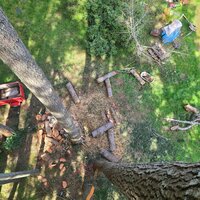
I quickly dumped these millable logs off the spar right where I needed them (not beating up other trees or the facuet at the base of the spar). There is not a lack of control. 20230605_144337.jpg20230426_130736.jpg

Picture one: ezpz deep hinge.
Picture two: ezpz Magic Cuts on a neutral spar. Bathtub for size reference.

Nothing hard to predict or comprehend...just a snap cut with a snipe.
Extra easy compared to big double-cutting (which I do as needed, without strain).


Gord hasn't been around in a long time.
He's not a joker.
BC big tree feller.
 
To simplify it, it is an over center notch with a dutchman. Once it starts to fall it snaps the hinge. Idea being it falls in the direction on its own and no need for the hinge attachment once it is going that way.
Works fine for chunking down straight spars, but takes up more time than really needed to get the job done. Plus, you end up with a lot of big notches to clean up.
I've tried it. It works. But I find it too much work for what you get. Maybe for you fellows with the big trees it would be better suited. Not my cup of tea, and I don't like dutchmans no matter what they are supposed to do to help you.
Full dutchman, zero hinge.
 

New threads New posts

Back
Top Bottom