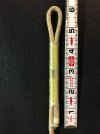
Documenting my hand-sewn eye process

Shit either way i dont have anywhere to break test them actually. Thats why i was thinking to try splicing but shit idk ill have to check around see if i can find somewhere. But thanks for the tread and all of your experience. Good job you know your shit thats for sure.
 
Shit either way i dont have anywhere to break test them actually.

 
Which brings me to something I've been wondering for a while - does anyone have a list (or should we start one) of all the break test facilities/ contractors that are available? Maybe sorted by country or something.
 
Which brings me to something I've been wondering for a while - does anyone have a list (or should we start one) of all the break test facilities/ contractors that are available? Maybe sorted by country or something.
Good idea, and deserving of a dedicated thread.
 
Thanks for the shoutout! I do the breaking and I'd be happy to help anyone out. Please feel free to reach out on here or email, brandon@arbsession.com, if you have any questions! I am always willing to chat about results if needed as well.
 
I've never done this and find it simple and fascinating, remember a chat about it long ago w/Nick here.
.
Just tossing out thar that 40# test whatever , would think that is a linear , pure inline pull along longest linear dimension not across minimal axis. So 40# x so many stitches would not be straight multiplier to strength. Certainly 10 more stitches is stronger tho.
.
Linear length of imposed frictions would be factor i'd think,compounding by distance as legs of eye bound to each other. Something Teflon slick might reveal this (as a loss) if need more stitches?
.
Any experiments on 2 separate patches of stitch runs independent vs. 1 single longer run?
 
Last edited:
Pretty sure AJ is doing 3 separate passes on all his eyes. I’d like to see the breaking point on his stuff at 1 pass and 2 passes too. Looks great to me.
 
“Any experiments on 2 separate patches of stitch runs independent vs. 1 single longer run?”

I’ve done two separate sewn sections on tree bracing ropes I’ve used to try correct storm damage. Neither one moved, so experiment didn’t show much. But I have started to make my splices longer - the Tachyon splice above is ~ 3 3/4 inches long - I started doing this because it didn’t seem to get rock hard so fast esp. the third pass.
And the recipe I use is the first two passes are continuous and the third is a separate thread - it just gets too long otherwise.
I’ve also started lightly freesoling the thread before shrink tube - it becomes like Teufelbergers coating which they don’t shrink tube over. With the precompression, the thing’s like rock.
 
In many things a double stop/check is better than single.
>> 1 bolt/nail/pin is a pivot, 2 compounds separate pivots to a lock
>>2 half hitches etc.
Not just a safety dual concept of 2 is 1, 1 is none.
>>But rather nothing is 100% efficiency
>>so have full stop with possible 'leakage'
>>then the double damn wham cutting that off too, totally snubbed.
Part of this in rope etc. would be to be more inline too i think.
inline and double sure inline w/o deformation
w/the long serial of the stitching, this may be muted here
>>but is always something i look for and try to weigh out.
.
Another thing i've wondered about these would be a clear glue, non harming to fibers. Not soaked to make overly stiff section
>>stiff sections are more leverage-able against the rope than flexible and can be in key position by load or input effort against.
Stitching seems would provide contact friction that would fight before the thread the loading imposed/ported.
>>then any persisting pull beyond mated frictions would carry on the thread(s).
>>the glue would increase the adhesion handling load quantity before thread takeover
>>the shrink tubing Brocky shows here would protect threads, but also increase the adhesion/friction value (all around )before thread takeover of persisting, lesser persisting load in this model. (and stiffen more).
.
To me as like large fender washers each side and pinch together hard with bolt, so the pinch between on the larger washer area is the hold area not the shank of the bolt, that is 2nd stop check if wide pinched frictions of fender washers don't handle all of load. The bolt leverages and assures the high friction pinch area as the hung board tries to pull out across the bolt hole but stopped by the frictions. Bolt not used as stop, but is 2nd ck if properly tight.
.
Also, my standard Hitch and Bend model is that the Standing Part is the linear input into the Primary Arc, together form hook. As long as this hook stays rigidly in place, knot holds. Receding tensions and rigidity in the rest of knot to a certain extent/model is just to keep the key hook attaching load to host as converts from focused linear input to arc control around, diffusing force around arc from focused linear. The splice threads give positive mating/adhesion , that in turn leverage more friction/adhesion into handling load as a primary w/o more thread stress than preset/no increase type model would fit 'my' knot hook model; and could be solution if just not a player.
.
Holding against vertical linear pull with thread on cross-axis of horizontal would not be fully using thread tensile at this non inline angle. But is in proper position for increasing mating friction/adhesion w/all tensile. The friction/adhesion invoked is in best position for fighting the vertical pull tho.
.
187% USDA more of my crazy theories tho from observation and feel and cross comparisons to other models, looking for consistency across as pivotal rules.
 
Last edited:
“Any experiments on 2 separate patches of stitch runs independent vs. 1 single longer run?”

I’ve done two separate sewn sections on tree bracing ropes I’ve used to try correct storm damage. Neither one moved, so experiment didn’t show much. But I have started to make my splices longer - the Tachyon splice above is ~ 3 3/4 inches long - I started doing this because it didn’t seem to get rock hard so fast esp. the third pass.
And the recipe I use is the first two passes are continuous and the third is a separate thread - it just gets too long otherwise.
I’ve also started lightly freesoling the thread before shrink tube - it becomes like Teufelbergers coating which they don’t shrink tube over. With the precompression, the thing’s like rock.

I like keeping the length of the stitched area 1.75" or less on 11-11.7mm cordage so the 3-pass method is optimal towards that goal.
-AJ
 
I like keeping the length of the stitched area 1.75" or less on 11-11.7mm cordage so the 3-pass method is optimal towards that goal.
-AJ
Reason being I do a lot of different choked configurations and I don't want a long rigid area above the eye getting in the way. I think I'm going to try a stitched eye that is "jointed" (ya mon) say two 3/4" inch stitched areas with maybe a half inch space between them so the stitched area above the eye wraps better for a positioning choke on narrow diameter wood.
-AJ
 
I've just used the stitched splices on one end of double end climbing lanyards - the lanyard end (the climbing end has a spliced eye always). So the stiffness (stiff like board, an old friend of my Dad's used to say) and length don't really matter as this leg is around the stem, back to the harness side D's, just. But yeah, for choking a stem as an example, the shorter sewn sections would be better I think too. For choking, I suppose you could build in a "sidedness" by "prebending" the rope/ cord sections around something before taping/ compressing and sewing (less stress??). This whole thread is fascinating to me - sewing, whipping, glueing . . . .
Cheers and Seasons Greetings everybody.
 
Last edited:
Previously spoke w/o reading whole 40 pages of generous input, but maintain the model stated. Especially seeing Yoyo man and others say it first.. Many good tips etc. Brocky thumbtack trick very simply, cleanly ingenious. Thank-you Moss et al for a very illuminating ride of many reflections!
.
Bonner's concerns point at some things etc. To differentiate a splice would get frictions all around inside a shrinking 'tube', then stitched and many more made and can be machined away from human f'ups. Totally different than 1 side frictions, no shrink around and stitch by hand that quite possibly a teenager in a rush might try, even gift to someone...
.
My interest academic and safety only a sprinkle of self sufficiency. i think that the frictions/adhesion is the property to watch, 5# added thread strength a secondary concern for when it all hits the fan/threads pulled diagonally as the friction mating hookup is surpassed and eye goes to backup strategy. A way to test the theories i think would be to make lesser splices instead of better for testing for built in headroom and to prove theory. Like if usually throw 100 stitches in, try 30 and test. If that even comes close to acceptable, would seem bringing back to 100 stitches very confidently and go on. Kinda a reverse strategy to same point, round world view. 100 stitch count not total focus, the linear length of the 'tacking surfaces' is how frictions are compounded.
.
My knot view of Hitch terminations and Bend couplings are that they are external linear force fed into arc control(Binding is internal radial force to same arc controls w/o linear to radial conversion). The first, Primary Arc whether 90 or 180 forms a hook to the preceding linear/Standing Part in Hitches and Bends. Rest of knot is to keep this hook aligned in place on host hook keeps load connected. By that model, after the hook in this 'hand sewn eye process' is the frictions tacking to side, and some lil'baby shelves of texture catching on each other as long as this stays in position, the hook is good,. This is dependent on the frictions imposed by the thread mating the surfaces tightly, on a linear run the frictions will compound by distance of contact so that is factor, so is the slickness of the materials and their manufacture/braid. The way the braid catches itself or not might surprise in a different kind of rope handled same. And the slickness of the material used then of course too. So this would still be more towards select fire not shotgun all across everything with claims of what works.
.
Clear coat would help keep this simple alignment, keep colors brightest for most dramatic inspection, protect threads and keep grit out from working it's way inside to work on cutting fibers unseen from the inside. This would seem more like a buried splice concern, but is additive here that get with the protection of the sheathing. Cleaning carpets makes them last longer, as sand model is 18 cutting surfaces per uncrushable grains deep in carpet powered by people walking back and forth etc. silently destroying carpet from inside.
.
The warnings on the threads getting slanted under load is what i envisioned. This would be the place where raw tensile of thread x numbers of threads is more of an argument necessity. This would also be the time when would want thread more matching the host material so neither had the advantage to cut the other etc. Similar to Square Knot needing matching materials for even fight to maintain Square-ness. Otherwise, in normal use, the threads sitting 90 degrees to rest of rope are just for the side adhesions/frictions . Thus still feel some non stiff, non destructive glue could help on that facing. ABoK talks of putting fresh varnish on mast area and then knotting on that for extra tack in the lengthwise pull chapter (which this is), other ways were to use wood ashes, best he recommends is cut open inner tube to use thin rubber to alter the CoFs Co-efficient of Friction of the mated surfaces.
.
So i maintain my fender washer model, for hanging sheet vertical. Pinch with bolts across, but held in place by frictions of fender pinches invoked by bolts. Don't want it so much hanging on bolts, and in use the holes elongating or any wear as a safety flag not carrying on simple frictions and stressing across the bolt minimal not maximum size dimension. The fender washers spread stress to wider area while using bolt force properly, even tho not aligned to the load force but across. The best strength of the thread is pulling along it's length across eye, to then leverage the frictions into holding eye. Not eye losing these frictional catches and actually pulling across threads where they have to slant trying to hold on by aligning with the force pull of rope as can as a last bailout resort before failing.
.
Too small an eye could get spread by host against the first thread 'tack'. Longer with preceding tack, space, then real list of stitches kept safe from spread by tack riding point could be improvement. As first position to slant, perhaps this could be softer thread, less cutting primary type model if slants. Eye long enough to Girth/Choke to carabiner would take some strength concerns off stitching and realign concerns to bend against the Standing Parts of eye, and this should not be stiff if going this route. Rigidity invokes leveraged length, loaded soft parts will already give this, thus efficiency/cosine loss. Stiffer/stiffened material will emphasize this.
.
Sorry had to get that out, even tho not my game. Carry on muchachos, am making popcorn to watch!
 
Last edited:
The fender washer join is a good way to describe your point.

Looking at this from an even bigger view, it’s all about sewn eyes made by any means, by machine or by hand. The original point of this thread is that machine sewn eyes are accepted as safe for climbers to hang their lives on and that it’s possible to make a very strong eye sewing by hand.

In regard to shrink tubing or coatings to protect the stitching from abrasion and grit... the reality is that the cordage will wear out before grit or exterior abrasion compromises the thread. We beat on our ropes much harder than we do the stitching on sewn eyes.

I still like to put shrink tube over my stitching but in the cases where it is problematic to do so, like in my sewn harness bridges, I’m seeing no degradation of the thread before the cordage is retired.
-AJ
 
Which brings me to something I've been wondering for a while - does anyone have a list (or should we start one) of all the break test facilities/ contractors that are available? Maybe sorted by country or something.
There's apparently an older Treebuzz 2009 thread on this:

As of Dec 2020, what I found was:

Wisconsin, USA

Greensboro, N Carolina

Vancouver, BC, Canada

If anyone knows of addtional locations please post.
 
Great topic into roots of commanding rope to greatest bidding, after a single turn, w/practical; fullest test application..
.
Still, in ABoK many reference examples of around both parts of each leg of eye circumference/rather than thru close side of each:
That tend to favor tiered series of series of turns
>> w/break between series-es(!)
To my (a)typical modeling; as like air buffer/thermal break in insulation
>>so force not just run 1 continuous degrading gauntlet,
>>but then once devastated faces another, but is softening by self equalizing in between
and even perhaps woven in as shift/creep check!
>>cable 3 or more such spaced grabs typical, in higher friction broader surface, Natural ropes Ashley shows 5 series.
.
In all my understandings collectively from ABoK shows better to seized in spaced Half Hitch etc. as stopper/final ballast/tailer main in capstan speak, then allow the same stopper construction to (in my terms) 'ram the mainframe/carriage' of the preceding knot to deform from the rear as fight same of not deforming on input. Seems favorable to be a spaced maintainer of the rear part of the knot main carriage shape, not deformer/rammer. Carriage being machine between Standing Part linear input and final tailer man/ballast of Nip etc. The less self contained final size, is more buffered from deforming squareness of carriage from rear aspect. Carriage is also a leveraged friction buffer between the input (load) and output(tailer man/ballast)


ABoK is massive book has unique layout of overly massive subject (to me, as workman that means 'frilly' knots thrown in as distracting bloat:muyenojado: ). But opens and closes with generals as builds to specifics in center. Hard not to get caught up in how many can tie as knots flood by, while tying them trying to extract pivotal principles that still carry on into today and further into many things. Folks then were forced to be more in touch with forces more rawly, which few disciplines carry forward so fully as ours.

 
Great topic into roots of commanding rope to greatest bidding, after a single turn, w/practical; fullest test application..
.
Still, in ABoK many reference examples of around both parts of each leg of eye circumference/rather than thru close side of each:
That tend to favor tiered series of series of turns
>> w/break between series-es(!)
To my (a)typical modeling; as like air buffer/thermal break in insulation
>>so force not just run 1 continuous degrading gauntlet,
>>but then once devastated faces another, but is softening by self equalizing in between
and even perhaps woven in as shift/creep check!
>>cable 3 or more such spaced grabs typical, in higher friction broader surface, Natural ropes Ashley shows 5 series.
.
In all my understandings collectively from ABoK shows better to seized in spaced Half Hitch etc. as stopper/final ballast/tailer main in capstan speak, then allow the same stopper construction to (in my terms) 'ram the mainframe/carriage' of the preceding knot to deform from the rear as fight same of not deforming on input. Seems favorable to be a spaced maintainer of the rear part of the knot main carriage shape, not deformer/rammer. Carriage being machine between Standing Part linear input and final tailer man/ballast of Nip etc. The less self contained final size, is more buffered from deforming squareness of carriage from rear aspect. Carriage is also a leveraged friction buffer between the input (load) and output(tailer man/ballast)


ABoK is massive book has unique layout of overly massive subject (to me, as workman that means 'frilly' knots thrown in as distracting bloat:muyenojado: ). But opens and closes with generals as builds to specifics in center. Hard not to get caught up in how many can tie as knots flood by, while tying them trying to extract pivotal principles that still carry on into today and further into many things. Folks then were forced to be more in touch with forces more rawly, which few disciplines carry forward so fully as ours.

I need a translator for many of your more technical sentences but the last paragraph and the last sentence are music to my ears, no translation required.

-AJ
 
Last edited:

New threads New posts

Kask Stihl NORTHEASTERN Arborists Wesspur TreeStuff.com Teufelberger Westminster X-Rigging Teufelberger
Back
Top Bottom