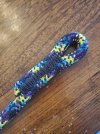
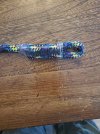
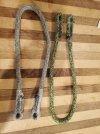
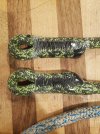
Documenting my hand-sewn eye process

ABoK is massive book has unique layout of overly massive subject (to me, as workman that means 'frilly' knots thrown in as distracting bloat:muyenojado: ). But opens and closes with generals as builds to specifics in center. Hard not to get caught up in how many can tie as knots flood by, while tying them trying to extract pivotal principles that still carry on into today and further into many things. Folks then were forced to be more in touch with forces more rawly, which few disciplines carry forward so fully as ours.

I have the same experience with that book. It is cumbersome if one is looking for a specific knot, but the massive barrage of potential knot constructions conveys general principles of what makes a knot hold, what lets it release, etc.
For those times when tying something down, etc. tying knots on the fly, no idea what their names are, just simply understanding what feels tight, what can grab, and what directional forces one is working against.
 
Most folks say ABoK knot #, and self too for specific references.
But mostly like saying ABoK lesson#....
Like Lesson#1669. "The FIGURE-EIGHT HITCH and Round Turn. If the rope is weak and the hoist is heavy, a Round Tum on the standing part adds materially to the strength of the knot."
Is TOTALLY about the Round Turn(RT) around Standing Part(SPart) to me, and to carry that principle to other forms. The fig.8 Hitch reference is just an example application to me of the RT around SPart principle/knot module seen in other forms. i see a single Turn around SPart as shearing across the sole support ('iBeam') of SPart at 90 degrees worst angle, but giving an RT around SPart instead more grabs along the rope column of SPart like splice than across it. Is better hear in flexible support/rope just as same principle of pulling across a rigid iBeam or along it's length.. EXCEPT in rope the singe Turn around SPart fights tendency to pull away/seat less to host on load side of host, whereby RT around SPart accentuates the pull away from host more for less tight grip on that side of host. knudeNoggin adds that if precede w/RT on host, then RT on SPart, effect about lost; i think too much tension reduction via RT on host, not leaving enough force to grip RT on SPart to pull along it's length, and so becomes more of a shear across SPart for less efficient SPart, but does grab the host tighter in trade. So is trade off of grab tighter to host or leave SPart less deformed as control leg joins load leg(SPart). THAT is why use a fig8 Hitch with it at least, to get the nip up into the higher nip region towards the top apex of the opposing 180arc on opposite side of host than load, for a Half Hitch position is the worst nip position, and RT around SPart enhances that worst nip effect in trade for 'stronger' more efficient, less deformed SPart...
.
This RT study extends to a wider scope in Lesson#1732 "Be certain that the turns are snug before lowering away. There's a lot of virtue in a Round Turn." i find RT has 3x180 arcs of capstan effect tension reduction AND 2dimensional support architecture that single or double arc does not. More arcs add to the friction and 2 dimensional support breadth that 3arcs, Round Turn begins in real working class knots. Single Turn bases being more of a minimal get by of 1 dimensional support construction, just not the same. This inherits to Crossed Turn(cross on host) bases of 3x180 arcs and Backhand Turns (crossing off host) of 3x180 arcs with added frictions.
.
There simply is much more than knots in the knots book, wisdoms across the (p)ages of time, the focused knots are many times the examples of principle usages, than the focus themselves to me.
.
some of these things easier to sift out, in redundancy; especially when rings the bellmore than once announcing 'double bearing' and then proclaiming several times as of importance to the needed utilities at the time, that double bearing can be had with single pass in Backhand Turn type things. But, sometimes, there is only one fleeting reference to some slim importance that carries much wider than initially stated.. Focusing too much on how many can ya tie, can blur by this part of the more important journey, than the knot destination (type analogy).
.
And, yes, DIRECTION is it's own quantity and as important as the tension quantity it self.
 
Last edited:
interesting point about how "just adding extra turns and tension" can sometimes not allow the knot to grab where it's needed. allowing the pull of force to travel through the line and knot to cinch where it counts.

I appreciate your insights from the ABoK!
 
i compare this to adding not 1 but 2 Half Hitches(HH) as final ballast to complete/'seal' a knot.
.
To me with just 1 single preceding Turn, the 2nd HH is to keep the 1st from pulling out.
.
But, same adage applied after a Round Turn(RT), the 2nd HH sometimes seems more so the 1st doesn't fall out sometimes.
As the RT reduces the tension in the 'working end' to such an extent, can be more of a risk of 1st HH falling out, from lack of holding tension.
.
In either case follow the adage to be more secure, but sometimes to different function to do so. Adding another rope part/module isn't always to enforce a particular mechanic across the board; but rather avail that part now to the system. That in turn, autonomously can use the added mechanic to particular flavor by Natural selection of system now self maximizing with more usable parts.
.
This can also be witnessed, in using the same lacing for different usages/force type fed. If on round host form a Half Knot, Strangle, Constrictor, Bag(fave), Groundline etc. and use as a Hitch, the rope parts load force in 1 fashion as the raw force source is linear input. But, remove load and swell host is now a radial input of force of Round Binding, the same lacing of same rope parts now loads differently, as Nature self maximizes to a different input force type.
.
i see these individual rope parts as 3 main players of 0,90,180 degrees directional (horizontal or vertical etc.)end points deflection, making linear/same directional axis(even if bent), cross axis and reverse direction to same axis respectively(in linear force input systems). If rigid parts, these parts would need connecting flexible hinging; body of rope provides this utility. But rope still has essentially separate rope parts that can be used differently on the fly if loaded differently. Just as rigid support chain loaded from side, reverse etc., or even same passive electric parts circuit with the force element ported differently thru; to extrude different effects. All the same lesson, viewed from this larger context, of suddenly rope not mysterious but amazingly consistent to what already know. Parts and positions don't dictate outcome, but rather how the force uses and ports thru the offered parts, dictates outcome. Thus follow the force to decode, as a detective follows the money(force) thru the bit parts.
.
....sorry for the interruption; we now return you to the safety of normal thinking peoples...

 
Last edited:
I came here looking for Ocean Vectran then stayed for the sewn eyes. Materials collected. Plan is to do a sewn eye in 10mm Sterling HTP for DIY U-Rig.

i-PK3K4Kh-L.jpg
 
Attempt #2. Less work when using shorter stitch length... Broke the needle once and thread a few times when trying to bury the lock stitch knot inside the core. Going forward, my strategy will be to intentionally stop and tie the ends together as soon as I start to see the thread fray. First thread was .025" waxed nylon, #2 was .035" waxed polyester.

i-vGVMZr4-L.jpg


i-XZhS63g-L.jpg


The back side.
i-7vXvWsW-L.jpg
 
Attempt #2. Less work when using shorter stitch length... Broke the needle once and thread a few times when trying to bury the lock stitch knot inside the core. Going forward, my strategy will be to intentionally stop and tie the ends together as soon as I start to see the thread fray. First thread was .025" waxed nylon, #2 was .035" waxed polyester.

i-vGVMZr4-L.jpg


i-XZhS63g-L.jpg


The back side.
i-7vXvWsW-L.jpg
I bury the lock stitch by first tightening the thread with both hands, balanced pull on each side, I put tape on my baby and ring fingers so my fingers don’t get cut by tne thread over entire stitching process. When the stitch is tight/stabilized I pull on one side by gripping the thread and rolling my hand slightly (gives good control) and burying the lock a couple of millimeters. If i pull it through the other side I pull it back in from the opposite side if that makes sense.

When sewing leather with a sewing awl/Speedy Stitcher you can use the needle to bury the lock but sewing cordage pull the needle down the thread out of the way and use your hands, makes a really nice balanced tight stitch and lock bury.
-AJ
 
Last edited:
This thread has been a great read and a treasure trove of technical info. I read every page completely until about 32, then skimmed up until the last 3 pages which I read fully. The backlash to the idea of someone trusting their own judgment, ability and sense of self-preservation was surprising and very eye-opening. I'm not a professional climber, and a huge part of why I really enjoy the Buzz is that so many of us here enjoy solving problems, thinking outside the box, using multiple skill sets and being open to new ideas. I've sewn a number of eyes now, most of them accessory use, not life support, but I did one 25" E2E in 9.3 Epicord, and just completed this sewn eye in one of my climb lines. I broke one needle, and after starting again I called it good when the next needle was flexing and slipping in the chuck due to the hardness of of eye, which were the precursors to the first needle breaking. Thanks @moss for sharing and thanks to all those who added their knowledge and experiences to this thread!
 

Attachments

  • 20220208_094845.jpg
    20220208_094845.jpg
    551 KB · Views: 31
  • 20220208_101859.jpg
    20220208_101859.jpg
    696 KB · Views: 29
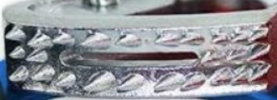
Thinking outside the box a bit, what about having someone with a 3D printer make plastic inserts with barbs on both sides similar to those on the cam in ascenders?
1644378485983.png
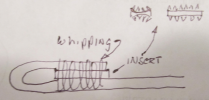
The insert would fit between the two ropes being spliced with barbs going into both. It would be the same length as the typical sewn splice. After the ropes are clamped together, you'd secure them with whipping.

We know these barbs can develop a lot of force without damaging the rope, even after much use. A splice using the barbed insert would be easier than sewing, and less likely to damage the rope fibers. Sailing vessels from years ago used rope splices that depended solely on the whipping, so a whipped splice using a barbed insert certainly seems worth exploring.
 
No, this is completely different.
1644410427207.png

One advantage of this approach is that you could undo it without ruining the rope. Not a big deal for a tight eye, but maybe for a larger one. Also, you could do this without special tools after you put the rope around something. Being able to make a strong splice quickly in the field would be nice, don't you think?

Of course you'd use shrink tubing to protect the whipping.
 
Synthetic lines lose too much in diameter when loaded for whipping to hold. Not sure I would be comfortable relying on a toothed device to not shred the rope if it happened to be dynamically loaded, also.
 
Not sure I would be comfortable relying on a toothed device to not shred the rope if it happened to be dynamically loaded, also.
Agree. I was thinking that cam devices often cause the rope to fail before the device itself fails.

For a quick eye, the rated rope crimps are an option. I remember having a rescue 5:1 system with a "factory" crimped termination. I believe it was pair of crimped connectors. I'm guessing the crimping tool/machine isn't cheap.
 
View attachment 80205
Someone already thought of that.
That looks super cool! not enitrely sure it would be the strongest of splices, but for ropes with really tight outer jackets, to pull the bury through without a tool might make it easier? kind of like using a basket fid, but being able to leave it in place... Got some dog leashes to make for a friend, if I remember this, i might give it a try for that.
 

New threads New posts

Kask Stihl NORTHEASTERN Arborists Wesspur TreeStuff.com Teufelberger Westminster X-Rigging Teufelberger
Back
Top Bottom