Matias
Been here much more than a while
- Location
- Silicon Valley
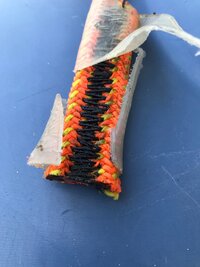
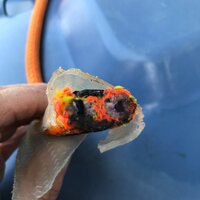
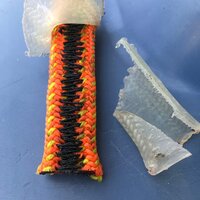
I mean, play around with it a couple feet off the ground and let us know what you think? I liked the idea of sewn eyes because it, like a knot, is a termination with no throat, like splices have. It is almost as clean as a handsplice too, so it is a bit of the best of both worlds. I have several hand sewn eyes that I have been using for a long time without any deformation of the stitching. I have also been sewing since I was a kid, and did embroidery, so I enjoy the challenge and artistry of it. I don't even use a speedy stitcher.I read this whole thread with interest. I have done neither splicing nor stitching and it stimulated thoughts about how all this works. One of these, impractical as it is:
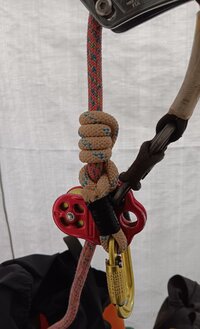
A friction hitch can hold quite a lot, enough indeed to be a life support implement. Why could not the same mechanism be used for a bend or an eye: a hitch on each strand pulling against each other? A friction hitch can be expected to slip initially but is that just because it is not maximally tight? And smaller cord is known to bite harder than thicker cord closer to the rope diameter.
Suppose we start with a pattern like this from Winchman but instead of the figure-8 pattern between strands we form a short two or three wrap coil before switching sides, the hope being that each of those coils will tighten under load?
That would only give us direct friction on the mantle strands. Could one expose the kern at the bitter end and place another series of opposing wraps on it to provide additional hold? Could this be combined with limited stitching to lock everything together? Could the mantle bundles from the exposed section themselves be sewn through the other strand in a form of splice?