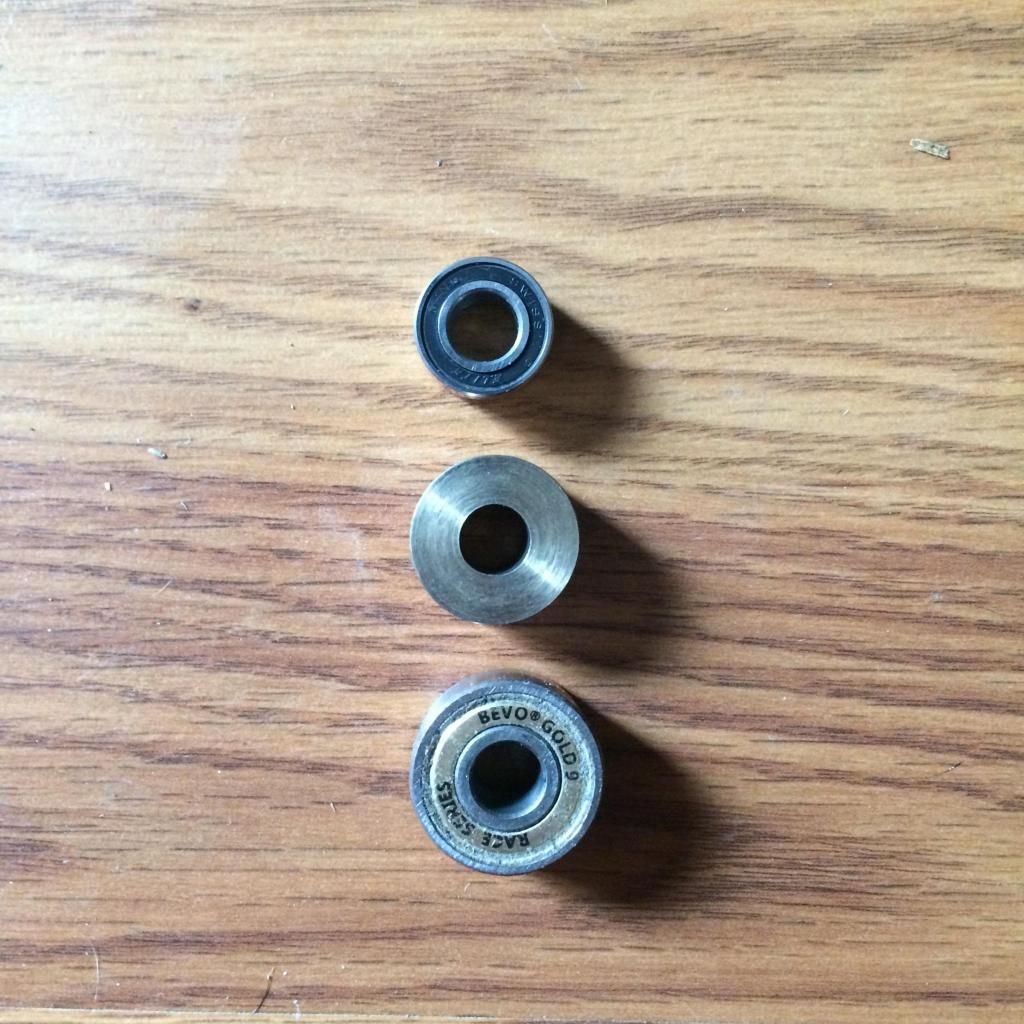
I believe the slippage reported is due to the rope being flattened by the clamping action of the Bone with repeated use, rather than wear on the spine. It would be useful to know or see the amount of wear that the spine is developing on the users Bones to date. It may help to go with a larger bollard if possible, or even the DMM spacer shown in Tyler's picture.
I have experimented before with the DMM spacer, with the spacer installed on the link pin (with no inner bearing) for 1/2" size ropes, and with the spacer installed with the 1/2" bollard as the inner bearing for 7/16" size ropes. When installed in this manner the spacer has a sort of rolling cam action on the rope that may help with grip.
Tyler, if you were to obtain a size 80 roller connecting link, you could press the axles out and they would fit perfectly on the link pin, and also span the width of the link across the top of the release arm. You could then capture the axle/bollard with the locking swivel link. This not only narrows the gap, but raises the swivel link a bit, giving a bit more bend to the rope. You could do the same thing with the other axle/bollard on the bottom arm with the same effect.
I have experimented before with the DMM spacer, with the spacer installed on the link pin (with no inner bearing) for 1/2" size ropes, and with the spacer installed with the 1/2" bollard as the inner bearing for 7/16" size ropes. When installed in this manner the spacer has a sort of rolling cam action on the rope that may help with grip.
Tyler, if you were to obtain a size 80 roller connecting link, you could press the axles out and they would fit perfectly on the link pin, and also span the width of the link across the top of the release arm. You could then capture the axle/bollard with the locking swivel link. This not only narrows the gap, but raises the swivel link a bit, giving a bit more bend to the rope. You could do the same thing with the other axle/bollard on the bottom arm with the same effect.