- Location
- Central Hardwood Belt, USA
I did not own a set of dually redundant duals back then. I'm sorry, Tyler did not see me climbing on these. They weren't single-handled, and they weren't dually redundant in the safety features. This is entirely new gear from before, related, but way, way different in performance.
The game has changed a lot.
[ QUOTE ]
What are other advantages of double line other than retrievabilty and bigger purchase area for footlock. I like the retrievability
[/ QUOTE ]
Not even retreivability so much, that has nothing to do with the ascent/work climb. That's just repositioning the rope, nice if you have a long line of trees and you're able to traverse the canopies.
[ QUOTE ]
dont think footlocking a single line is very difficult.
[/ QUOTE ]
Nor do I. but this is the science behind it;
SRT one rope beneath you, not moving.
TWIN two ropes beneath you, not moving.
DdRT one rope below you, moving downward with every footlock, which is why footlocking DdRT is generally considered a pain in the arse, soiling the true advantages of what footlocking can do for you.
Footlocking to ascend a twin line is unquestionably easier than on a single line..... there is twice as much rope to create foot-on-rope friction. Again, the phsyics don't lie. Physisics. Phizzz. Ugh. As well, the dual ascender, as with a single ascender, adds negligible friction going up. Now, you can move the ascender freely, at will, up or down, and with this, there is no difference between twin and SRT. The difference is that most guys like some rope to grip onto with their non-ascender hand. With 11 mm, in a twin rope configuration, you have ~22 mm of rope to grip. The hand thing and the foot thing I see both as advantages in twin rope ascent, pretty much everything, if you ask me.
Half the stretch in the rope, another little advantage, less bounce.
No tying off (anchoring) to the base of the tree.
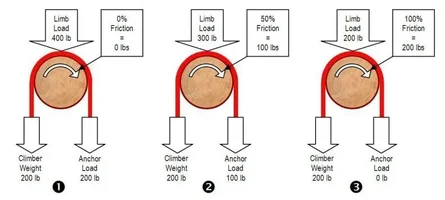
Forces distributed 50% to each side of the ascender making the practical working load on each side of the ascender halved.
Guys tend to want to climb on 13 mm SRT, which is fat, heavy rope. Twin welcomes the lighter more amble 11 mm and all the advantages that carries, while still giving big rope(s) to handle below the ascender.
In descent, using a twin line descent device, each side of the rope takes half the wear, half the forces, distributes heat equally and need only provide half the frictional forces, each side taking on half the duties. This translates to half the wear and half the hand-belay pressure when using certain dual-sided friction devices. This is an advantage that must be experienced, light fingertip control pressure, precise, smooth.
Crawlovers, possibly one of the biggest advantages I can see. In DdRT these can wreck your ascent. In twin, you can look forward to limb crawlovers. Really. You can do & go places with a 4 wheel drive vehicle that you can't with a two-wheel drive. This is sort of like that. Twin can do everything SRT can do, and additionally can do the things it does uniquely well.
Just having different options to exercise, being able to drop through crotches into 2:1's/3:1's like you do in SRT, all that stuff you would never, ever consider doing inn DdRT, you can now look at differently. A twin line offers 2X the friction on drop-throughs, making the belay hand friction halved as compared to the same being done SRT.
Being able to use redirects and drop through natural crotches, like in SRT, & great abilities to set safety through slinged redirects.
Really, there is nothing that SRT can do that Twin line can't. Twin doesn't require anchoring one end. Lace your rope up and over, clip in, and go.
I could go on with finer details, maybe another time
Since we are essentially talking about ascent and work positioning with these things, all things considered, the dual should blow the single out of the water because the dual can BE a single, by just using one side. But the dual can go twin, which really opens you up to new options, hopefully enhancing your safety, confidence and abilities.

The game has changed a lot.
[ QUOTE ]
What are other advantages of double line other than retrievabilty and bigger purchase area for footlock. I like the retrievability
[/ QUOTE ]
Not even retreivability so much, that has nothing to do with the ascent/work climb. That's just repositioning the rope, nice if you have a long line of trees and you're able to traverse the canopies.
[ QUOTE ]
dont think footlocking a single line is very difficult.
[/ QUOTE ]
Nor do I. but this is the science behind it;
SRT one rope beneath you, not moving.
TWIN two ropes beneath you, not moving.
DdRT one rope below you, moving downward with every footlock, which is why footlocking DdRT is generally considered a pain in the arse, soiling the true advantages of what footlocking can do for you.
Footlocking to ascend a twin line is unquestionably easier than on a single line..... there is twice as much rope to create foot-on-rope friction. Again, the phsyics don't lie. Physisics. Phizzz. Ugh. As well, the dual ascender, as with a single ascender, adds negligible friction going up. Now, you can move the ascender freely, at will, up or down, and with this, there is no difference between twin and SRT. The difference is that most guys like some rope to grip onto with their non-ascender hand. With 11 mm, in a twin rope configuration, you have ~22 mm of rope to grip. The hand thing and the foot thing I see both as advantages in twin rope ascent, pretty much everything, if you ask me.
Half the stretch in the rope, another little advantage, less bounce.
No tying off (anchoring) to the base of the tree.
Forces distributed 50% to each side of the ascender making the practical working load on each side of the ascender halved.
Guys tend to want to climb on 13 mm SRT, which is fat, heavy rope. Twin welcomes the lighter more amble 11 mm and all the advantages that carries, while still giving big rope(s) to handle below the ascender.
In descent, using a twin line descent device, each side of the rope takes half the wear, half the forces, distributes heat equally and need only provide half the frictional forces, each side taking on half the duties. This translates to half the wear and half the hand-belay pressure when using certain dual-sided friction devices. This is an advantage that must be experienced, light fingertip control pressure, precise, smooth.
Crawlovers, possibly one of the biggest advantages I can see. In DdRT these can wreck your ascent. In twin, you can look forward to limb crawlovers. Really. You can do & go places with a 4 wheel drive vehicle that you can't with a two-wheel drive. This is sort of like that. Twin can do everything SRT can do, and additionally can do the things it does uniquely well.
Just having different options to exercise, being able to drop through crotches into 2:1's/3:1's like you do in SRT, all that stuff you would never, ever consider doing inn DdRT, you can now look at differently. A twin line offers 2X the friction on drop-throughs, making the belay hand friction halved as compared to the same being done SRT.
Being able to use redirects and drop through natural crotches, like in SRT, & great abilities to set safety through slinged redirects.
Really, there is nothing that SRT can do that Twin line can't. Twin doesn't require anchoring one end. Lace your rope up and over, clip in, and go.
I could go on with finer details, maybe another time
Since we are essentially talking about ascent and work positioning with these things, all things considered, the dual should blow the single out of the water because the dual can BE a single, by just using one side. But the dual can go twin, which really opens you up to new options, hopefully enhancing your safety, confidence and abilities.