Climbing above decay

I would say that pulleys along the spine in these setups actually do more than you’d think.
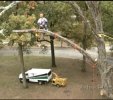
In an excellent video from ISA/Arborpod, they demonstrate the fishing pole technique.
Screenshot_20211226-081750_YouTube.jpg
The two intermediate shackles are barely deflecting the rigging line. The force vectors are not appreciably different than if they were omitted. It's not registering with me how they're doing much. What am I missing?

I can see if you have a severely curved branch and the intermediate redirects are pretty tight to the branch, the force vector along the branch can be improved. If a branch is fairly straight, I don't see the intermediate redirects having a significant effect on the force vectors.
 
Once the force is applied, like a piece dropped into the system, those angles change and the middle ones are seeing force, even if just a little and just for a few seconds. If this was a video you could probably watch it happen in slow motion.
 
...
That's why I'm having a hard time seeing how a little change in the force vector is somehow significant.

You are correct. If the limb used in that video had a significant structural defect, using that system would have been a very poor choice.

Plenty of structure 'above' the lowering point that would achieve a far greater reduction in lateral force while increasing the compressive load.
 
The last thing I would do in this scenario is do a fishing pole style rigging set up. A lot of dynamic force put into the questionable lead that way.
There is a substantial about of tree to work with that is not attached to that most questionable portion. Utilizing the more trust worthy parts of the canopy us how you manage safely accessing and working back the questionable portion.
Setting up rigging points to be loading the damaged portion in compression (pushing down the grain of the wood, not pulling the stem one direction or the other when loading the rigging) is the most important thing you can do (aside from what ropeshield said about getting weight off of it).
Personally I would be utilizing natural crotch rigging so as to add a little.bit of friction to the rigging points, which can reduce peak forces at the terminal rigging point.
 
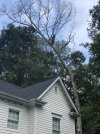
I would climb it. Everyone has pretty much explained why and how. There's a bunch of methods. And it does look like your other main lead is pretty solid so a great place for main climb line position or secondary. Your problem is mainly being comfortable and competent. Your guts not always right. Like man my guts telling me I can't go out there. Experience will hone your instincts.
 
I have climbed some crazy shit.. wish I had pics of this spruce from last week. Had storm damage from the winds. Spruce tipped over and just leaning on a garage. Not attached at the bottom or anything. Started going up hand picking everything I could while setting up a fishing pole technique another poster was talking About. And it worked great. And I'm not going to lie I was still a bit nervous taking the tops.
 
Sometimes those feelings of anxiety / nervousness are there for good reason. No amount of money is worth a potential catastrophe.

A lot of good opinions and information on here, but ultimately you should do what feels comfortable and right for you and not anyone else.

Even if there are alternative ways to safely perform the work, what matters here is do YOU feel comfortable and confident enough to be able to do it safely?

If you have any doubts, nothing wrong with declining to climb.
 
Last edited:
I kind of don't get why someone would extensively fishing pole a horizontal limb like in the photograph instead of taking the "fishing pole" attachment that's right near the trunk, and put it 6 feet up the trunk and convert almost all of the fishing pole bend force to compression in the branch, with a new extra side load on the much beefier trunk?

I watched a guy do this one day, after he eagerly talked about learning the fishing pole technique and I didn't have the heart to point out the (to me) obviously superior alternative. This of course keeps the terminal fishing pole redirect by where you're cutting.

Sorry for not addressing the original topic. I'm of the twin lines/systems, SRT basal into the sketchy half (so a failure slides down your rope rather than pulling you down) , breakaway possibly on the sketchy side/system opinion. Was in another post recently.
 
I may be speaking out of my backside since I've never used the fishing pole technique, but my understanding is the chief benefit is that the tension in one leg of rope (of the 2 legs of rope in the distal pulley) is directed along the branch or trunk, putting it in compression. Then, only the leg of rope with the load attached exerts a bending force.

I guess I'm thinking the fishing pole technique converts some bending force into compressive force (via redirects), rather than dispersing the bending force. In what I've seen online, in many cases the intermediate pulleys are more for the convenience of rigging down subsequent pieces, as the pulleys which don't provide much change of direction aren't doing much.

@evo has me thinking about failure scenarios with a fishing pole arrangement - additional chunks of wood falling that are attached to your rigging line with a pulley and sling.
Having multiple redirects (especially on a leaning trunk) not only spreads the load, it changes the mechanics of leverage on the primary rigging point. Here's a picture where I found it to be quiet helpful.
 

Attachments

  • IMG_20220104_220437.jpg
    IMG_20220104_220437.jpg
    805.6 KB · Views: 53
Tom, thanks for the clarification. It kind of goes toward my observation, though. Wouldn't a picture of a scenario where fishing pole is actually saving your bacon get the message across more reliably to those rely primarily on pics and read less of the text? Maybe this sort of situation is what lead to my misguided eager beaver. To me, the primary advantage of fishing pole is the where to part (is that like where-to = wherefore means why ;) The subtleties of the English language to the idle mind :)

Is leaning trunk/leaning solo leader basically the main usefulness? Seems so to me.
 
a picture of a scenario where fishing pole is actually saving your bacon get the message across


I think this is a screen capture of the video. It might be from the ASPRn book, I'm not sure. Either way, the materials aren't in a comic book format where the user can get all of the knowledge with just their eyes. It is expected that the user actually read the text or listen to the whole video.

Maybe this is a societal issue about education. The ASPRn vid was made in 2000. Educational materials have changed since then. Books and reading seems to be almost obsolete.
 
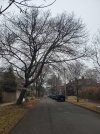
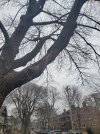
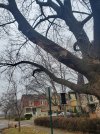
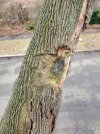
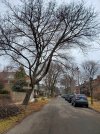
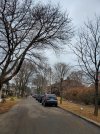
Here's an example of climbing above a compromise. This is a Norway Maple on my extension, or treelawn depending on where you're from. The leader that extends out over the street has been hit by the front left corner of about 100 moving trucks over the years. Last year I put up a sign that says "Look Up" which confuses many drivers but gets the attention of guys driving delivery trucks. I've lived in this house since 2015 and in that time I have witnessed this leader get smashed by a truck at least 10 times, although the truck box always comes out on the worse side of the fight. This is about 14-16" where it attaches to the main stem and about 12" where it has been smashed halfway through. There is only living tissue on the upper 1/3 of the wounded spot but it is keeping up with the demand of foliage above the wound so well that I'm worried it will break under it's own weight when leafed out and windy. I did a base tie(about 9' off the ground because this piece of rope is only 65' long) over a TIP on a structurally sound leader and redirected over another union on the damaged leader. Took off some end weight and a big laterally growing branch to reduce the stress on the damaged area. The one small thing I did to mitigate risk in this case was to set up my redirect from the ground by making a series of throws rather than doing it aloft. That way the compromised leader never saw my full weight. It probably wouldn't have mattered anyways but better safe than sorry. Here's some before shots as well as the damaged area.
 

Attachments

  • 20220113_101121.jpg
    20220113_101121.jpg
    1.1 MB · Views: 36
  • 20220113_101207.jpg
    20220113_101207.jpg
    1.2 MB · Views: 35
  • 20220113_101155.jpg
    20220113_101155.jpg
    1.1 MB · Views: 34
  • 20220113_160851.jpg
    20220113_160851.jpg
    862.6 KB · Views: 35
Last edited:
And after. It was growing into a smaller Autumn Blaze maple on the other side of the street so it was nice to give that little guy some breathing room too.
 

Attachments

  • 20220113_162410.jpg
    20220113_162410.jpg
    1.3 MB · Views: 23
  • 20220113_162412.jpg
    20220113_162412.jpg
    1.2 MB · Views: 23

New threads New posts

Back
Top Bottom