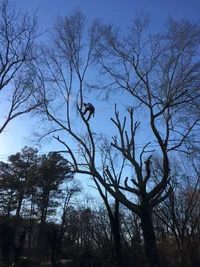
Canopy anchors v Climbing skills

I think it should be more common for the ground guy to tend the climbers slack while he climbs the tree so the climber can advance more aggressively without the fear of a dynamic fall.

You don't need a ground guy for that. Just a properly set up SRWP system, as it will self-tend as the climber climbs.
 
I think it should be more common for the ground guy to tend the climbers slack while he climbs the tree so the climber can advance more aggressively without the fear of a dynamic fall.
I assume you are talking about using some kind of belay device on the ground person. That way, if the climber falls, he won't swing so hard against the trunk as the ground person gets dragged towards the tree.
 
This was a spikeless solo removal Jan of this year. I brushed it out first and then went back up and dropped the wood(It was just easier that way, working solo). The double crotch was set for work positioning after I'd limb walked and finger tip gripped out the leader. None of the stubs were pointing my way in case of a swing. It's hard to see in the photo but this piece was caught by two loops and biners then cut into smaller pieces which were free dropped..

IMG_0086.webp
 
Did a spikeless removal on a couple monterey pines last week. My partner decided my spurs looked dangerous when we moved last month and put them somewhere safe, but couldn't remember where. Found them yesterday in the tire well in her car.
 
Levi brought up a good point. I started climbing just before the first wrench was introduced. I was used to having the 2:1 hauling system and almost always muscled myself around using that mechanical advantage climbing the rope. When Srt came out I really struggled with it except for access. I hated having to clip in ascenders to move only a few feet and often struggled with moving around the canopy.

Srt actually forced me to become a better tree climber and less of a rope climber. I didn't have the time to fiddle with ascenders when I could just climb the tree. Now I try to maintain the proper balance of both techniques although the use of spikes and just climbing the tree is still not a strong point, I like to be able to use the 2:1 hauling system to help me find my balance more than I should. When climbing without them I tend to only use ascenders for open air climbs, and spans between limbs that are far enough apart it would take more energy and time to free climb rather than just blast up on ascenders.
 
.... the same as a child reaches up and holds one of his parents fingers. To instinctively walk around the canopy free of inhibition, ....

This is a great illustration, Reg. It is also a great sales pitch for the use of SRWP as opposed to DdRT systems. A DdRT system with its 2 to 1 hand and arm activated haul back always at the ready, not only encourages support dependent posture, the lean-back to pull, but an all or nothing use because it will not advance, in most cases, without assistance. This situation will cause a bold climber to manoeuvre with slack in their system when they want unencumbered and upright movement.

On the other hand, an SRWP system, with its lack of haul-back, unless added, encourages upright body posture and will encourage a bold climber to move using their rope as a balance point, not unlike a child navigating rough terrain while holding onto an elder's hand.
 
Last edited:
You don't need a ground guy for that. Just a properly set up SRWP system, as it will self-tend as the climber climbs.
We're talking about climbing the tree and not the rope but you still need to advance your system. On trees with lots of open space between limbs ,while you are out on an angle too big to use an ascender, you can still maneuver yourself by climbing just the tree. But the aid of someone tending your slack can help you keep powering up so you don't have to stop and tend your own slack
 
When I started tree work in 97 the first thing I found with ddrt is it forced you to slack tend all the time taking away the freedom to climb the tree you'd had with free climbing ,
Srt gives you back this freedom let the chest harness tend rope :))


Sent from my iPhone using Tapatalk
 
Should this all be chalked up to the right tool for the right job for the right person? I absolutely agree that a climber starting out should learn a core group of skills and be able to do them without a problem. But I also know that climbers come from different backgrounds of education in climbing. So if a climber is taught to climb the tree in the start then that climber will be very strong in the area due to it being his/her home. As for me I was taught SRT from the start in a different background of climbing (rescue). So when I came to tree work not very long after I was comfortable using SRT as my main means of climbing. Well that is until the old guard finally had their way telling me SRT would never be a means of tree work and that I was better off finding a different job and go find someone "who needs rescue".

I say do what you are most comfortable with for each given task. As long as you are productive and safe there should be no issues what you go with. @Reg is right though... you should try to be well rounded learning from what you can and using what is best while leaving behind other things that just slow you down.
 
Last edited:
I once was driving up a hill in my town and just off the road on a huge tree stood a guy like in that picture (only bigger tree and further out). He took a miss step and fell off and fly swatted his self into the trunk. The ambulance arrived shortly. He was a mess. Have heard of this happening plenty of other times. I'd likely rather take a dive straight to the ground (and have done so a couple of times).

View attachment 36242[/QUOTE]
 
ps. slack tending mechanicals/pullyhitches are the best thing ever happened in climbing from an ole timers perspective. The old trick of advancing your hitch while you pinned your line between the tree and your boot...well...just did not get it. So often one climbed with mass slack and said whatever.
 
When I started tree work in 97 the first thing I found with ddrt is it forced you to slack tend all the time taking away the freedom to climb the tree you'd had with free climbing ,
Srt gives you back this freedom let the chest harness tend rope :))


Sent from my iPhone using Tapatalk

great in theory
 
I learned the old school way with the taught line hitch , moved to split tails and then jumped to SRT in 2009 when my wife and i climbed the old growth dug firs in Oregon. I still use some of my old techniques when they are best suited!
 
SRT is an amazing thing that for sure! But I've seen to many climber on jobs or during meeting having 1500$ of different SRT tree gear related stuff, but they don't know the difference bettween beeing tie around the sterm or a branch! Wich is the freaking basic of tree climbing. Or they got this fancy basal anchor system but don't understand half of the components... Or take 10 min to put a re-direct that they will use for 45 sec... SRT gadgets feel to me like fashion sometime... But hey!! when does the Rope Runner 2 will be out????
 
There's no difference in how I ascend, descend, tend slack, or move in the tree DdRT or SRT. What's different is 1:1 vs. 2:1 motion while moving up the rope and multiple redirects available SRT to increase horizontal range and load sharing on the anchor.

I'm stating the obvious but I don't believe that SRT with the new devices inherently makes a person a more "natural" climber on the tree. However if you're already good on the tree, SRT is going to open things up quite a bit. Gear has never made the climber and it never will. Smart gear use can make a climber more efficient and safer, no guarantees though.

Speaking of which a climber who mentored me when I was starting out taught me something he learned from an old-timer, maybe this is common knowledge, don't know, works well SRT or DdRT ;-)

The arm lanyard. There are four ways to deploy your arm as a lanyard, from strongest to weakest:
1. Arm over branch up to your shoulder, resting on your armpit, very strong, very stable, hands free
2. Crook of your elbow around a spar or branch, what I use most often besides a hand grab, very stable position, hands free
3. Crook of your wrist, a strong hold, leaves your fingers free for a task
4. Hand grab on a branch, most useful, very effective for quick moves but weakest of the four

Disclaimer: this assumes all your arm parts are working pretty well ;-)
-AJ

 
Last edited:
Well said moss and great tips. It seems that the "lanyard" tips are similar to rock climbing- no body ever gave me those tips, but they would have been nice. It took a while to naturally learn what was wasting my energy and how I could more efficiently sustain weight


Sent from my iPhone using Tapatalk
 

New threads New posts

Back
Top Bottom