[ QUOTE ]
Many of these devices we are speaking about have a CE# and/or an EN#. I cannot say all as I do not have some in front of me.
Now as I understand it (take for granted I am going on some fact, some research, some things told to me and a bit of intuition) the CE # signifies the testing organization. The EN# signifies the standard tested to. This standard contains the criteria on how tests were completed, slippage ect if applicapable.
If I am incorrect in any of this please let me know as all this detail stuff has never been my strong point!
I have a few messageges out to those who know better, but have not received any answers as of yet.
Tony
[/ QUOTE ]
Hi Tony, you are right that CE# identifies the testing organisation that has provided the Documentation of Conformity to a particular EN# being the standard/testing method.
Where it gets tricky is many things may have been tested to meet a certain standard, but often that standard is of little or no relevance to how the item is used outside of that test lab.
Example: There is NO information included with a Hitchclimber Pulley that indicates it should be used in the configuration it is used in by Arborists.
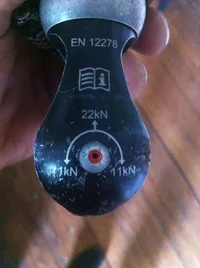
Yes, it has been tested to EN 12278. So it meets use as a pulley. The test is in the configuration of how a pulley is normally loaded. i.e: anchored from above with 2 legs of rope over the wheel.
Yes it has been tested to EN 795(B). So it meets use as a Transportable Temporary Anchor. This is a pretty broad scoped test. Other things that meet that are everything from a sling to a rigging plate, to an anchor ring, to a tripod rescue frame! But it is mentioned within this standard that it is NOT appropriate for sports or recreation (competition tree climbing???)
So while it might be ok as a pulley or a connection point, none of it has anything to do with adding a friction hitch as a link in a running doubled rope climbing system, let alone in competitions.
The Hitchclimbers Guide To The Canopy, while offering great ideas is explicitly NOT part of the User Instructions. And the independent testing done in it again is not relevant to the typical arborist configurations in use.
The strength of the sling (prusik) when pulled end to end or in a basket configuration has nothing to do with it's function in the myriad of different configurations of friction hitches climbers use.
How well a 6 coil prusik holds when pulled on a static single line doesn't either.
I'm not knocking the HC. I personally think it is a great system that is well thought out, designed and executed, and is completely appropriate to use.
The trouble is, there seems to be an ever increasing focus by some on some brands/products to meet all sorts of "standards" that others are not being questioned on.
There is no applicable EN standard that the complete Hitchclimber System can meet.
There is no applicable EN standard that the ZigZag System can meet. (The EN on the ZigZag is only referring to the type of rope that should be used)
There is no applicable EN standard that the RopeWrench System can meet.
I would guess that the wrench could easy pass as an EN 12278 pulley and that either it or the tether could easy pass as either an EN 795(B) temporary anchor. But neither would be relevant to it's applied use.
After all that, i guess i'm just trying to say standards are great, and if you understand them and have read the complete documents even better, but the are pretty meaningless when taken out of context.